Introduction
A vaccine sitting at 9°C for six hours doesn't look any different. It just stops working the way it should.
That's the core problem with vaccine cold chain management: potency loss is invisible until a patient doesn't develop immunity. Even brief excursions outside the 2-8°C range can degrade a dose, and once that happens, there's no way to reverse it.
Many clinics still track temperatures on Fahrenheit-calibrated equipment or handwritten paper logs that staff fill out inconsistently. That combination creates real compliance risk during Vaccines for Children (VFC) audits and site visits.
This guide breaks down the correct Celsius ranges for refrigerated, frozen, and ultra-cold vaccines. It also covers how to build a log that survives an audit, and when it's time to move from manual checks to automated monitoring.
Key Takeaways
- Log temperatures in Celsius to match CDC and WHO storage thresholds and avoid conversion rounding errors
- Refrigerated vaccines require 2-8°C, while frozen and ultra-cold products follow stricter, product-specific Celsius ranges
- Record min/max readings each workday morning instead of relying on a quick twice-daily glance
- Digital loggers catch far more temperature excursions than manual spot-checks, per peer-reviewed simulation studies
Why Accurate Vaccine Temperature Logging Matters
Vaccine potency isn't forgiving. According to the CDC's 2026 Vaccine Storage and Handling Toolkit, a single freezing exposure at 0°C or colder can completely destroy the potency of a refrigerated vaccine. There's no recovering the dose once that happens.
The same CDC toolkit sets three separate Celsius bands that providers must track:
- Refrigerator: 2°C to 8°C
- Freezer: -50°C to -15°C
- Ultra-cold freezer: -90°C to -60°C
Auditors check every log against these exact bands during compliance visits.
The Compliance Reality on the Ground
Temperature logging failures happen more often than most providers assume. In an independent HHS OIG review, 34 of 45 sampled VFC providers, or 76%, exposed vaccines to inappropriate temperatures for at least five cumulative hours during a two-week monitoring window.
VFC compliance visits happen every 24 months, and reviewers examine at least the prior three months of temperature logs or logger data. Gaps in that record create serious downstream consequences:
- Mandatory revaccination of affected patients
- Loss of provider reimbursement for wasted doses
- Reputational fallout with patients and state health departments
In 2021, Ohio health officials suspended a pharmacy provider after inadequate refrigerator and freezer monitoring rendered 890 remaining Moderna doses nonviable, halting future vaccine allocations to that site entirely. That's the kind of outcome automated, FDA 21 CFR Part 11 compliant logging, like the PDF and CSV records Realog View's data loggers generate without extra software, is designed to prevent, keeping every Celsius reading audit-ready from the start.
Why Celsius specifically? CDC and WHO both anchor their guidance in Celsius, with Fahrenheit equivalents rounded for convenience (2°C rounds to 36°F, 8°C to 46°F). Logging directly in Celsius removes an unnecessary conversion step, one that introduces rounding drift when staff try to reconcile older Fahrenheit-only thermometers against Celsius-based compliance forms.
Ideal Vaccine Storage Temperature Range in Celsius
Standard Refrigerator and Freezer Ranges
Every provider needs to know these numbers cold, literally:
| Storage Type | Celsius Range | Notes |
|---|---|---|
| Standard refrigerator | 2°C to 8°C | Most inactivated and some live vaccines |
| Standard freezer | -50°C to -15°C | Per current CDC guidance |
| Ultra-cold freezer | -90°C to -60°C | Certain mRNA COVID-19 vaccines |
Don't assume every vaccine in a category follows the same rule. Manufacturer inserts override generic ranges.
For example, current COMIRNATY single-dose vials support ultra-cold storage at -90°C to -60°C. Once thawed and moved to 2-8°C, they're good for up to 10 weeks and must never go back in the freezer.
Storing those same vials at -25°C to -15°C, a range some older guidance still floats around, is explicitly not permitted per the current package insert.
The takeaway: check the insert for every product line you stock. Don't default to a "general" frozen range. Dual-parameter, FDA 21 CFR Part 11-compliant loggers (like Realog View's) flag excursions against each product's specific insert range, not a generic bucket.
Quick Celsius-Fahrenheit Reference
Older units still display Fahrenheit. Cross-check readings with this table:
| Celsius | Exact Fahrenheit |
|---|---|
| 2°C | 35.6°F |
| 8°C | 46.4°F |
| -15°C | 5°F |
| -50°C | -58°F |
| -60°C | -76°F |
| -90°C | -130°F |
Keep this posted near any unit still equipped with a Fahrenheit-only display.
How to Create a Reliable Vaccine Temperature Log
A compliant log needs specific fields, not just a blank grid. At minimum, include:
- Date and time of each reading
- Current, minimum, and maximum temperature in Celsius
- Staff initials for accountability
- Corrective action taken, left blank if no reading occurred rather than backfilled after the fact
On frequency, current CDC guidance is more precise than most clinics realize. If your thermometer captures min/max data, you only need to check and record it once, at the start of each workday. If your device only shows current temperature with no min/max memory, then you need two readings per workday, morning and end of day.
Other non-negotiables:
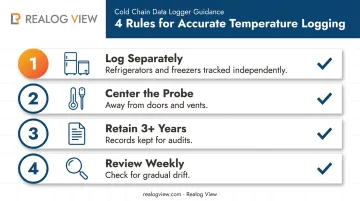
- Log refrigerators and freezers separately. They have different acceptable ranges and different failure modes.
- Place the probe in the center of the unit, surrounded by vaccines, not near the door, vents, walls, or floor. Off-center placement is one of the most common reasons logged readings don't match actual vaccine temperature.
- Retain records for at least three years, or longer if your state requires it. Vaccines for Children (VFC) program reviewers will ask for the prior three months at minimum during a site visit.
- Review digital logger data at least weekly for gradual drift, not just hard alarm triggers.
Many practices now layer a backup automated logger behind their manual process, specifically to close the overnight and weekend gap that handwritten logs can't cover. Look for models that capture min/max data automatically and generate FDA 21 CFR Part 11 compliant PDF reports without extra software.
Manual Logbooks vs Digital Data Loggers: Which Is Better?
Manual logs have one structural weakness: they only capture a moment in time. Nobody's checking the fridge at 2 a.m. on a Saturday, which means excursions during off-hours can go completely undetected until the next scheduled reading.
The data backs this up. A peer-reviewed Monte Carlo simulation study found that twice-daily current-temperature checks, without min/max capability, caught only 4.8% to 6.4% of simulated excursions. Min/max-based checks performed better but still varied wildly, detecting anywhere from 27.8% to 96.7% depending on method and excursion type.
Continuous digital data loggers close that gap. They record temperature at set intervals around the clock and flag deviations the moment they happen, not hours later during a scheduled check.
Where Realog View Fits
This is the exact problem Realog View's TempTrail™ line was built to solve. The loggers are FDA 21 CFR Part 11 compliant and generate PDF and CSV reports automatically over USB, no external software required, which matters when an auditor asks for three months of records on short notice.
For standard refrigerated storage, the TempTrail™ Classic and TempTrail™ XL come pre-configured with alarm thresholds set at <2°C and >8°C, matching WHO and CDC guidance out of the box.
For ultra-cold applications, the TempTrail™ Glacial covers -85°C to +70°C with ±0.2°C accuracy, fully user-configurable alarms, and a tamper-proof IP67 sealed housing built to survive dry ice shipments and cryogenic handling.
Both product lines share a few practical advantages over paper logs:
- User-replaceable batteries (18-month shelf life on multi-use models) mean no downtime waiting on a device swap
- Time-stamped, continuous records give auditors exactly the traceability they're looking for
- Reusable multi-use loggers cut the ongoing cost of restocking paper sheets and thermometers across multiple storage units
For clinics managing several refrigerators and freezers, that reusability adds up fast compared to constantly replenishing manual logging supplies.
Common Mistakes to Avoid When Logging Vaccine Temperatures
A few recurring errors show up again and again during immunization program audits:
- Skipping weekend and holiday readings. Gaps here are one of the most frequent findings reviewers flag, and they're exactly the periods continuous monitoring is designed to cover.
- Recording Fahrenheit on a Celsius-based form. This creates confusion during multi-site reviews and increases the odds of a rounding mismatch that misrepresents actual compliance.
- Placing the probe too close to the door or vent. An OIG review found 14 of 45 providers lacked a centered freezer thermometer, and 23 skipped one in the refrigerator—positions that misrepresent true storage conditions.
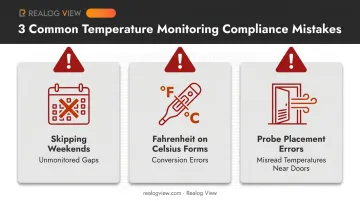
Correcting these three habits eliminates most of the compliance gaps flagged during immunization program audits.
Frequently Asked Questions
What temperature should vaccines be stored at (°C)?
Most vaccines need refrigeration between 2°C and 8°C. Frozen products typically require -50°C to -15°C, while certain ultra-cold vaccines need -90°C to -60°C per manufacturer guidance.
Why must vaccines be stored between 2 and 8°C?
This range preserves the biological stability of vaccine components. Temperatures above or below it can degrade potency and reduce how well the vaccine protects patients.
How do I log vaccine fridge temperatures in °C?
Use a calibrated thermometer or digital logger to record min/max or current readings on a Celsius-based log sheet. Document any corrective actions taken for out-of-range readings.
What happens if a vaccine temperature excursion occurs?
Isolate the affected vaccines immediately and label them as "do not use" pending review. Document the excursion details and contact the manufacturer or immunization program for usability guidance.
Is manual temperature logging still acceptable, or is digital logging required?
Manual logs remain acceptable in many jurisdictions, but digital loggers are increasingly recommended for continuous monitoring and stronger audit-ready compliance.
How often should vaccine temperatures be checked and logged?
CDC guidance requires min/max checks at the start of each workday, or twice daily current-only readings if the device lacks min/max capability. Continuous digital monitoring covers gaps manual checks miss entirely.