This scenario plays out more often than most facilities realize. Manual twice-daily checks simply can't catch what happens while the lights are off and no one's watching. In fact, research shows non-continuous monitoring misses most excursions entirely.
This guide breaks down how modern temperature monitoring systems work, what regulators expect, and how to choose a system that actually protects your inventory.
Key Takeaways
- Continuous digital monitoring catches excursions that twice-daily manual checks routinely miss
- FDA 21 CFR Part 11 compliance and tamper-proof records are non-negotiable in regulated settings
- The right setup pairs buffered sensors, configurable alarms, and audit-ready reporting
- Software-free PDF/CSV loggers simplify compliance without adding IT overhead
Why Temperature Monitoring Matters in Medical Refrigeration
Vaccines and most biologics need storage between 36°F and 46°F (2°C to 8°C), according to CDC's Vaccine Storage and Handling Toolkit. Frozen vaccines require far colder conditions, sometimes down to -58°F (-50°C).
Here's the problem: temperature damage doesn't announce itself. A vial sitting a few degrees too warm for six hours looks identical to one stored perfectly. The potency loss is cumulative and invisible.
A 2020 peer-reviewed simulation using data from 243 real digital loggers found:
- Twice-daily current-temperature checks (no min/max) caught only 4.8-6.4% of simulated excursions
- Adding daily min/max tracking improved detection to 27.8-96.6%, still wildly inconsistent
- No non-continuous method reliably caught every excursion
That data comes from Leidner et al.'s 2020 study. Facilities still relying on spot-checks leave most excursions undetected.

The financial stakes are real too. CDC notes that reliable monitoring helps facilities avoid the "financial hardship of replacing vaccines" lost to undetected excursions. That cost is locked in the moment potency drops, whether or not anyone notices right away.
How Medical Refrigerator Temperature Monitoring Systems Work
Every medical refrigerator monitoring system needs four components working together:
- Sensors or probes that measure actual product temperature, not just ambient air
- Data loggers that record readings at set intervals
- Transmitters or storage that preserve data for reporting
- Alarms that flag problems before they become losses
Types of Monitoring Devices
Facilities typically choose from three device categories:
- 30-day electronic recorders — suited for shorter transport cycles or short-term storage checks
- **Digital data loggers with buffered probes** — use a glycol or similar buffer to mimic vaccine temperature and avoid false alarms from brief door openings
- **PDF/CSV loggers with no external software** — plug in via USB to generate a compliance-ready report automatically
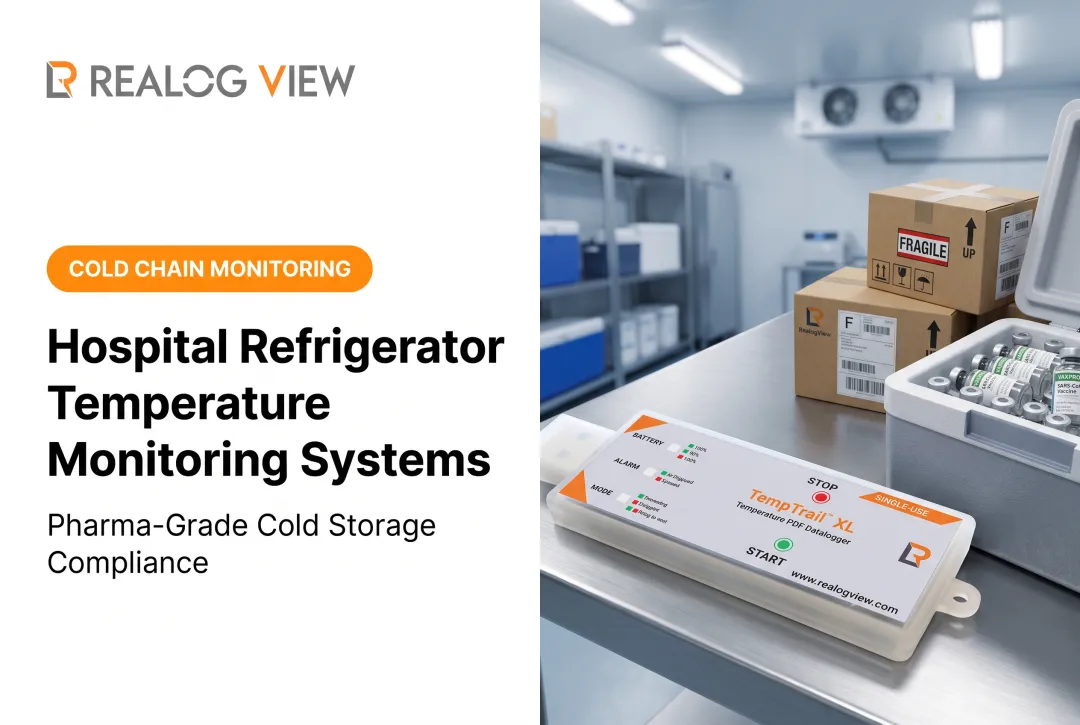
Realog View's data loggers fall into that third category. Their TempTrail line connects through USB 2.0 and outputs FDA 21 CFR Part 11 compliant PDF and CSV reports without dedicated software or drivers. That setup suits smaller clinics and pharmacies that lack IT staff to manage a monitoring platform.

Alarming and Data Logging
Effective systems escalate alerts through multiple channels: text, email, or phone calls, ideally with a backup power source so an outage doesn't also kill your alarm.
CDC recommends readings no less often than every 30 minutes for vaccine storage. Realog View's TempTrail Display models log every 10 minutes by default on single-use units, with configurable intervals on multi-use models. Both store up to 32,000 data points, giving facilities a long runway before data has to be pulled.
Regulatory Requirements and Compliance Essentials
Regulatory expectations vary by agency, but monitoring intervals, record retention, calibration, and audit-ready hardware show up again and again.
CDC requires continuous monitoring at 30-minute intervals or tighter, plus manual verification at the start and end of each workday. Keep records for 3 years minimum, longer if your state requires it.
Calibration is a core audit item. CDC recommends:
- A valid Certificate of Calibration Testing per device
- Testing every 1-2 years, or per manufacturer guidance
- Recommended uncertainty of ±0.5°C (±1°F) or less
Traceability to NIST means your calibration connects through an unbroken, documented chain back to a national reference standard, per NIST's traceability policy. That's what auditors actually check for.
Sealed, tamper-proof hardware supports audit readiness. IP67 and IP68-rated casings resist dust, moisture, and tampering in hygiene-sensitive clinical settings where devices are wiped down often.
Realog View loggers use fully sealed IP67/IP68 designs so routine sanitation does not compromise the device or the data trail.
Note: The Joint Commission does not mandate a specific alarm interval for medication refrigerators, but reviews monitoring logs for completeness during audits. Don't assume "no explicit rule" means "no scrutiny."

Choosing the Right Monitoring System for Your Facility
Match the device to your actual storage conditions and risk profile.
Start with these criteria:
- Temperature range: Standard refrigeration, autoclave/high-heat, or ultra-low/cryo?
- Connectivity: Does your facility need remote alerts, or is a USB-download PDF report sufficient?
- Alarm configurability: Fixed thresholds work for simple vaccine storage; research labs often need custom ranges
Single-use vs. multi-use loggers:
| Type | Best for | Battery |
|---|---|---|
| Single-use | One shipment or short cycle | CR2032, ~12-month shelf life |
| Multi-use | Ongoing facility monitoring | Replaceable ½ AA, ~18-month shelf life |
For ongoing facility monitoring, software-free options avoid adding another platform to manage. Automatic PDF reporting covers compliance checks without a separate login or dashboard.
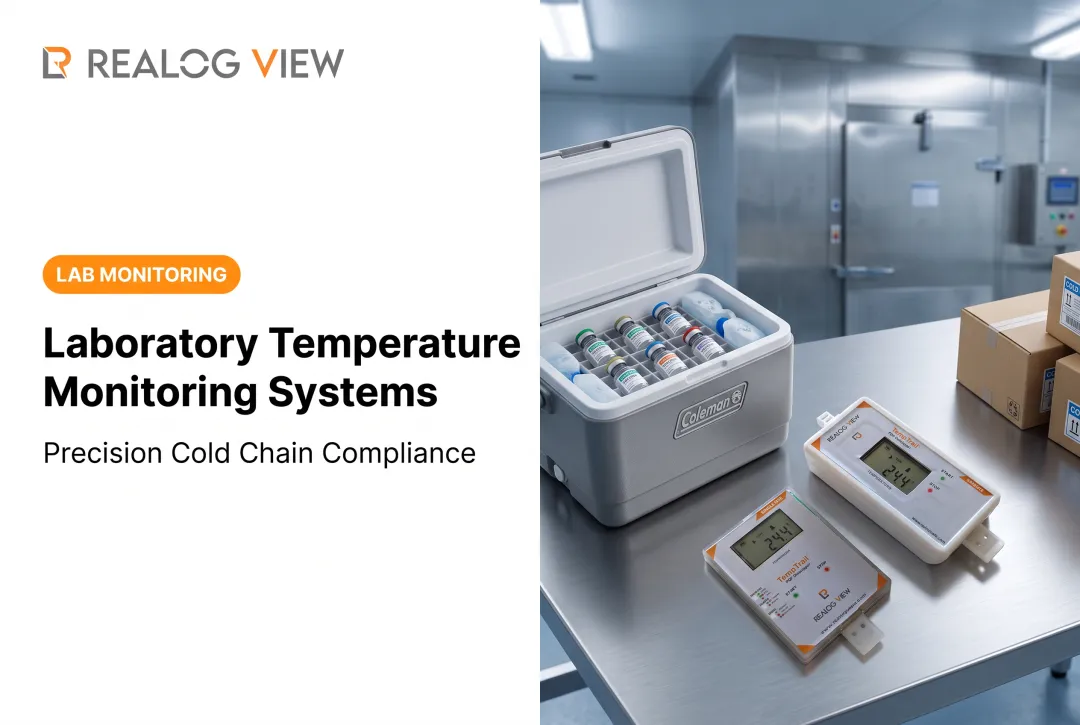
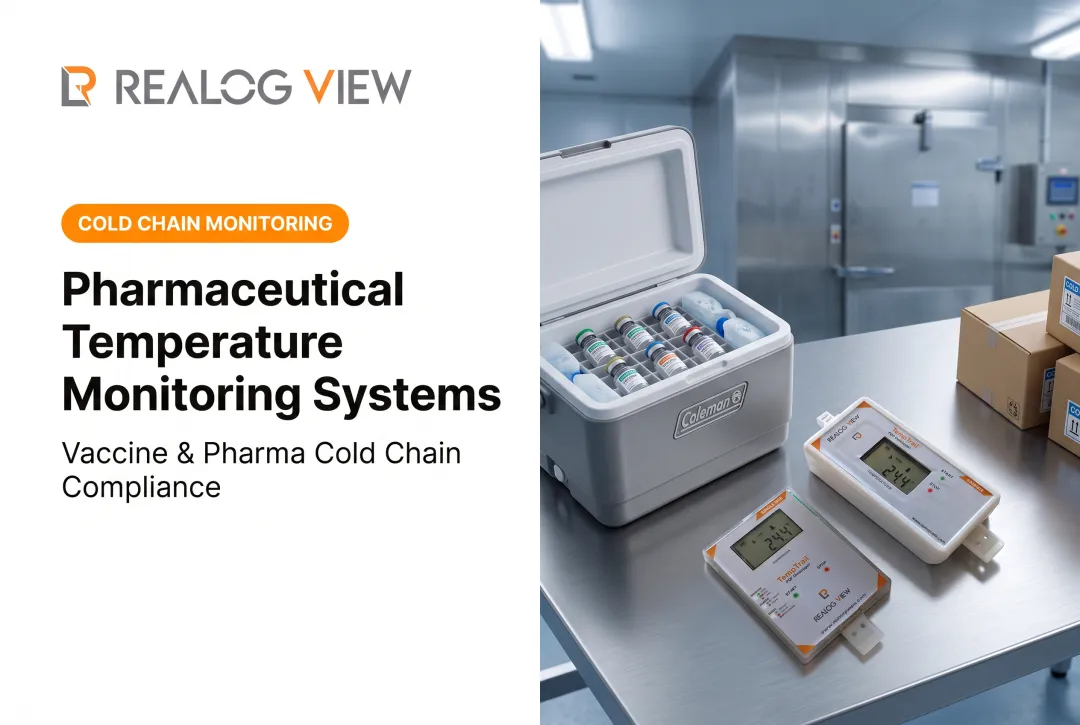
Realog View's TempTrail Display loggers combine large LCD screens, user-configurable alarms, and automatic PDF reporting. Staff can glance at a bell icon or red LED and know instantly whether there's a problem. No login required.
Environmental durability also matters. A pharmacy fridge has very different needs than a cryogenic biobank:
- Standard cold chain (-30°C to +70°C): general pharmaceutical and vaccine storage
- High-temperature/autoclave (+5°C to +140°C): sterilization and lab equipment validation
- Ultra-low/cryo (-85°C to +70°C): dry ice shipments, cryogenic storage, biologics

Common Mistakes to Avoid
Even well-intentioned facilities trip over the same issues.
- Using unbuffered thermometers. A standard air thermometer reacts instantly to door openings, triggering false alarms and masking real excursions. Buffered probes mimic actual product temperature.
- Sharing power or network with the refrigerator itself. If the fridge loses power and your monitor runs on the same circuit, you lose your alarm exactly when you need it most.
- Skipping calibration. An uncalibrated logger can invalidate your entire compliance record during an audit, even if the fridge never actually went out of range.
- Skipping a backup device. CDC recommends a second monitoring device for every storage unit, since primary devices fail or go down for calibration.
Frequently Asked Questions
How often should a medical fridge temperature be checked?
CDC recommends continuous digital monitoring at intervals no longer than 30 minutes, plus manual verification at the start and end of each workday. Relying only on manual checks misses the majority of brief excursions.
How can I monitor my fridge temperature remotely?
Wi-Fi, cellular, or cloud-connected systems can send real-time alerts to a phone or email when temperatures drift out of range. For facilities without remote connectivity, USB-based loggers with automatic PDF reports still provide a complete audit trail.
What is the best refrigerator temperature monitor?
FDA 21 CFR Part 11 compliant, tamper-proof loggers with automatic reporting are the safest choice for regulated pharmaceutical and vaccine storage. Match features to your facility size and audit requirements from there.
What temperature should a medical refrigerator be kept at?
CDC recommends 36°F to 46°F (2°C to 8°C), with 40°F as the target midpoint. Frozen vaccines require much colder storage, down to -58°F depending on the product.
How long do I need to keep temperature logs?
CDC recommends a 3-year minimum retention period, though some state programs require longer. Always check your state's specific rules on top of federal guidance.