Introduction
A broken cold chain doesn't announce itself. It shows up later, as a spoiled vaccine batch or a rejected seafood shipment.
IATA has estimated that as much as 25% of temperature-sensitive vaccine shipments degrade before reaching their destination, often tied to handling and temperature excursions during transit. That's product loss that monitoring could have caught before it happened.
Without reliable tracking, temperature-sensitive goods face spoilage, reduced drug efficacy, failed compliance audits, and financial loss. Manual spot-checks can't catch a two-hour excursion at 3 a.m. in a warehouse.
This guide covers how cold chain monitoring actually works, the device types available, compliance requirements you can't ignore, and how to pick a monitoring solution that fits your operation.
Key Takeaways
- Continuous digital monitoring catches excursions that periodic spot-checks routinely miss
- Pharma, food, biologics, and aerospace each rely on cold chain monitoring, but thresholds vary
- Data loggers remain the backbone of documentation for FDA and GDP compliance
- Reusable loggers cost more upfront but pay off for warehouses and repeat shipments
- Match calibration frequency to product risk: annual for most goods, biannual for vaccines and seafood
What Is Cold Chain Temperature Monitoring?
Cold chain temperature monitoring is the continuous tracking of temperature-sensitive products from the moment they leave production through storage, transport, and final delivery. It functions as an integrated system, not a single device or a one-time check.
That system relies on four components working together:
- Sensors that measure temperature (and sometimes humidity) at the product level
- Data loggers that record those readings at set intervals
- Alert systems that flag deviations before they become disasters
- Reporting platforms that turn raw data into audit-ready documentation
Why Continuous Monitoring Is Replacing Spot-Checks
Manual checks once or twice a day used to be standard. They're not anymore, and for good reason.
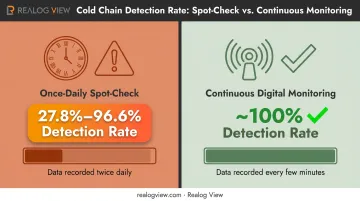
A 2022 evaluation found that once-daily min/max checks detected only 27.8% to 96.6% of modeled temperature excursions, depending on the shipment profile. Twice-daily checks barely improved on that. In other words, a huge range of real excursions simply go unnoticed until it's too late to act.
Continuous digital logging closes that gap by capturing data every few minutes instead of a couple of times per shift.
Why It Matters Across Industries
Cold chain monitoring isn't a niche pharma concern. It spans:
- Pharmaceuticals and vaccine transport
- Biological and laboratory sample shipping
- Cryogenic and ultra-low storage
- Food processing, seafood, poultry, and floral logistics
- Aerospace and defense medical supply chains
The stakes shift by industry, but the pattern is the same. Vaccines lose potency outside their range. Food spoils in the USDA's "danger zone" between 40°F and 140°F, where bacteria can multiply rapidly within as little as one to two hours of exposure.
Biologics degrade in ways that can't be reversed. One missed excursion, and the product is compromised.
Types of Cold Chain Temperature Monitoring Devices
Different points in the cold chain call for different tools. Here's what's actually deployed in the field.
Data loggers are the most common device type. They record temperature at set intervals, creating a time-stamped history that travels with the shipment or stays fixed in a storage location.
Wireless and Bluetooth-enabled sensors add live visibility. Instead of waiting to download data after the fact, staff get instant alerts the moment a threshold is breached.
Probe thermometers handle spot-checks at receiving docks, giving a quick manual verification when goods arrive.
Single-Use vs. Reusable Loggers
This distinction matters more than it might seem:
- Single-use/disposable loggers are built for one shipment. They come pre-configured, travel with the box, and get discarded after the trip.
- Reusable/multi-use loggers are redeployed across multiple shipments or fixed monitoring points, with user-replaceable batteries and configurable settings.
Realog View's TempTrail lineup illustrates this well. The single-use TempTrail XL runs up to 220 days on a 10-minute interval, storing 32,000 data points, and ships pre-set for plug-and-play deployment.
On the reusable side, models like the TempTrail Glacial and TempTrail Display (Model M) let operators configure intervals, alarms, and start delays for repeat use in warehouses or return-trip shipments.
One standout feature: automatic PDF and CSV report generation on USB connection, with no external software required. That alone removes a common bottleneck in compliance documentation.
Beyond sensors, the broader cold chain equipment list includes:
- Refrigerated trucks and reefer containers
- Cold storage warehouses
- Insulated packaging
- Dry ice and phase-change materials for backup cooling
Matching Devices to Applications
| Application | Recommended Device Type |
|---|---|
| Cryogenic/ultra-low storage (-85°C) | Ultra-low range loggers (such as TempTrail Glacial) |
| Long-haul transport | Rugged, IP67-rated single-use tags |
| Autoclave/sterilization validation | IP68 submersible loggers (such as TempTrail HiTemp) |
| Warehouse monitoring | Reusable loggers with configurable intervals |
| Humidity-sensitive perishables | Dual-parameter temperature and humidity loggers |
Why Cold Chain Temperature Monitoring Matters
Three forces make this non-negotiable: regulation, cost, and trust.
Regulatory compliance is the most immediate pressure: standards like FDA 21 CFR Part 11, EU Good Distribution Practice (GDP), and HACCP all require documented, defensible proof that temperature was controlled. Fail an audit, and you're looking at product seizure or worse.
Waste reduction follows close behind, as CDC identifies vaccine waste, replacement costs, and potential revaccination as direct consequences of improper storage. Every excursion that goes undetected is money and product walking out the door.
Brand protection rounds it out. Documented, tamper-evident proof of product integrity does more than satisfy auditors: it gives pharmacies, distributors, and retailers confidence to accept your shipment without a second thought.
How to Monitor Cold Chain Temperature Effectively
Getting this right isn't complicated, but it does require discipline. Follow these five steps:
Identify critical control points. Focus on loading docks, vehicle transfer points, and storage areas near doors or heat sources, where risk of excursion is highest.
Set thresholds with buffer zones. Build in an early-warning alert that triggers before the critical limit is reached, giving staff time to respond before an excursion occurs.
Shift from spot checks to continuous monitoring. Interval-based data capture with instant deviation alerts catches what daily manual checks miss.
Maintain a calibration schedule. Most products need annual calibration. High-risk items like vaccines and fresh seafood require checks every six months.
Establish backup protocols. Prevent excursions from going unnoticed overnight with:
- Redundant cooling for critical storage areas
- Backup power to keep monitoring running during outages
- A documented staff response plan for after-hours alerts
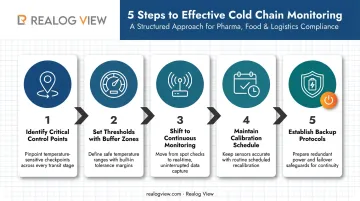
Skip any one of these steps, and you risk missing the early signs of a temperature excursion.
Cold Chain Compliance and Regulatory Standards
Three frameworks govern most cold chain documentation requirements, and each covers different ground.
| Standard | What It Requires |
|---|---|
| FDA 21 CFR Part 11 | Electronic records must be secure, traceable, and tamper-evident when used for regulated documentation |
| EU GDP | Temperature mapping before use, calibrated monitoring devices, tested alarms, and investigation of any transport excursion |
| HACCP | Hazard analysis, critical control points, monitoring, corrective action, and verification records |
Part 11 doesn't set the actual temperature range. It governs how electronic records are created and protected. That's an important distinction: GDP and HACCP tell you what to monitor, while Part 11 tells you how the resulting data needs to hold up under scrutiny.
Tamper-proof, traceable digital records are what get you through an inspection without a scramble. These records deliver:
- Automatic data capture that removes human error risk from manual logging
- PDF-based storage that protects records from disappearing or being altered
- Time-stamped audit trails that satisfy auditor requests on demand
Realog View's temperature and humidity data loggers are built around this exact need. Every model is FDA 21 CFR Part 11 compliant, generating secure, traceable digital records automatically, without relying on someone remembering to hit "export."
Choosing the Right Cold Chain Temperature Monitoring Device
Not every logger fits every application. Before buying, evaluate:
- Temperature range wide enough for your actual use case, not just your average shipment
- Tamper-proof, IP-rated housing that survives real-world handling
- Ease of use without requiring external software or IT setup
- User-configurable alarms and intervals for flexibility across shipments
Realog View's PDF-based loggers were built against this checklist. The lineup spans -85°C to +140°C, with reusable options like the TempTrail Glacial for cryogenic storage and the TempTrail HiTemp for autoclave validation.
All models carry CE, RoHS, and DO-160G certification, built to withstand the environmental stress that hygiene-sensitive and extreme-condition applications demand.
Total Cost of Ownership: Reusable vs. Single-Use
| Factor | Multi-Use Loggers | Single-Use Loggers |
|---|---|---|
| Upfront cost | Higher | Lower |
| Long-term cost | Lower (amortized over multiple trips) | Higher (cumulative per shipment) |
| Battery | User-replaceable, 18-month shelf life | Fixed, 12-month shelf life |
| Best fit | Warehouses, repeat routes, cryo storage | One-time shipments |
For a single one-way shipment, a disposable logger makes sense. For warehouse monitoring or recurring routes, a reusable logger with a field-replaceable battery pays for itself over time.

Frequently Asked Questions
What are the temperature monitoring devices used in cold chain?
The main types are data loggers, wireless/Bluetooth sensors, real-time monitors, and probe thermometers. Data loggers dominate for documentation, while wireless sensors add live visibility during transit.
How do you check cold chain temperature?
Place continuous sensors and loggers at critical control points like loading docks and storage entries, with automated alerts for deviations. Supplement this with periodic manual verification using a probe thermometer at receiving.
What are examples of cold chain equipment?
Common equipment includes refrigerated trucks, cold storage warehouses, insulated packaging, temperature data loggers, and dry ice or phase-change materials for backup cooling.
What is the ideal temperature range for cold chain products?
Ranges vary by product: 2°C to 8°C for most vaccines, below -18°C for frozen foods, and ultra-low ranges for cryogenic storage. Always verify against the manufacturer's specific guidance.
How often should cold chain monitoring devices be calibrated?
Standard goods typically need annual calibration. High-risk products like vaccines and fresh seafood require calibration checks every six months.
What happens when the cold chain is broken?
A broken cold chain risks spoilage, reduced drug efficacy, or contamination. Affected products should be labeled, quarantined, and assessed for disposition rather than automatically discarded or used.