Introduction
A single refrigerator malfunction overnight can wipe out an entire batch of vaccines before anyone notices. No visible change, no odor, no warning. Just a silent loss of potency that turns a shelf of life-saving medication into medical waste.
This isn't a rare event. IQVIA estimates the European vaccine cold chain's annual economic impact at EUR 21.5 billion, with 17.3% of that figure tied directly to wastage.
Much of that wasted product traces back to outdated monitoring habits. Many pharmacies and logistics teams still rely on manual temperature logs. A staff member checks a thermometer, writes down a number, and moves on. That approach leaves gaps in coverage, invites human error, and rarely satisfies FDA or state board expectations for auditable data.
This guide breaks down what pharmaceutical temperature monitoring systems actually do. It covers how FDA and 21 CFR Part 11 apply, which sensor types matter, and how to pick a system that fits your storage or transport environment.
Key Takeaways
- Continuous digital monitoring replaces error-prone manual temperature logs
- 21 CFR Part 11 requires tamper-evident, auditable electronic records for compliance
- Thermocouples, thermistors, RTDs, and digital sensors drive modern monitoring hardware
- The best systems balance certifications, usability, and durability for your storage needs
What Is a Pharmaceutical Temperature Monitoring System?
A pharmaceutical temperature monitoring system is technology that continuously measures, records, and alerts on temperature (and often humidity) conditions throughout storage and transport. The goal is simple: catch a deviation before it destroys product effectiveness or safety.
These systems range from a compact data logger tucked inside a shipping box to a stationary sensor mounted in a warehouse freezer. What they share is the ability to produce a documented, time-stamped record that proves a drug stayed within its labeled range.
Why It Matters: The Risks of Temperature Excursions
Temperature deviations aren't a gray area. They cause measurable chemical degradation.
The CDC states that a single exposure at 0°C or colder can completely destroy the potency of refrigerated vaccines, and appearance alone won't tell you it happened. There's no visible sign. The vial looks fine. The medicine isn't.
Beyond potency loss, improper storage can promote:
- Bacterial growth in liquid formulations
- Harmful degradation byproducts in heat-sensitive compounds
- Structural breakdown in biologics and cell-based therapies
The financial fallout compounds quickly. Discarded doses, replacement costs, and (in vaccine programs) the added expense of re-testing or re-vaccinating patients all add up. An undocumented excursion carries risks well beyond the invoice, potentially triggering:
- FDA inspection observations
- Product recalls
- Application delays for pending drug submissions
- Reputational damage with distributors and regulators
Common Applications Across the Pharma Supply Chain
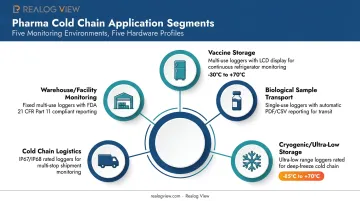
Temperature monitoring isn't a one-size-fits-all deployment. Different segments of the pharma supply chain need different hardware configurations:
- Vaccine storage: ultra-wide range loggers built for refrigerated and frozen vaccine stock
- Biological sample transport: rugged, tamper-proof loggers for plasma, serum, and cell line shipments
- Cryogenic and ultra-low storage: devices rated down to -85°C for mRNA vaccines and gene therapy materials
- Cold chain logistics: long-duration loggers for multi-day, multi-leg shipments
- Warehouse and facility monitoring: stationary sensors for distribution centers and storage rooms
Realog View's TempTrail™ Glacial and Glacial Display, for example, are built specifically for the -85°C to +70°C range that ultra-low vaccine and biologics storage demands. The TempTrail™ XL, by contrast, covers long-haul shipments with a 220-day recording window.
FDA Requirements & 21 CFR Part 11 Compliance
FDA's core expectations for temperature monitoring aren't buried in obscure guidance. They're written plainly into 21 CFR Part 211. Storage areas must maintain conditions so a drug's identity, strength, quality, and purity aren't compromised, and any temperature recording equipment must be routinely calibrated under a written program with documented results.
That means every facility needs:
- Validated monitoring equipment: calibrated instruments with documented accuracy
- Accurate, retrievable documentation: not scraps of paper that disappear after a shift change
- Adherence to GMP and GDP guidelines: covering both manufacturing storage and distribution
What Is 21 CFR Part 11 and Why Does It Matter?
21 CFR Part 11 governs electronic records and signatures used to meet FDA requirements. It demands that data be secure, tamper-evident, and traceable, recorded in a way regulators can trust without question.
Section 11.10 lays out the specifics: system validation, restricted access, protected record retrieval, and secure, computer-generated audit trails with time stamps.
This is exactly where compliant hardware simplifies life for pharmacy and logistics teams. FDA 21 CFR Part 11-compliant data loggers, like Realog View's models, generate automatic PDF and CSV reports the moment the device connects via USB, with no external software, drivers, or third-party platform required.
The report format captures the full temperature history without manual data entry, cutting out one of the most common sources of tampering risk.
FDA's 2019 warning letter to Glenmark Pharmaceuticals illustrates the stakes. The agency cited the company for failing to thoroughly investigate multiple drug-product transit temperature excursions and classified the affected products as adulterated. It warned that unresolved issues could delay pending applications or block products from entering the U.S. market entirely.
Other Key Standards to Know
USP <1079> adds another compliance layer, requiring storage facilities to be qualified through thermal mapping that reflects actual workflow and load conditions. Mapping studies typically run one day to one week, and monitors must be placed according to the mapped risk locations, not just wherever's convenient.
State pharmacy boards often go further than federal baselines:
- Oregon requires continuous temperature measurement with records retained for at least three years
- Massachusetts mandates temperature logs identifying out-of-range conditions, retained for at least one year
Check your specific state board rules before assuming federal guidance covers you completely.
Types of Temperature Sensors & Monitoring Devices Used in Pharma
Monitoring accuracy starts with the sensor inside the device. Get the sensor technology wrong for your application, and even the best reporting software won't save you.
Common Sensor Technologies
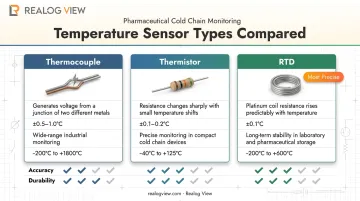
Three sensor types dominate pharmaceutical monitoring:
- Thermocouples: Two dissimilar metals form a junction that generates voltage as temperature shifts. Rugged and effective across wide ranges, though they need cold-junction compensation for accuracy.
- Thermistors: Semiconductor resistors whose resistance changes sharply with temperature. Highly sensitive over a narrower range, ideal for precision at moderate temperatures.
- RTDs (resistance temperature detectors): Platinum-based sensors offering high accuracy and repeatability. Often chosen for critical storage where drift isn't acceptable.
Older systems relied on external probes wired to a separate logger unit. That design introduces failure points: disconnected cables, contamination risk, and calibration mismatches between the probe and the logger.
Modern devices are shifting toward integrated internal sensors built directly into the device casing. Realog View's TempTrail™ Glacial Display, for instance, uses an attached internal probe with no external sensing components at all, eliminating the disconnection and contamination risks that plague probe-based designs in the field.
Monitoring System Types: Passive vs. Real-Time vs. Stationary
Not every monitoring device works the same way, and picking the wrong architecture for your use case creates blind spots. These devices fall into three main architectures:
- Passive data loggers record continuously, then get reviewed via USB download once the shipment or storage cycle ends. This self-contained model remains the top choice for compliance documentation: no network dependency, no cloud outage risk, and no signal to lose mid-shipment.
- Real-time or wireless IoT monitors transmit data live during transit, useful for teams that need immediate alerts if a shipment drifts out of range en route.
- Stationary systems stay fixed in one location (a warehouse, refrigerator, or freezer) and continuously log conditions over months or years rather than a single trip.
Realog View's TempTrail™ product line is built around the passive, store-and-forward model. Models like the multi-use Display and Glacial Display work well for stationary lab and warehouse deployment, while single-use models like the XL and Classic are purpose-built for in-transit shipping documentation.
How to Choose the Right Pharmaceutical Temperature Monitoring System
Picking hardware isn't just about temperature range. It comes down to certifications, usability, and how the device holds up in real conditions.
Certifications Worth Checking
| Certification | What It Confirms |
|---|---|
| FDA 21 CFR Part 11 | Secure, tamper-evident electronic records for GMP audits |
| CE | Compliance with EU safety and electromagnetic standards |
| RoHS | No restricted hazardous substances in electronics |
| DO-160G | Proven durability under aviation-grade environmental stress testing |
| FCC | U.S. electromagnetic compatibility for use near sensitive lab equipment |
Realog View's data loggers carry all five, which matters for teams shipping across borders or storing products near other regulated electronics.
Software-Free Reporting Reduces Training Burden
A device that requires a dedicated software license or IT setup adds friction to every deployment. Look for automatic PDF and CSV report generation triggered simply by plugging the device into a Windows PC: no drivers, no installation, no compatibility headaches. This keeps the compliance workflow accessible to anyone on staff, not just IT-trained personnel.
Durability for the Real World
Field conditions are unforgiving. Prioritize:
- IP67 or IP68 sealed casing: protects against dust and submersion during rough handling
- Tamper-proof physical design: pre-configured single-use models can't have alarm thresholds altered mid-shipment
- Wide operating temperature range: matched to your actual storage conditions, whether that's -85°C cryogenic freezers or +140°C autoclave cycles
- User-replaceable batteries: multi-use models with swappable ½ AA batteries (typically an 18-month shelf life) extend field life without replacing the whole unit

Match the device to the job. A short-haul refrigerated shipment doesn't need a -85°C rated logger, and a cryogenic freezer definitely shouldn't rely on a standard-range device.
Frequently Asked Questions
What are the FDA requirements for pharmaceutical temperature monitoring?
FDA requires validated monitoring equipment, accurate and retrievable documentation, and adherence to GMP and GDP guidelines for drug storage. Calibration must be routine and documented under a written program.
How does 21 CFR Part 11 apply to pharmaceutical temperature monitoring?
Part 11 mandates that electronic temperature records be secure, tamper-evident, and traceable through audit trails. This applies to any electronic record used to meet an FDA requirement, including data logger reports.
What is a temperature monitoring device for a pharmacy?
It's a sensor-based tool, such as a data logger, digital thermometer, or wireless sensor, that tracks and records storage conditions for controlled substances, vaccines, and other temperature-sensitive medications.
What are the main types of temperature sensors used in pharmaceutical temperature monitoring?
Thermocouples, thermistors, RTDs, and integrated digital sensors are the primary technologies. Each offers different accuracy and range tradeoffs depending on the storage environment.
How often should temperature data be reviewed or recorded?
Continuous or interval-based recording is standard, often as frequent as every 15 to 30 minutes depending on the product and regulatory requirement. Regular review, not just recording, is what catches issues early.
What should be done if a temperature excursion occurs?
Document the deviation immediately, including duration and severity, then assess whether the product remains stable using manufacturer stability data. Follow your facility's defined corrective action protocol and report as required.