Introduction
One unplugged freezer can wipe out an entire vaccine inventory overnight. That's what happened at a Boston-area VA facility in January 2021, when a contractor accidentally disconnected a freezer plug. 1,900 doses of Moderna's COVID-19 vaccine spoiled before staff caught the failure.
According to NBC News, the facility's freezer alarm system failed to alert staff in time.
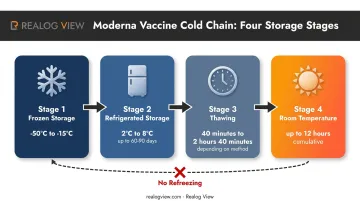
Moderna's mRNA vaccine isn't like a carton of milk. It moves through frozen, refrigerated, thaw, and room-temperature stages, each with its own narrow window and its own clock. Miss a step, and doses become unusable.
This guide breaks down the exact Moderna storage temperatures and explains why a temperature log is a legal and clinical requirement, not just paperwork. Then it shows you how to build or choose a log that keeps your facility compliant and your doses viable.
Key Takeaways
- Moderna requires frozen storage at -50°C to -15°C or refrigerated storage at 2°C to 8°C
- Refrigerated vials stay stable for 60-90 days, depending on the formula
- CDC mandates daily temperature checks with records kept for a minimum of 3 years
- A structured temperature log is your primary defense against wastage, failed audits, and lost potency
- Automated data loggers close the "blind spots" that manual paper logs leave overnight and on weekends
Moderna Vaccine Storage Temperature Requirements at Every Stage
Moderna currently markets two COVID-19 vaccine formulas, Spikevax and mNEXSPIKE, and they don't share identical thresholds. Using one formula's storage chart for the other is a fast way to accidentally spoil a batch.
| Stage | Spikevax | mNEXSPIKE |
|---|---|---|
| Frozen storage | -50°C to -15°C (-58°F to 5°F) | -40°C to -15°C (-40°F to 5°F) |
| Refrigerated (post-thaw) | 2°C to 8°C, up to 60 days | 2°C to 8°C, up to 90 days |
| Refreezing | Never | Never |
Frozen and Refrigerated Storage
That frozen range is narrower than what standard pharmaceutical freezers are calibrated for out of the box, so most facilities need dedicated temperature adjustment before stocking Moderna doses.
Once thawed and moved to the refrigerator, Moderna's official storage guidance confirms doses remain viable at 2°C to 8°C for up to 60 days (Spikevax) or 90 days (mNEXSPIKE), or until the printed expiration date, whichever arrives first.
Here's the part that trips people up: once thawed, it cannot go back in the freezer. Accidental refreezing means immediate disposal. No exceptions.
Thawing and Room Temperature Limits
Thaw time depends on where you thaw and how much you're thawing:
| Thaw Method | Single Syringe / 2-Dose Carton | 10-Dose Carton |
|---|---|---|
| Refrigerator | 1 hour 40 minutes | 2 hours 40 minutes |
| Room temperature | 40 minutes | 1 hour 20 minutes |
After thawing, Spikevax can sit at 8°C to 25°C (46°F to 77°F) for up to 12 hours cumulative. That window isn't resettable: every minute at room temperature counts toward the total, even if the vial goes back in the fridge in between.
mNEXSPIKE's post-thaw window differs by source document, so always defer to the insert packaged with your specific lot.
Punctured vials or prefilled syringes carry their own, even shorter usability clock starting the moment the seal breaks. Track that separately from your storage log.
A multi-use data logger that timestamps each reading automatically, like the models Realog View builds for pharmaceutical cold chain monitoring, makes it easier to keep these overlapping clocks straight without relying on handwritten notes.
Why a Temperature Log Is Non-Negotiable for Moderna Vaccine Compliance
CDC guidance isn't a suggestion here. Providers must check and record unit temperatures on a set schedule:
- Min/max display units — record once, at the start of every workday
- Standard units without min/max — record twice daily, at open and close
CDC's Vaccine Storage and Handling Toolkit is explicit that these logs must be retained for a minimum of 3 years to help identify recurring equipment problems, and some states require longer.
Beyond compliance, a solid log protects your facility in three concrete ways:
- Audit protection — a documented history is your evidence during FDA or state health inspections
- Manufacturer claims — Moderna's excursion team needs temperature data before approving replacement doses for compromised stock
- Trend detection — recurring near-misses show up in logs before they become full-blown spoilage events
Automatic PDF and CSV report generation, standard in FDA 21 CFR Part 11-compliant loggers, builds these three protections into the device itself, since every reading gets time-stamped and stored the moment it's captured.
A Vermont hospital learned the cost of gaps here the hard way. In January 2021, 860 Moderna doses got flagged after monitors disagreed on whether storage was 0.1°C outside the acceptable range.
The clinic had to cancel a scheduled session while the discrepancy got sorted out. No doses were lost, but the disruption was real, and it happened because two monitoring systems told two different stories.
Beyond-use-date labels and transport logs complement your storage log rather than replace it. Together, they form the paper trail that keeps expired or excursion-affected doses out of arms.
How to Build an Effective Moderna Vaccine Temperature Log
Every compliant log, whether paper or digital, needs the same core fields:
- Date and time of check
- Current temperature reading
- Minimum and maximum temperature since the last check
- Staff initials
- Corrective action taken (if any)
Manual vs. Continuous Monitoring
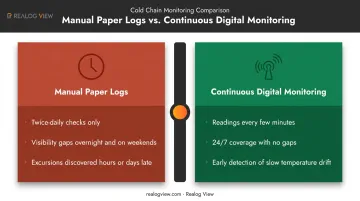
Manual paper logs work off twice-daily checks. That leaves gaps: overnight hours, weekends, holidays. If a freezer drifts out of range at 2 a.m. on a Saturday, nobody knows until Monday morning, and by then the damage is done.
Continuous digital monitoring closes that gap. Instead of two data points a day, you get a reading every few minutes, around the clock. That's the difference between spotting a slow drift early and discovering a full excursion after the fact.
Alarms and Automated Reporting
Set your high/low alarm thresholds to match Moderna's exact ranges, not generic vaccine settings:
- Frozen storage: alarm at -50°C (low) and -15°C (high)
- Refrigerated storage: alarm at 2°C (low) and 8°C (high)
These exact thresholds catch a real excursion immediately, instead of waiting for a generic alarm to trip well outside Moderna's actual storage limits.
Automated PDF/CSV report generation removes another failure point: manual transcription errors. Realog View's data loggers generate these tamper-evident reports on demand without external software, so there's no risk of a staff member mistyping a reading or forgetting to log one entirely.
Manual Logs vs. Automated Data Loggers for Vaccine Storage
The core weakness of a manual log is simple: it only captures a snapshot. Between checks, you have zero visibility. If your facility runs overnight shifts thin on staff or closes for the weekend, that's exactly when excursions tend to happen unnoticed.
Automated data loggers with built-in sensors solve this by recording and timestamping continuously, without external probes or extra software.
Realog View's TempTrail line answers this need, built around FDA 21 CFR Part 11 compliance and generating tamper-proof PDF/CSV reports directly from the device with no software required. The line splits by application:
- TempTrail™ Glacial — covers -85°C to +70°C with ±0.3°C accuracy, matching Moderna's -50°C to -15°C frozen range with user-configurable alarms
- TempTrail™ Display (Model S) — single-use, pre-configured with alarms at <2°C and >8°C, matching Moderna's refrigerated window out of the box
- TempTrail™ Display (Model M) — multi-use, user-configurable alarms, better suited for ongoing in-facility fridge monitoring rather than one-time shipments
One important caveat: a single device can't cover both the frozen and refrigerated ranges simultaneously. Since the vaccine can't be frozen and refrigerated at the same time anyway, deploying separate, purpose-configured units for each stage is standard practice, not a limitation.
Every model in the line carries an IP67/IP68 waterproof rating, so accidental spills or condensation in a cold room won't compromise the recorded data.
Handling Excursions and Maintaining Compliant Records
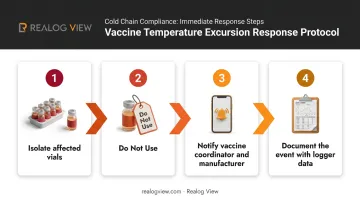
When your log flags an excursion, speed and documentation both matter. CDC's Handling a Temperature Excursion guidance lays out the immediate steps:
- Isolate the affected vials and physically separate them from usable stock
- Label them "DO NOT USE — TEMPERATURE EXCURSION"
- Notify your vaccine coordinator and contact Moderna's excursion team before administering anything
- Document the event, including data logger reports showing the excursion's duration and severity
Do not discard the affected stock before getting a viability determination. Moderna's Temperature Excursion Tool is built for exactly this situation, letting providers check whether unadministered doses remain usable.
For recordkeeping, back up digital logger reports the same day they're generated, and keep both digital and physical copies retrievable for at least 3 years. Loggers that automatically generate FDA 21 CFR Part 11 compliant PDF and CSV reports, such as those from Realog View, make this step straightforward with no extra software needed. Auditors don't accept "we'll find it" as an answer.
Frequently Asked Questions
What temperature does the Moderna vaccine need to be stored at, and how long can it sit at room temperature?
Frozen storage runs -50°C to -15°C, and refrigerated storage runs 2°C to 8°C. Once thawed, Spikevax can remain at room temperature for up to 12 hours cumulative before it must be used or discarded.
How long can Moderna vaccine stay in the refrigerator before it expires?
Up to 60 days for Spikevax or 90 days for mNEXSPIKE, or until the printed carton expiration date, whichever comes first.
What should I do if the Moderna vaccine temperature log shows an excursion?
Isolate the affected vials, label them clearly, avoid administering them, and contact Moderna's excursion team for a viability determination before any further action.
How often should Moderna vaccine storage temperature be recorded?
CDC requires checks at the start of every workday at minimum, though continuous automated monitoring with a data logger is strongly recommended for full visibility between checks.
Can Moderna vaccine be refrozen once thawed?
No. Thawed Moderna vaccine must never go back in the freezer. If it's accidentally refrozen, discard it.
How long should vaccine temperature logs be kept for compliance?
CDC recommends a minimum of 3 years, though some states and jurisdictions require longer retention periods.