That's the core problem with temperature-sensitive cargo: risk doesn't sit still. Vaccines, biologics, perishables, and industrial materials can degrade at the loading dock, during a carrier handoff, or sitting on a tarmac, not just at the warehouse door.
This article breaks down what transit temperature monitoring actually means, the device types available, the compliance rules that shape your choices, and how to pick a solution that fits your shipment risk profile.
Key Takeaways
- Excursions often happen mid-transit, not just at pickup or delivery.
- Device choice depends on risk: passive loggers for standard lanes, cellular trackers for high-value cargo.
- FDA 21 CFR Part 11, EU GDP, and FSMA each impose different documentation duties.
- Lost product potency can't be reversed, regardless of industry.
- Software-free, automatic PDF/CSV reporting simplifies audits for teams without dedicated IT resources.
What Is Temperature Monitoring In Transit?
Temperature monitoring in transit is the practice of tracking and recording the temperature (and often humidity) of goods continuously, or at set intervals, as they move from origin to destination. The goal is straightforward: detect excursions, document what happened, and act before product integrity is compromised.
This practice builds a defensible record: proof that conditions stayed within range, or documentation of exactly when and where they didn't.
Industries that depend on this practice include:
- Pharmaceutical and vaccine distribution
- Biological and clinical sample transport
- Cryogenic and dry-ice storage
- Food processing and perishable logistics
- Industrial and aerospace component shipping
What Is Transit Temperature?
Transit temperature is the actual temperature range a shipment experiences while moving, measured against the product's labeled or required storage range. The World Health Organization uses the term "transport temperature profile" to describe the anticipated ambient variation and duration a time- and temperature-sensitive product may face during transport, per WHO Technical Report Series 961, Annex 9.
Required bands vary widely by category:
| Product Category | Typical Transit Range |
|---|---|
| Refrigerated pharma | +2°C to +8°C |
| Deep-frozen food | -18°C or colder |
| Cryogenic biological samples | Down to -85°C or lower |
| Industrial/high-heat cargo | Up to +140°C |
Staying inside that band determines whether a product is usable on arrival or discarded.
Why Single-Point Checks Fall Short
A shipment might read perfectly fine at pickup and again at delivery, yet still spend two hours out of range during a carrier transfer nobody witnessed. This reflects a common excursion pattern: temperature deviations cluster around handoffs, not endpoints.
Every loading dock, warehouse stop, and carrier swap is a potential gap. Continuous or interval-based recording is the only way to catch what a spot check misses.
How Temperature Monitoring Works: Devices, Sensors & Data Capture
The basic workflow is consistent across device types:
- Sensor detects ambient or product temperature at the point of monitoring.
- Device records the reading at a configured interval.
- Device transmits or holds the data for retrieval, depending on connectivity.
- Software compares readings against set thresholds to trigger alerts or generate a compliance report.
Where devices differ is how and when that data becomes accessible.
Types of Temperature Monitoring Devices
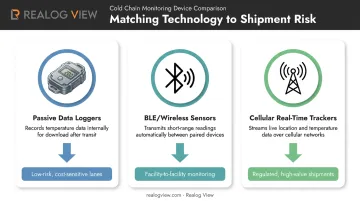
Passive or standalone data loggers record internally and produce results on retrieval. Many now auto-generate PDF or CSV reports without needing external software, which makes them ideal for teams that want simple, audit-ready documentation without IT overhead.
Wireless or Bluetooth (BLE) sensors depend on a local gateway. They offer near real-time visibility, but only within gateway range. GS1 pegs typical BLE range at roughly 80 meters, which makes this option better suited to facility or warehouse settings than open-road transit.
Cellular-connected real-time trackers transmit continuously to the cloud, enabling mid-transit alerts. They're best reserved for very high-value or high-risk regulated lanes, since coverage gaps, power demands, and aviation restrictions on cellular transmission can all interrupt the data stream.
Matching device to shipment:
- Low-risk, cost-sensitive lanes → passive loggers with automatic reporting
- Facility-to-facility or warehouse monitoring → BLE sensors with gateways
- Regulated, high-value, multimodal shipments → cellular real-time trackers
Key Features That Improve Monitoring Reliability
Three features separate a reliable device from a liability:
- Traceable calibration and tamper-proof housings. Sealed designs rated IP67 or IP68 protect against moisture, impact, and rough handling, and support data integrity requirements under regulations like FDA 21 CFR Part 11.
- Wide operating range. A single product line covering cryogenic through high-heat conditions means one vendor relationship instead of three, whether you're shipping dry ice or autoclave-validated equipment.
- User-configurable alerts and intervals. Adjustable thresholds, logging frequency, and measurement units let one device model fit multiple shipment types, cutting the need to stock separate loggers per product line.
Why Temperature Monitoring In Transit Matters
Regulatory pressure is a major driver here, but the rules aren't interchangeable:
- FDA 21 CFR Part 11 governs electronic records and signatures used in place of paper, requiring secure, tamper-evident, time-stamped audit trails.
- EU Good Distribution Practice (GDP) requires calibrated monitoring equipment and documented handling of excursions during medicinal product transport.
- FSMA's Sanitary Transportation Rule assigns temperature-condition responsibilities between shippers, carriers, and receivers of covered food.
None of these functions as a blanket "cold chain certification." Each addresses a different regulated activity.
Beyond compliance, there's a harder truth about the products themselves. The CDC's Vaccine Storage and Handling Toolkit states that improper conditions can reduce or destroy vaccine potency, and once that potency is lost, it cannot be restored. Appearance isn't a reliable indicator either; a vial can look fine and still be compromised.
That same one-way risk extends well beyond vaccines, showing up across several other regulated categories:
- Biological samples collected for diagnostic or research use
- Certain biologics and temperature-sensitive pharmaceuticals
- Perishable food categories like seafood, poultry, and dairy
In each case, a monitoring record isn't just paperwork. It's the basis for a real disposition decision: accept, quarantine, or discard.
How To Monitor Temperature Remotely In Transit
Remote monitoring relies on connected sensors or loggers transmitting readings via cellular, WiFi, or Bluetooth to a cloud dashboard or mobile alert system. It's the answer when someone needs to know about a problem before the truck arrives.
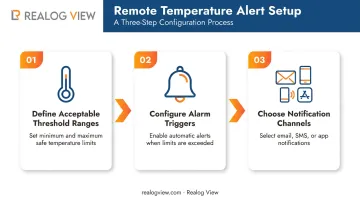
A typical remote alert setup involves:
- Defining acceptable threshold ranges based on the product's known stability data.
- Configuring alarm triggers for upper and lower limits.
- Choosing notification channels, whether email, SMS, or an app, routed to logistics or quality teams.
That said, remote monitoring has real limitations:
- Connectivity gaps during transit can delay or block transmission entirely.
- Continuous data transmission adds cost through radio hardware, network fees, and higher power draw.
- Device fleet management adds overhead, since each sensor needs charging, activation, and dashboard setup before every shipment.
For many shipment types, a simpler logger with automatic PDF/CSV reporting on retrieval delivers the same audit-ready record at a lower cost, without depending on network coverage the whole route.
Choosing The Right Temperature Monitoring Solution For Your Shipments
Buyers should weigh a handful of criteria before committing to a device:
- Operating temperature range needed for the product category
- Required certifications for your industry and region
- Device durability, including drop, moisture, and impact resistance
- Preferred reporting format, whether PDF, CSV, or both
For organizations without dedicated IT staff or system-validation resources, software-free devices offer a real operational advantage. Deploying across multiple facilities or shipment lanes shouldn't require installing and maintaining separate software on every machine that touches the data.
That's also why automatic, tamper-proof PDF/CSV report generation matters for audit readiness. A device that produces a compliance-ready report the moment it's plugged in removes an entire step from inspection prep, and removes a point of potential data tampering along with it.
Realog View's data logger range is a useful reference point here. The lineup is FDA 21 CFR Part 11 compliant, DO-160G certified for extreme-condition durability, and built with IP67/IP68 tamper-proof, submersible housings.
Across the product range, operating capability spans -85°C to +140°C, covering cryogenic and dry-ice shipments on one end and autoclave or industrial monitoring on the other. User-replaceable batteries mean a device doesn't need to be retired just because power ran low mid-cycle.
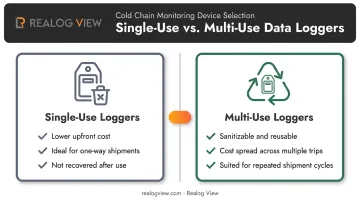
Beyond specs and certifications, one more decision shapes total shipping costs: reusable versus single-use.
- Single-use loggers suit infrequent or one-way shipments where cost-per-trip matters most and the device won't be recovered.
- Multi-use loggers suit repeated shipment cycles or hygiene-sensitive industries, where a sanitizable, reusable unit spreads its cost across many trips instead of one.
Best Practices For Reliable In-Transit Temperature Monitoring
A good device only performs as well as the process around it. A few habits make a measurable difference:
- Calibrate regularly and place sensors near the product, not just the surrounding container air. Ambient readings can miss slower-moving temperature changes deep inside dense packaging.
- Standardize alert thresholds, using actual product stability data. Too-tight thresholds cause false rejections; too-loose ones miss real excursions.
- Train personnel at every handoff point, from loading to carrier transfer to receiving, on proper device placement, sealing, and data retrieval. Skipping any step leaves a blind spot.
None of this requires elaborate infrastructure. It requires consistency at the points where shipments actually change hands.
Frequently Asked Questions
What is temperature monitoring during transportation?
Temperature monitoring during transportation is the tracking and recording of temperature conditions throughout a shipment's transit journey to detect excursions and protect product integrity. The record also supports compliance documentation for regulated industries.
What is transit temperature?
Transit temperature is the actual temperature a shipment experiences while in motion, measured against its required storage range. Staying within that band determines whether the product remains usable on arrival.
How to monitor temperature remotely?
Remote monitoring uses connected sensors or loggers that transmit readings via cellular, WiFi, or Bluetooth to a cloud dashboard or mobile app. Alerts via email, SMS, or push notification flag threshold breaches as they happen.
What is the difference between a real-time tracker and a passive data logger for transit monitoring?
A real-time tracker transmits continuously via cellular connection, enabling alerts during the trip itself. A passive data logger records internally and is reviewed only after retrieval, once the shipment has arrived.
How long can a temperature data logger operate during a shipment?
Battery life and recording duration vary by device and logging interval; some single-use loggers run up to 220 days at standard intervals. User-replaceable batteries on multi-use models extend usability across long or repeated shipments.
What certifications should a transit temperature monitoring device have?
Look for FDA 21 CFR Part 11 for electronic record integrity, CE and RoHS for regulatory compliance, and DO-160G for durability under extreme conditions. Each certification validates a different aspect of the device, not one blanket standard.