Get relative humidity wrong and you're looking at frost-clogged coils, moldy packaging, or drug stability failures that trigger a recall. Many facility managers struggle with this because humidity isn't static. It shifts every time a door opens, a forklift idles too long, or a defrost cycle kicks in.
There's no single fix, either. A pharma vault, a produce cooler, and a frozen seafood warehouse all need different approaches based on room design, product type, and traffic patterns. This guide walks through the exact steps to control humidity, the RH targets that matter for your specific product, the variables that make or break your results, and the mistakes that trip up even experienced teams.
TL;DR
- Humidity control requires monitoring, sealing, correctly sized equipment, and documentation.
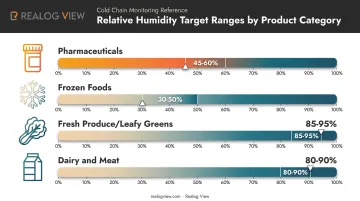
- Target RH varies by product: 45-60% pharma, 30-50% frozen goods, 85-95% fresh produce.
- Most failures trace to poor door discipline, undersized equipment, or missing monitoring.
- Regulated industries need traceable, auditable records, not occasional spot checks.
How to Control Humidity in Cold Storage
Fixing humidity problems takes more than buying the biggest dehumidifier available. The real fix is a sequence: measure first, seal the room, size equipment to the actual load, then monitor continuously so small deviations never become big losses.
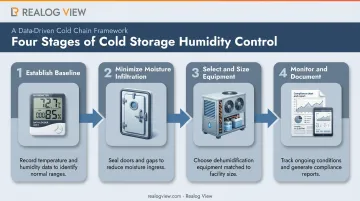
Step 1: Establish a Humidity and Temperature Baseline
Before changing anything, find out what's actually happening in the room. Install calibrated hygrometers or data loggers at multiple points, including:
- Near dock doors and vestibules
- Close to evaporator coils
- Directly on or near product racks
Run this baseline for at least 24-72 hours in a cold or freezer room, matching the World Health Organization's mapping guidance, and at least seven consecutive days for ambient warehouses that don't hold steady conditions year-round.
Watch for condensation, frost, or fog patterns that line up with door openings, loading cycles, or defrost schedules. Then compare what you're seeing against the RH range required for your product or regulatory standard, whether that's GDP or FDA guidance.
For this step, a dual-parameter logger with an on-screen display earns its keep. Realog View's dual-parameter humidity and temperature logger with LCD display, for instance, tracks both readings simultaneously and shows them live on screen. A technician walking the floor can spot a problem zone immediately, without waiting for a report to generate later.
Step 2: Minimize Moisture Infiltration at the Source
Once you know where moisture is entering, close the gaps. Warm, humid air condenses the instant it touches a cold surface, and doorways are the biggest offender.
An OSTI field study on walk-in cold rooms found that infiltration through doors can account for more than half of total cooling load in some configurations. That gap alone can be the single biggest driver of cooling load in the room.
Practical fixes include:
- Air curtains, strip curtains, or fast-closing doors to slow the exchange of warm and cold air
- Vestibules or anterooms as buffer zones between ambient and refrigerated space
- Regular inspection of insulation panels, gaskets, and wall/floor joints for gaps that let moist air seep in undetected
- Door-discipline SOPs that train staff to minimize total open-door time during loading and picking
None of these need to be expensive. A worn gasket costs a few dollars to replace but can undo thousands of dollars in dehumidification effort if ignored.
Step 3: Select and Size the Right Dehumidification Equipment
Equipment choice depends heavily on room temperature. Mechanical dehumidifiers cool air below its dew point to wring out moisture, but that process breaks down once coil surfaces approach freezing. Below roughly 10°C, desiccant systems perform far more reliably because they adsorb vapor without needing condensation to occur.
Sizing should account for:
- Room volume and air exchange rate: how much air moves through the space and how often
- Product moisture load: what your stored goods themselves release into the air
- Infiltration and internal generation: moisture from doors, staff, and equipment combined
Skip the shortcut of sizing by floor area alone. It routinely leads to units that run constantly without ever reaching target RH, which wastes energy and shortens compressor life. Before finalizing a unit, confirm its duty cycle and controls can talk to your existing refrigeration and building management system without conflicting on defrost timing.
Step 4: Monitor Continuously and Document for Compliance
Sealing and sizing get you close. Ongoing monitoring is what keeps you there and proves it to an auditor.
Deploy loggers at multiple zones for real-time RH tracking, and set product-specific alarm thresholds so a deviation triggers action immediately rather than being discovered during a routine check days later. This is where compliance-driven facilities separate themselves from the rest.
FDA 21 CFR Part 11 requires that electronic records be secure, time-stamped, and traceable. Realog View's data loggers generate PDF and CSV reports automatically, with no external software or extra probes needed. That matters during an audit, when the last thing you want is a compliance gap caused by unsupported software or a missing file.
Beyond alarms and reports, schedule recalibration and equipment maintenance based on trends in your logged data rather than a fixed calendar. A unit that's slowly drifting off target will show up in the numbers long before it fails outright.
Ideal Humidity Levels and When Active Control Matters Most
RH targets aren't universal. Matching your setpoint to what's actually stored on the racks is the first decision, not something to figure out after equipment is already installed.
| Product Category | Typical RH Range |
|---|---|
| Pharmaceuticals | 45-60% |
| Frozen foods | 30-50% |
| Fresh produce, leafy greens | 85-95% |
| Dairy and meat | 80-90% |
For context, the USP standard defines a "dry place" as not exceeding 40% average RH at 20°C, with brief excursions to 45% permitted if the average holds. Meanwhile, USDA data shows most fresh fruits and vegetables need 85-95% RH, with some leafy vegetables requiring up to 98%.
Meeting these numbers on paper is the easy part. Sustaining them under real operating conditions is what separates passive sealing from active control, and that gap shows up fastest in:
- High-traffic facilities with frequent door cycles
- Hygiene-sensitive industries like pharma and biologics
- Facilities under regulated audit (GDP, FDA)
- Humid climates where ambient moisture load is constant
Low-traffic, single-product rooms often need only passive sealing to hold their target range.
One wrinkle worth flagging: mixed-use rooms create conflicts. Storing onions next to fresh meat in the same space, for example, pits a low-humidity-tolerant product against one that needs high RH. Zoning or scheduled storage windows are the only real solutions here.
Key Parameters That Affect Humidity Control Results
Outcomes hinge on a handful of variables you actually control, not just the rated capacity printed on a dehumidifier's spec sheet.
Door Opening Frequency and Air Infiltration
Warm, moist ambient air condenses the moment it hits a cold surface. Repeated door openings spike RH within seconds and force the dehumidification system into constant re-drying cycles, driving up both energy use and wear on the equipment.
Insulation Integrity and Building Envelope Sealing
Gaps, cracks, and degraded panels are a slow, hard-to-detect entry point for moisture. Left unaddressed, they cause localized condensation, mold risk, and a higher energy draw as the system compensates for a leak nobody's noticed yet.
Dehumidifier Type, Capacity, and Placement
Desiccant versus mechanical technology, and correct sizing for both, determine whether your RH target is even achievable at the room's actual operating temperature. Get the match wrong and:
- The unit runs nonstop without ever reaching target RH
- Energy costs climb well beyond the rated draw
- Compressor or desiccant wheel wear accelerates, shortening service life
Monitoring Frequency and Sensor Placement Accuracy
RH isn't uniform across a room. Readings near a door or evaporator coil can look nothing like readings at product level. Poor sensor placement, or checking too infrequently, delays detection of frost, mold, or dehydration risk until damage is already done. Multi-use, dual-parameter data loggers placed at product level, near doors, and by evaporator coils turn that blind spot into a continuous, exportable record instead of a guess.
Common Mistakes and Troubleshooting Humidity Issues
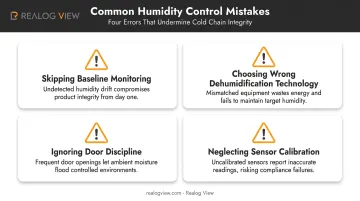
Most humidity problems in cold storage trace back to a short list of avoidable errors:
- Skipping baseline monitoring. Installing dehumidification equipment based on guesswork instead of measured RH and load data almost always results in an undersized or mismatched system.
- Choosing the wrong technology for the temperature. Mechanical dehumidifiers underperform badly in sub-10°C rooms, where only desiccant systems hold up.
- Ignoring door discipline. Frequent or prolonged openings repeatedly reintroduce moisture-laden air, undoing hours of dehumidification work in minutes.
- Neglecting sensor calibration. Inaccurate RH readings mask developing frost, condensation, or dehydration problems until they've already caused damage.
These setup errors explain most humidity failures, but some symptoms point elsewhere. Recurring frost near doors usually signals infiltration, pressure imbalance, or a failing gasket rather than a weak dehumidifier. Wet packages after storage typically trace back to uncontrolled tempering, not a failure inside the room itself.
Conclusion
Humidity control works best as a system, not a single fix. Baseline data, sealing, correctly sized equipment, and continuous monitoring all have to work together. Skip one and the others compensate poorly, if at all.
Most failures trace back to preparation, not the equipment itself:
- A baseline that was never measured
- A door left propped open too long
- A sensor that hasn't been checked in months
The right approach balances product protection, energy efficiency, and regulatory traceability. It starts with knowing what's happening in your room right now, not what you assume is happening. FDA-compliant data loggers turn that visibility into verifiable records.
Frequently Asked Questions
How do you control humidity in cold storage?
Start with baseline RH monitoring, then seal infiltration points, install correctly sized dehumidification equipment, and maintain continuous documented monitoring so you can adjust before problems escalate.
What is a good humidity level for cold storage?
It depends entirely on the product: roughly 45-60% for pharmaceuticals, 30-50% for frozen goods, and 85-95% for fresh produce.
What happens if humidity is too high in cold storage?
Excess moisture causes condensation, frost buildup on coils, mold growth, reduced refrigeration efficiency, and compromised product safety or stability.
Can humidity be controlled without a dehumidifier?
Sealing, air curtains, and strict door discipline reduce infiltration, but they rarely hit tight RH targets on their own in regulated or high-traffic environments.
How often should humidity be monitored in cold storage?
Use continuous or near-continuous monitoring via data loggers, especially in compliance-driven facilities, rather than periodic manual spot checks.
What is the standard humidity level for pharmaceutical cold storage?
Pharmaceutical products typically require RH in the 45-60% range, with exact limits set by product-specific stability data and GDP/FDA guidelines.