Introduction
A -80°C freezer doesn't look dramatic. It hums quietly in a hallway or lab corner, holding vaccines, plasma, tissue samples, or research reagents that took years to collect.
Then the compressor fails at 2 a.m. on a Friday, and by Monday, everything inside is gone.
Many labs and pharmaceutical teams still rely on a freezer's built-in display and trust it won't fail. That's a problem, because even a short temperature excursion can destroy irreplaceable biologics or an entire vaccine shipment.
This guide breaks down how ultra-low temperature (ULT) monitoring actually works, what a data logger does differently than a sensor, and which features matter most. It also covers how to stay compliant with FDA and CDC requirements along the way.
Key Takeaways
- ULT monitoring safeguards biological and pharmaceutical assets stored between -80°C and -85°C
- Reliable loggers work without external software and hold up under FDA 21 CFR Part 11 scrutiny
- Continuous logging paired with temperature mapping catches hot spots that a single sensor misses
- Battery-backed, independent loggers keep recording through power outages and network downtime
What Is Ultra-Low Temperature Monitoring and Why Does It Matter?
ULT storage covers equipment operating at -80°C and below. Mechanical freezers typically run between -80°C and -86°C, while liquid nitrogen dewars push down to roughly -196°C.
If someone asks about "the temperature of an ultra low freezer," they're almost always referring to that -80°C to -86°C mechanical range, not cryogenic LN2 storage, which is a different beast entirely.
The stakes are high because these assets can't be replaced once they're compromised. A silent temperature drift for a few hours can spoil vaccine doses, degrade DNA or tissue samples, or trigger a failed audit that costs a facility its accreditation.
There's also a hidden cost that rarely makes headlines: energy. A conventional ULT freezer draws about 20 kWh per day, roughly what an average US household consumes, according to the US Department of Energy's Federal Energy Management Program.
Every hour that unit runs inefficiently or fails without anyone noticing adds operational and financial strain on top of the sample loss itself.
Built-In vs. Independent Monitoring Systems
Most ULT freezers ship with a digital display and some basic onboard logging. That's useful for a quick glance, but it has real limits:
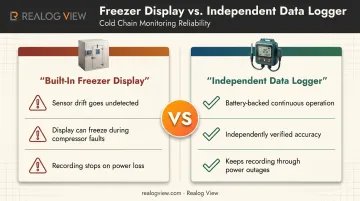
- Built-in sensors can drift out of calibration without any visible warning
- A display can freeze or fail silently during a compressor fault
- These systems typically stop recording the moment the unit loses power
An independent, external data logger adds a second layer of verification. Realog View's ultra-low/cryo loggers, rated from -85°C to +70°C with FDA 21 CFR Part 11 compliant reporting, are built for exactly this failure scenario. If the freezer's internal system fails or the facility loses power, the standalone logger keeps working on its own battery, capturing the full excursion for the audit trail.
This is exactly why regulated industries, pharma manufacturers, blood banks, and clinical research labs, can't lean on built-in alarms alone for audit purposes. Compliance auditors want documented, independently verified temperature history, not just a manufacturer's default display readout.
How Ultra-Low Temperature Data Loggers Work
At its simplest, a ULT data logger uses an internal sensor to record temperature at set intervals, storing each reading in onboard memory until it's retrieved. That's the core mechanism behind every credible monitoring device on the market.
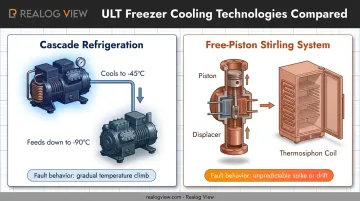
To understand what these loggers are actually watching, it helps to know how ULT freezers reach such extreme temperatures in the first place. This also answers a common question: how do ultra-low temperature freezers actually reach such extreme depths?
- Cascade refrigeration uses two vapor-compression stages: a high stage that cools refrigerant to around -45°C, and a low stage that pushes it further down to roughly -90°C, according to a Thermo Fisher technical comparison of refrigeration technologies
- Free-piston Stirling systems use a single reciprocating piston and displacer to move gas between hot and cold zones, paired with a thermosiphon that distributes cooling through the cabinet
- Fault behavior differs by design: cascade failures typically show a gradual temperature climb, while Stirling-engine issues can spike or drift unpredictably, so alarm thresholds need validation against the specific freezer, not a generic default
Sensor Accuracy at Extreme Cold
Sensor accuracy determines whether that logged data can be trusted. Cryogenic conditions cause measurement shift over time through repeated thermal cycling, so a sensor's rated range and construction quality matter more than the label on the box.
Not every sensor marketed for cold environments is validated for true ULT service. Checking the manufacturer's stated accuracy at your specific operating range is a non-negotiable step before deployment.
From Raw Data to Usable Reports
Older loggers required downloading data through proprietary software, often with a dedicated USB dongle and a training session just to run the export. Modern devices skip that entirely. Plug the unit into a Windows PC, and it generates a formatted PDF and CSV report automatically, no software install, no IT ticket.
This speed matters most during an active excursion. Continuous monitoring (real-time, battery-backed tracking) and temperature mapping (multiple probes placed to catch hot spots) both depend on getting usable data out fast, not days later.
Finally, threshold-based alarms, whether visual, audible, or remote, exist to catch problems before they become losses. A logger that flags an excursion the moment it happens gives staff a chance to move samples before damage occurs.
Key Features to Look for in an Ultra-Low Temperature Data Logger
Not all ULT loggers are built the same. Here's what separates a reliable device from one that leaves gaps in your compliance record:
- Wide, validated operating range: Verify the exact rated range, since cryogenic and high-temp autoclave loggers are different tools despite sharing one product line.
- Software-free, automatic reporting: Choose devices that generate PDF and CSV reports via USB, no software or external probes needed, ideal for teams without dedicated IT support.
- Regulatory-grade compliance: FDA 21 CFR Part 11 compliance is table stakes for pharmaceutical and clinical use, ensuring the data integrity and traceability auditors expect.
- Rugged, tamper-proof construction: IP67 or IP68 sealed housings plus DO-160G environmental testing signal a device built for real-world transport and storage, not just lab-bench conditions.
- User-configurable settings: Adjustable alarm thresholds, logging intervals, and unit selection (°C/°F) let one device serve multiple use cases across a facility.
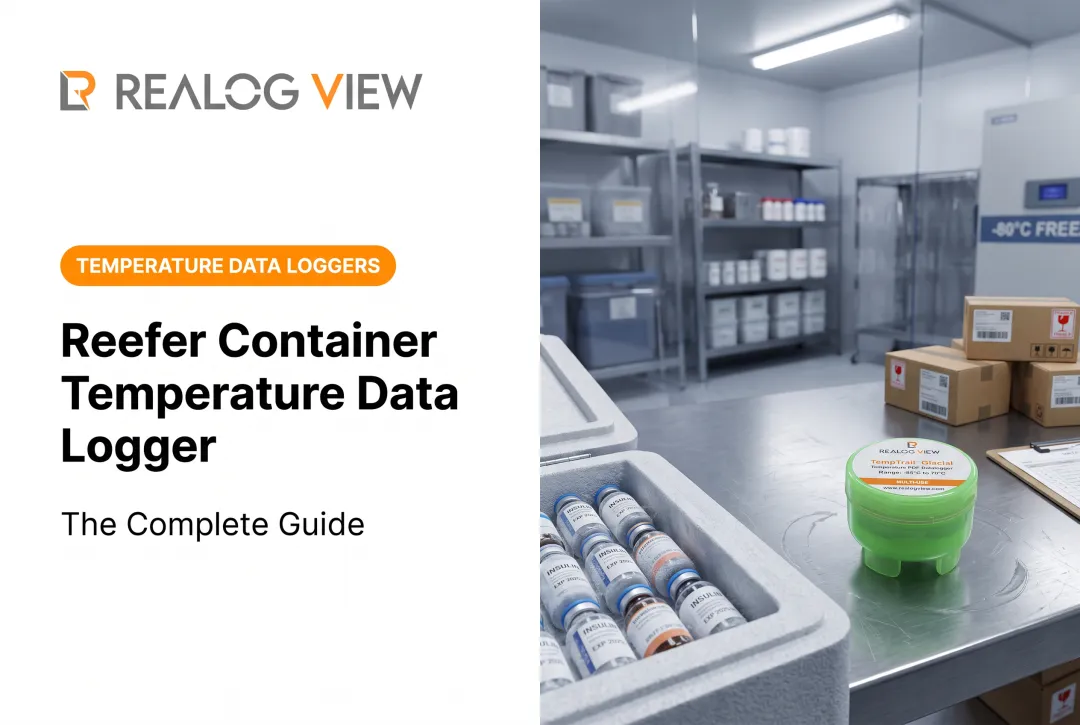
Realog View's TempTrail™ Glacial Display is built around these exact requirements. It monitors from -85°C to +70°C using an internal sensor, so no external probe is needed.
The device stores up to 32,000 data points and runs on a user-replaceable ½ AA battery rated for 18 months. Connect it via USB, and it generates PDF and CSV reports automatically, no software, no probes, just audit-ready documentation for cold chain and pharmaceutical teams.
Best Practices for Reliable ULT Monitoring
Getting a good logger is only half the job. How you deploy it determines whether it actually catches problems.
Map before you monitor. A single sensor placed wherever it's convenient can miss real spatial extremes.
A study of -80°C freezers, detailed in PMC research from UC San Diego, placed six sensors per unit at one-minute intervals. Front-of-unit temperatures spiked to roughly -54°C during door openings, while the rear stayed near -70°C the entire time. One probe near the door would have completely missed how stable the rear shelves actually were, or vice versa.
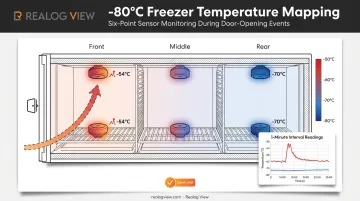
Use that mapping data to decide where permanent sensors go:
- Place probes near doors, vents, and known airflow gaps, not just in the geometric center
- Account for defrost cycles, which can create temporary hot spots even in a well-functioning unit
- Re-map after any major freezer relocation or repair
Build a calibration schedule. There's no universal mandate for annual calibration, but most facilities set that cadence based on manufacturer guidance, usage intensity, and drift history. Keep NIST-traceable certificates on file so your measurement chain holds up under audit.
Plan for redundancy. Battery-powered, independent loggers should keep recording straight through a power outage or network dropout. Realog View's multi-use loggers, for instance, run on user-replaceable batteries and log data locally. If your only monitoring option goes dark the moment the building loses power, you have a data gap exactly when you need records most.
Regulatory Compliance and Data Integrity for ULT Monitoring
Compliance isn't optional in regulated storage, and the requirements are specific.
FDA 21 CFR Part 11 applies when electronic records replace paper documentation for regulated activities. Closed systems must:
- Validate accuracy and reliability of recorded data
- Protect records through the full retention period
- Restrict access to authorized users only
- Maintain secure, time-stamped audit trails for record creation, modification, or deletion
NIST-calibrated instruments matter here too. NIST defines metrological traceability as a documented, unbroken chain of calibrations, with every step contributing to measurement uncertainty. That means a defensible calibration record needs to show the reference standards used, the method, and the resulting uncertainty, not just a sticker that says "NIST traceable."
Program-specific rules add another layer. Providers enrolled in the CDC's Vaccines for Children program take on additional storage and documentation obligations at their own sites :
- Continuous digital data logging, recording no less often than every 30 minutes
- Current calibration documentation on file for each device
- Records retained for at least 3 years
Hourly manual checks at temporary clinics don't substitute for that continuous recording requirement.
Realog View's ULT data loggers support continuous digital logging at user-configurable intervals and generate tamper-evident PDF and CSV records with FDA 21 CFR Part 11 audit trails, backed by DO-160G-certified durability. Device requirements for program-enrolled sites are set by each state immunization program - confirm specifications with yours before ordering.
Industries That Depend on Ultra-Low Temperature Monitoring
ULT monitoring isn't confined to one industry. It's foundational wherever cold means value.
- Pharmaceutical and vaccine cold chain: Continuous, documented monitoring during both transport and storage protects biologics from the moment they leave the manufacturer to the point of administration
- Biological sample and cryogenic storage: Biobanks, labs, and hospitals store DNA, tissue, and cell samples in ULT freezers or LN2 dewars, where one lapse can end years of research
- Industrial and specialized sectors: Food processing, aerospace and defense component testing, and medical device manufacturing all rely on validated extreme-temperature monitoring for quality and safety documentation

Across all of these, the pattern holds: once the asset is damaged, there's no undoing it. Monitoring is the only way to prove, after the fact, that storage conditions held.
Frequently Asked Questions
What is the temperature of an ultra low freezer?
Standard ULT freezers operate between -80°C and -86°C. Cryogenic storage using liquid nitrogen can reach as low as -196°C, which is a separate category from mechanical ULT storage.
How do ultra low temperature freezers work?
They typically use cascade refrigeration, which stacks two cooling stages, or free-piston Stirling-cycle systems, which use a single piston and thermosiphon. Both methods are engineered to reach and hold extreme low temperatures for long-term sample preservation.
What is the difference between a temperature data logger and a temperature sensor?
A sensor detects temperature at a given moment. A data logger records, stores, and often reports that data over time, which is what compliance and audit trails require.
How often should ultra-low temperature data loggers be calibrated?
Most facilities calibrate annually or per their internal SOP, using NIST-traceable standards. The right interval depends on manufacturer guidance, usage, and drift history rather than one fixed rule.
Can ultra-low temperature data loggers work without external software?
Yes. Modern PDF-based loggers, including Realog View's large-display models, generate reports automatically via USB connection with no installed software, external probes, or IT support required.
What certifications should an ULT data logger have for pharmaceutical use?
Look for FDA 21 CFR Part 11 compliance, NIST-traceable calibration, and environmental or durability certifications like CE, RoHS, and DO-160G. Together, these confirm both data integrity and physical reliability under real-world conditions.