By then, it's too late. The product is compromised, the shipment is a loss, and the paper trail only proves the failure happened. It doesn't prevent it.
This is the core problem with passive monitoring: it documents damage after the fact. Real-time alert systems flip that script, flagging excursions the moment they happen so someone can actually intervene. This guide covers how these systems work, what features matter, and what US pharma shippers need for compliance.
Key Takeaways
- Temperature excursions fall outside the validated range—unlike minor deviations—and require formal investigation.
- Real-time alerts enable mid-transit correction; passive loggers only confirm damage after delivery.
- FDA 21 CFR Part 11–compliant, software-free loggers with auto PDF/CSV reports speed audit readiness.
- Product-specific thresholds (2–8°C, frozen, ultra-cold) cut missed excursions and alert fatigue.
What Are Temperature Excursions and Why They Matter
The CDC defines a temperature excursion as any reading outside the range listed in a manufacturer's package insert. When one occurs, immediate action is required: isolate the product, label it "DO NOT USE," and seek a viability determination from the manufacturer.
A deviation, by contrast, is a quality-system record opened when an approved procedure wasn't followed. Not every deviation is an excursion, but every confirmed excursion should trigger a formal investigation.
Why Damage Often Goes Unnoticed
Protein-based biologics degrade through denaturation and chemical breakdown when exposed to heat or freezing. This damage isn't visible on inspection. A vial can look perfectly normal and still have lost most of its potency. That's the danger: without a validated logger, there's no way to know something went wrong until it fails in the field.
Standard product ranges and risks:
| Product Type | Validated Range | Primary Risk |
|---|---|---|
| Refrigerated | 2-8°C | Freezing destroys potency (even briefly at 0°C) |
| Frozen (vaccine) | -50°C to -15°C | Thaw cycles degrade stability |
| Ultra-cold | -90°C to -60°C | Narrow tolerance, rapid degradation |
| Controlled Room Temp | 20-25°C (15-30°C transient) | Mean kinetic temperature above 25°C accelerates decay |

Unresolved excursions don't just risk product loss. They become CAPA investigations and show up in FDA and EU GDP audit findings, often as evidence of poor process control rather than a one-off mistake.
Common Causes of Excursions in Pharma Shipping
Most excursions trace back to a handful of recurring failure points:
- Carrier or warehouse handoff delays: the product sits between custody transfers with no active monitoring oversight
- Tarmac exposure: ground hold times can range from minutes to several hours depending on the airport
- Equipment or reefer failure: mechanical cooling breaks down mid-transit
- Inadequate packaging insulation: thermal margin runs out before the shipment reaches its destination
Every one of these happens during a custody transition, which is exactly why alert systems need to stay active through loading, staging, and handoffs, not just during transport.
How Temperature Excursion Alert Systems Work
These systems follow a straightforward loop: a sensor takes continuous readings, compares them against a configurable threshold, and fires an alert the moment that threshold is breached.
Two monitoring approaches sit on opposite sides of that loop:
- Passive logging: Records temperature data for download after delivery. Strong for compliance records, but too late for intervention.
- Real-time or near-real-time alerting: Flags the breach as it happens, so teams can redirect, repack, or quarantine before the product arrives damaged.
Configurable Alarms Built for Product-Specific Ranges
Generic thresholds cause two problems: missed excursions (threshold too loose) or alert fatigue (threshold too tight, triggering constant false alarms). The fix is configuring alarms against each product’s validated stability profile, not a one-size-fits-all setting.
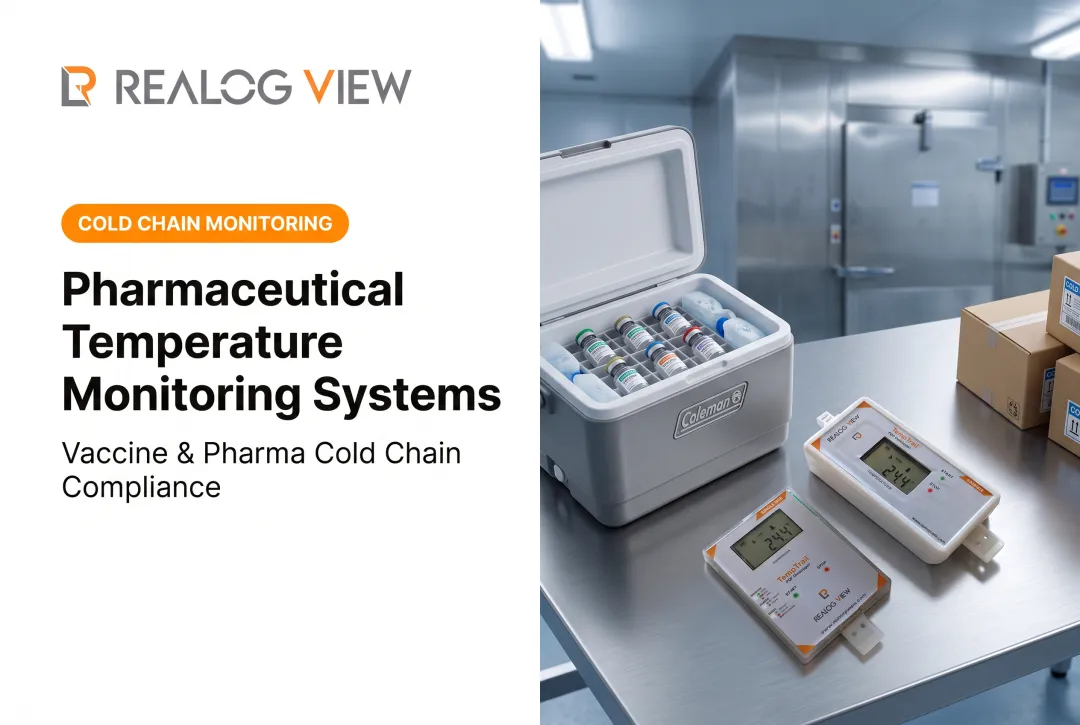
Realog View’s multi-use TempTrail loggers let users set upper and lower thresholds, adjust recording intervals, and choose °C or °F. Single-use models ship with preset alarms (2°C / 8°C points, 10-minute intervals) that fit standard cold-chain lanes with no setup.
Reporting Without Extra Software
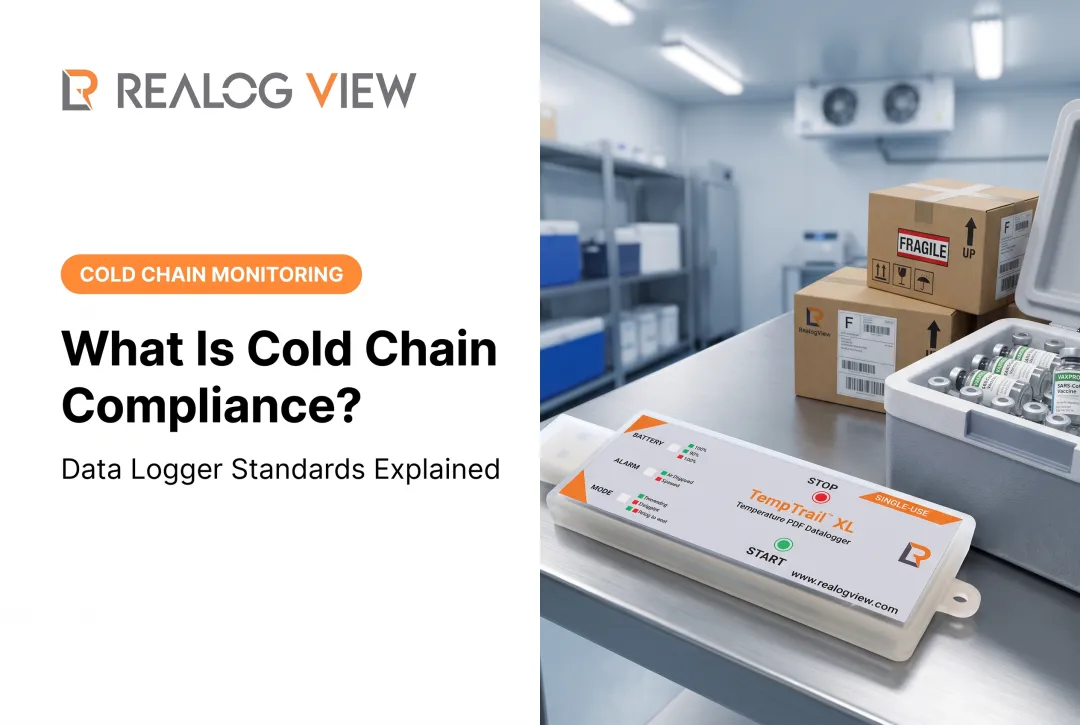
One friction point in cold-chain compliance is data access. Realog View’s loggers generate PDF and CSV reports automatically over USB, with no external software, drivers, or probes required. Quality teams can pull an audit-ready record as soon as the device is connected.
Built to Survive the Actual Shipping Conditions
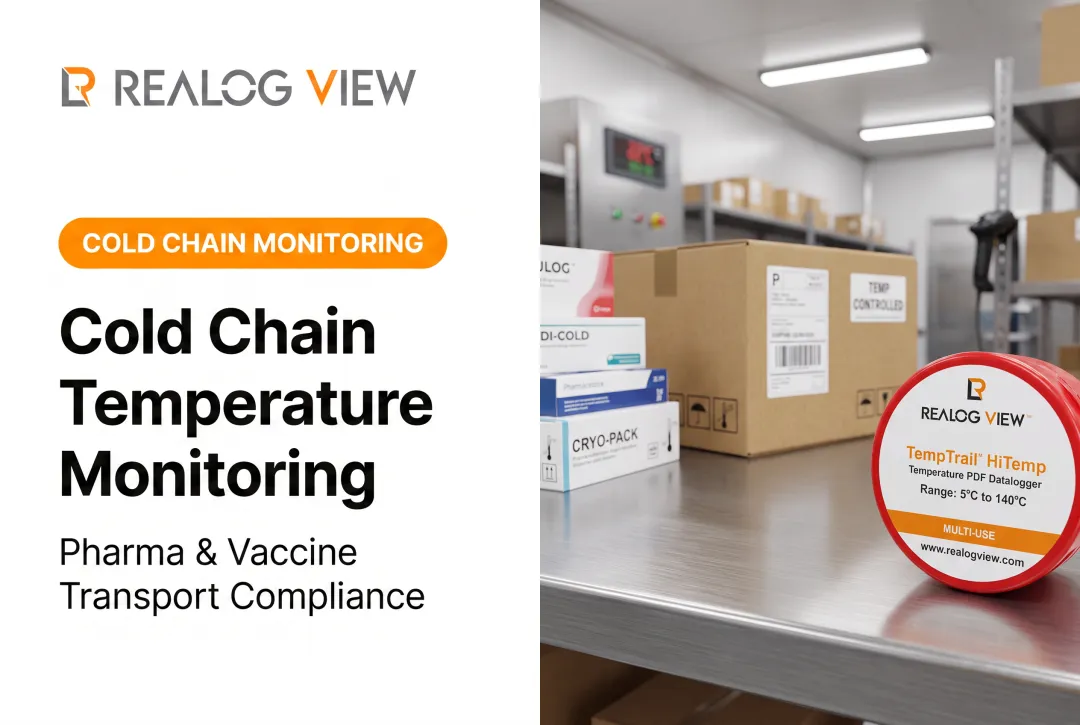
Alerts only help if the logger keeps reading accurately through rough handling, moisture, and temperature swings. Realog View’s TempTrail Glacial with Display uses an IP67-sealed, tamper-proof enclosure rated for submersion up to 1 meter, with an integrated internal sensor (no external probe to snag or fail). The TempTrail HiTemp uses an IP68-rated casing for high-heat, wet applications such as autoclave monitoring.

Key Features to Look for in an Alert System
Not every logger fits every shipment. Here's what separates a functional device from one that creates gaps in your cold chain.
Look for these capabilities when you specify an alert system:
- Temperature range from -85°C to +140°C across standard (-30°C to +70°C), high-temp/autoclave (+5°C to +140°C), and ultra-low/cryo (-85°C to +70°C) lines. Realog View covers CRT storage through cryogenic transport with one supplier.
- Instant-read displays on TempTrail Display and Glacial with Display show live temperature and alarm status (bell icon on breach) without a laptop or app.
- Single-use options (TempTrail Classic, XL) for one-off lanes at lower unit cost; multi-use models (Glacial, HiTemp, Display M) that pay off on repeat routes.
- User-replaceable batteries on Glacial, Glacial with Display, and HiTemp so a dead cell does not force a full device swap.
- Sanitizable, fully submersible IP68 housing on HiTemp for repeated cleaning in biological and pharma handling.

Regulatory Compliance for Excursion Alert Systems
Excursion alert systems create electronic temperature records that must hold up in an FDA inspection. FDA 21 CFR Part 11 governs those records for regulated industries. It requires:
- Validated systems that detect invalid or altered records
- Accurate, retrievable copies (human-readable and electronic)
- Secure, time-stamped audit trails
- Controlled system access and authority checks
Automatic PDF reporting supports this by generating a tamper-resistant record the moment a logger is connected, without manual reconstruction of raw data. That matters during an inspection, when auditors want proof the record wasn't altered after the fact.
Certifications worth checking:
| Certification | What it confirms |
|---|---|
| CE | European Economic Area conformity |
| RoHS | Restriction of hazardous substances |
| DO-160G | Environmental/durability testing for airborne equipment |
| FCC | US radio-frequency device authorization |
These marks indicate durability and regulatory-grade construction, but they don't replace product-specific stability validation. A DO-160G certification proves a device survives harsh environmental testing. It doesn't prove your vaccine's stability profile.
Best Practices for Implementing Alert Systems
Hardware alone won't stop excursions. These four practices make alerts actionable on live pharma shipments:
- Set thresholds from stability data, not convenience. FDA's Q1 draft guidance notes that transient excursions outside labeled conditions may only be acceptable when supported by actual stability data—not a generic buffer applied across products.
- Write an SOP defining alert response. Name who receives alerts, who can make disposition decisions, and the maximum response time before action is required.
- Keep calibration documentation current. NIST cautions that a calibrated instrument alone doesn't establish traceability. Keep certificates showing reference standard, uncertainty, and calibration date for every logger in the fleet.
- Test escalation paths at every handoff. An alert nobody sees during a carrier transfer is the same as no alert at all.
Frequently Asked Questions
What are the best temperature monitoring devices for pharmaceutical shipments?
The strongest options combine wide temperature range coverage, FDA 21 CFR Part 11 compliance, tamper-proof sealed design, and automatic reporting without external software. Software-free PDF loggers are a strong fit for compliance-focused shippers who need fast audit access.
How do you monitor cold storage temperature remotely for pharmaceutical products?
Remote monitoring uses connected sensors or gateways that transmit readings to a cloud dashboard, triggering alerts when thresholds are breached. This lets quality teams check conditions from any location without physically accessing the shipment.
What is the difference between a temperature deviation and a temperature excursion?
A deviation is a brief, often explainable fluctuation within acceptable process variation. An excursion is a confirmed reading outside the validated range that triggers a formal quality investigation and CAPA process.
How often should temperature be recorded during pharma transit?
Continuous monitoring is standard, with recording intervals often configurable from seconds to minutes depending on product sensitivity. CDC guidance recommends intervals of at least every 30 minutes for vaccine cold chain logging.
Can a single data logger cover multiple temperature zones (refrigerated, frozen, ultra-cold)?
Yes. Some logger lines, like Realog View's TempTrail Glacial, cover -85°C to +70°C in one device, spanning refrigerated through ultra-cold ranges and reducing the need for multiple device types.
What happens after a temperature excursion is detected?
Quality teams isolate the product and seek a viability determination from the manufacturer. They document the event, open a CAPA if warranted, and decide disposition—release, quarantine, or disposal—based on stability data.