That's the stakes behind an unglamorous but critical piece of public health infrastructure: the vaccine cold chain. In 2024 alone, UNICEF delivered 2.787 billion vaccine doses to 99 countries, enough to reach an estimated 45% of the world's children under five, according to its 2024 Supply Annual Report. Every one of those doses depended on an unbroken chain of refrigeration, monitoring, and careful handling.
This article breaks down what the cold chain actually is, how it works stage by stage, the temperature science behind it, the equipment that keeps it running, and the practices that prevent it from failing.
Key Takeaways
- The vaccine cold chain runs from manufacturing to the moment of injection, with 2°C to 8°C as the standard refrigerated range
- Temperature excursions cause permanent, irreversible potency loss, not just a quality dip
- Continuous digital monitoring, not spot checks alone, catches problems before they become wasted inventory
- Insulin, biologics, and blood products follow nearly identical cold chain rules to vaccines
What Is the Vaccine Cold Chain in Simple Terms?
Think of it as a relay race where the baton must never hit the ground. The vaccine cold chain is the temperature-controlled system of equipment and procedures that keeps vaccines within a safe range from the moment they're manufactured until the moment they're injected into a patient.
It's a lot like keeping frozen shrimp safe on its way from a fishing boat to your freezer. If the shrimp thaws and refreezes even once along the way, quality suffers, whether or not it looks fine on the outside. Vaccines work the same way, except the consequences are measured in immunity, not flavor.
The temperature ranges that matter:
- 2°C to 8°C (35.6°F to 46.4°F) — standard refrigerated range for most vaccines
- -50°C to -15°C (-58°F to 5°F) — freezer storage for many frozen vaccines
- -80°C to -60°C (-112°F to -76°F) — ultra-cold conditions for certain newer products
Miss that window at any single link, and the whole chain is compromised. There's no partial credit.
How the Vaccine Cold Chain Works: Stages and Key Elements
The chain doesn't start at the pharmacy fridge. It starts on the factory floor, and it doesn't end until the needle leaves the patient's arm. Every link in between carries equal weight; a mishap at hour two of a shipment matters just as much as one at hour twenty.
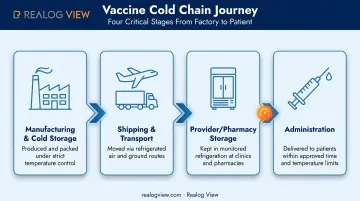
The Four Stages Vaccines Travel Through
Vaccines pass through four distinct stages, each with its own handling demands:
- Manufacturing and cold storage — vaccines are produced and held in temperature-controlled facilities at the plant before they ever ship
- Shipping and transport — doses move by air, sea, or road in refrigerated cargo and specialized containers
- Provider or pharmacy storage — clinics and pharmacies store doses in refrigerators or freezers with daily temperature checks
- Administration — the chain officially ends once the dose is given to the patient
Transport has gotten more creative lately. In 2025, UNICEF completed its first maritime vaccine shipment, moving pneumococcal conjugate vaccine from Belgium to Cote d'Ivoire by sea instead of air.
According to UNICEF, sea freight can cut shipping costs by roughly 50% on average and reduce emissions by up to 90% compared with air transport. Results still depend on route, shelf life, and whether ports have reliable cold chain infrastructure on the other end.
What Keeps the Chain From Breaking
Good equipment alone doesn't prevent failures. It takes a system:
- Trained staff and a designated coordinator who owns the SOPs and performs daily checks
- Purpose-built storage units and temperature monitoring devices, not household fridges pressed into service
- Accurate inventory management, including stock rotation and expiration tracking, so older doses get used first
Skip any one of these, and you're relying on luck.
Vaccine Temperature Requirements and Why They Matter
Not every vaccine plays by the same rules, and getting the range wrong, in either direction, isn't a minor slip.
Standard ranges according to CDC's Vaccine Storage and Handling Toolkit:
| Storage Type | Temperature Range |
|---|---|
| Refrigerator | 2°C to 8°C (35.6°F to 46.4°F) |
| Freezer | -50°C to -15°C (-58°F to 5°F) |
| Ultra-cold freezer | -90°C to -60°C (-130°F to -76°F) |
Individual products often need a narrower band inside these ranges—or the cold extreme of one. Certain single-dose vials of the Comirnaty COVID-19 vaccine require -90°C to -60°C, while the RSV vaccine mResvia can require -40°C to -15°C when frozen. Manufacturer labeling, not general guidelines, dictates the exact range for any given product.
Why potency loss is permanent: Heat denatures the proteins and antigens that trigger an immune response. Freezing can rupture the structure of certain formulations.
WHO research notes hepatitis B vaccine can be destroyed at temperatures as mild as -0.5°C, while DTP, DT, and TT vaccines can be damaged around -5°C to -10°C. Once that damage happens, no amount of correct storage afterward brings the dose back.
A temperature excursion is any deviation outside the approved range, even briefly. When one happens:
- Label the affected doses "DO NOT USE — TEMPERATURE EXCURSION"
- Move them to correct storage conditions immediately
- Isolate them physically from usable stock
- Notify the vaccine coordinator
- Document the time, duration, and temperatures involved
- Contact the manufacturer or immunization program for disposition guidance before discarding anything
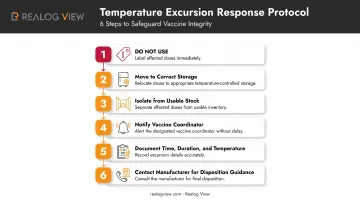
That protocol matters because excursions are common. A 2017 literature review found below-range exposure in 33% of studies from higher-income countries and 37.1% from lower-income countries during storage, with shipment exposure rates of 38% and 19.3% respectively. That's not a rare glitch. It's a persistent operational challenge.
Types of Cold Chain Equipment and Monitoring Systems
Keeping vaccines within range takes layered equipment, from short-term transport gear to facility-grade systems.
Passive equipment handles short trips and last-mile delivery:
- Insulated cold boxes
- Vaccine carriers
- Ice packs and gel packs
Active/mechanical equipment anchors facility storage:
- Pharmaceutical-grade refrigerators and freezers
- Ice-lined refrigerators for areas with intermittent power
- Walk-in cold rooms for high-volume storage
Off-grid solar solutions fill gaps where the electrical grid can't be trusted. In South Sudan, grid electricity reaches only about 8% of the population.
According to UNICEF South Sudan, 91% of the 1,900 vaccine refrigerators delivered over five years were solar powered. A 2024 push alone installed 222 solar refrigerators and 17 deep freezers. Solar isn't a niche backup anymore—in some regions, it's the primary system.
Monitoring Devices That Catch Problems Early
Storage equipment only matters if you know it's actually holding temperature. That's where monitoring comes in:
- Digital data loggers record temperature (and sometimes humidity) continuously and flag excursions as they happen
- Vaccine vial monitors (VVMs) are low-cost, single-use indicators on vials that change color with cumulative heat exposure; useful for spot-checks, but they miss freezing and don't measure potency
This is where FDA 21 CFR Part 11 compliant, software-free data loggers earn their keep. Realog View's TempTrail line, for example, generates automatic PDF and CSV reports through a built-in USB connection—no external software, probes, or IT setup required.
The TempTrail Glacial model covers -85°C to +70°C for cryogenic and dry-ice monitoring. Standard Display models track -30°C to +70°C for routine refrigerated storage. Clinics and shippers get tamper-evident records without adding a compliance headache to an already full plate.
Cold Chain Drugs Beyond Vaccines
Vaccines get most of the attention, but they're far from the only temperature-sensitive product moving through the healthcare supply chain.
Cold chain drugs are any pharmaceuticals or biologics that must stay within a defined temperature range to remain effective. That category includes:
- Insulin — FDA storage range 36°F–46°F (2°C–8°C); up to 28 days at higher temps if refrigeration fails
- Biologics and monoclonal antibodies — including RSV monoclonal products
- Blood products — strict refrigerated or frozen hold requirements in transit
- Certain injectable medications — potency depends on unbroken temperature control
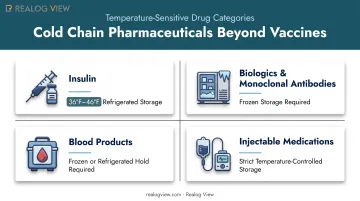
USP General Chapter <1079> treats storage and transport of these products as critical, integrated supply chain functions—not an afterthought bolted onto manufacturing.
The same documentation and monitoring discipline used for vaccines—continuous logging, alarm thresholds, calibrated equipment—applies equally to insulin shipments and monoclonal antibody transport. A logger in a biologics freezer or blood bank cooler does the same job as one in a vaccine shipment.
Best Practices to Prevent Cold Chain Failures
Most cold chain failures aren't dramatic. They're the result of a missed calibration date or an SOP nobody updated in three years.
Written SOPs matter more than people assume. They should cover routine storage, staff training, and emergency transport procedures. They also need to live somewhere staff actually check, not buried in a shared drive nobody opens.
A few habits separate reliable operations from fragile ones:
- Calibrate temperature monitors every 2 to 3 years, or per manufacturer schedule, and keep the certificate on file
- Keep a backup monitoring device on hand for when the primary unit is out for calibration or repair
- Record minimum and maximum temperatures at the start of each workday
- Retain temperature logs for at least 3 years
Emergency preparedness deserves its own line item. Power outages and natural disasters don't wait for convenient timing. That means:
- Having a backup generator or verified alternate storage site
- Confirming the alternate site can actually maintain required temperatures, not just that it exists on paper
- Training staff on excursion protocols before an emergency happens, not during one
None of this requires exotic technology. Consistency, and equipment that does its job without adding friction to a busy day, prevents most failures.
Frequently Asked Questions
What is the cold chain in simple terms?
It's the unbroken sequence of temperature-controlled storage and transport that keeps vaccines potent from manufacturing all the way to administration. Break the chain at any point, and the vaccine's effectiveness can't be guaranteed.
What are the types of cold chains?
Cold chains generally fall into two types: passive (cold boxes and carriers with ice packs) and active (powered refrigerators, freezers, cold rooms, and refrigerated vehicles). Data loggers and vaccine vial monitors support both.
What are cold chain drugs?
Cold chain drugs are temperature-sensitive pharmaceuticals that need controlled storage and transport end to end. Common examples include vaccines, insulin, biologics, monoclonal antibodies, and blood products.
What temperature should vaccines be stored at?
Most vaccines require 2°C to 8°C refrigeration, but some need freezer or ultra-cold storage per manufacturer guidance, ranging as low as -90°C for certain formulations.
What happens if the vaccine cold chain is broken?
A broken cold chain can permanently reduce or destroy vaccine potency. Affected doses typically must be discarded, and in some cases, patients may need to be revaccinated.
How is the vaccine cold chain monitored?
Facilities use digital data loggers with buffered probes to record temperatures continuously and flag excursions, plus vaccine vial monitors for quick spot-checks at the point of use.