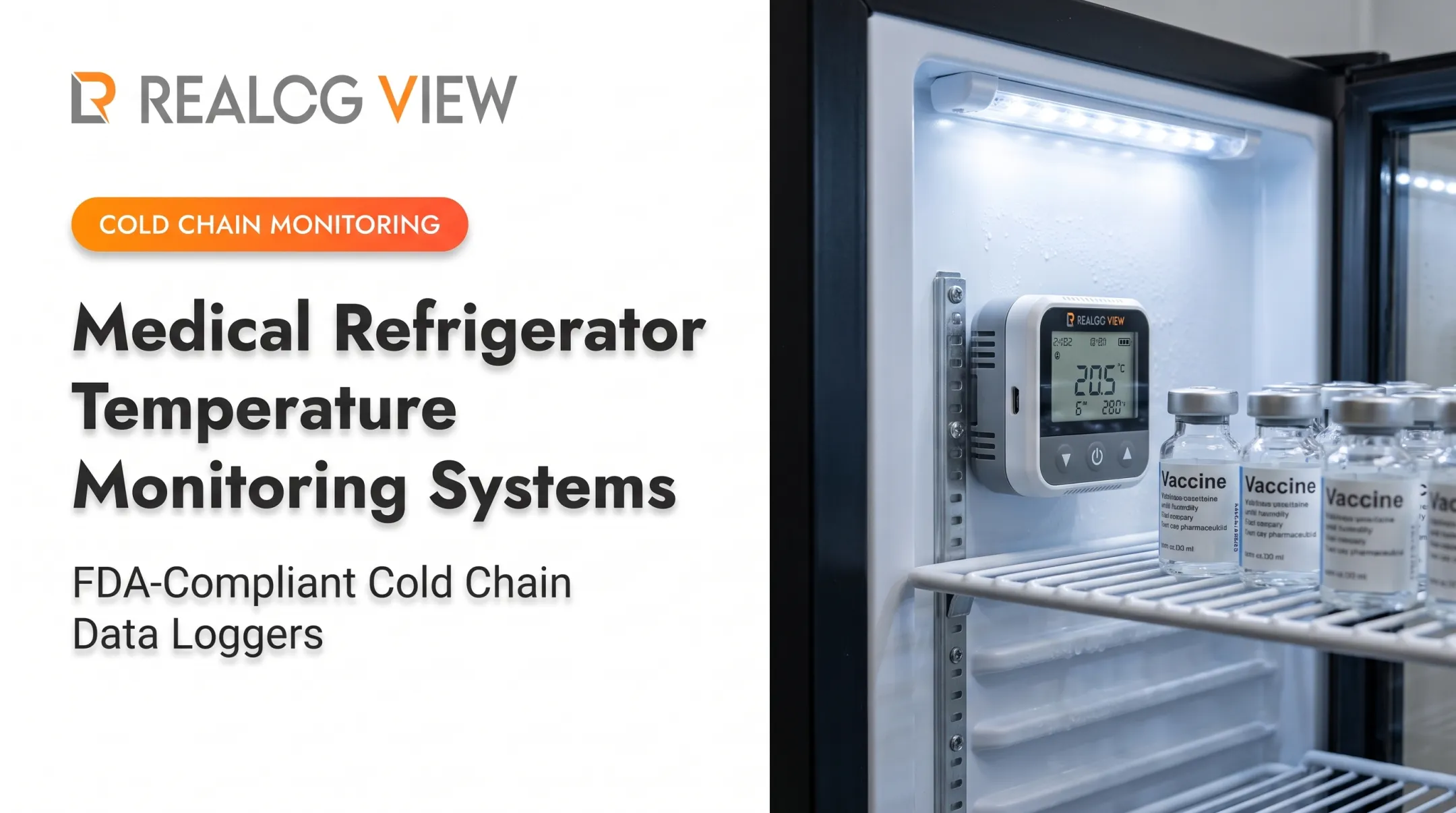
Many pharmacies struggle with this exact problem. A door left open ten seconds too long, a shelf packed too tightly, a compressor quietly aging past its prime — any of these can silently degrade a drug's efficacy long before anyone notices a visual sign. There's no warning label that appears on a vaccine vial when it loses potency.
This article covers the exact recommended range for pharmacy refrigerators, why a safety margin exists around that range, what actually causes real-world temperature fluctuations, and how to monitor and validate performance in a way that holds up during an inspection.
Key Takeaways
- Pharmacy refrigerators must stay within 2°C to 8°C (36°F to 46°F), per USP General Chapter 659 and CDC guidance
- Set units to a mid-range point of 5°C (41°F) to buffer against short-term fluctuations
- Door openings, overcrowding, and power interruptions cause most real-world excursions
- Continuous digital logging catches far more excursions than twice-daily manual checks
Understanding Why Temperature Control Matters in Pharmacy Refrigeration
Temperature is a preservation parameter that directly controls the rate at which active pharmaceutical ingredients and biologics chemically or biologically degrade. Move a vaccine outside its intended range, and the degradation clock starts ticking, whether or not anyone catches it in time.
That's why regulators treat refrigerator temperature as an actively regulated operating variable, governed by the FDA, USP General Chapter 659, and CDC storage guidance, and enforced through pharmacy standard operating procedures.
Staff are required to document readings, not just glance at a dial. Automated data loggers with FDA 21 CFR Part 11 compliant reporting can simplify that documentation requirement.
Cold Chain Context
The "cold chain" is the unbroken sequence of temperature-controlled storage and transport a drug passes through, from manufacturer to patient. A pharmacy refrigerator is just one link in that chain.
Pharmacy-grade refrigeration units differ from household fridges in ways that matter for compliance:
- Forced-air circulation keeps temperature uniform throughout the entire cabinet
- Glass doors allow staff to check inventory without opening the unit
- Lockable access restricts who can adjust settings or remove stock
- Faster recovery restores set temperature quickly after door openings, unlike a standard kitchen-style fridge
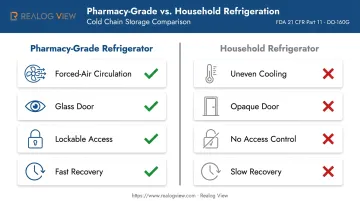
A household fridge simply wasn't engineered to hold a narrow range under frequent door traffic. That distinction matters more than most pharmacies realize until an inspection flags it.
The Recommended Temperature Range for Pharmacy Refrigerators
The 2°C to 8°C range didn't come from convention. It's defined by regulatory guidance and, more specifically, by drug manufacturer stability data submitted to the FDA.
Nominal Operating Range
For most refrigerated medications and vaccines, the standard is 2°C to 8°C (36°F to 46°F), as specified in USP <659> and current CDC vaccine storage guidance.
Freezer requirements vary more than many pharmacies assume:
| Storage Type | Range (°C) | Range (°F) | Source |
|---|---|---|---|
| Refrigerator | 2 to 8 | 36 to 46 | USP <659>, CDC |
| General vaccine freezer | -50 to -15 | -58 to +5 | CDC |
| USP freezer definition | -25 to -10 | -13 to 14 | USP <659> |
| Ultra-cold freezer | -90 to -60 | -130 to -76 | CDC (specific vaccines) |
Notice the freezer numbers don't fully align between CDC and USP. That's intentional. Manufacturer labeling always takes precedence over any general category, so check the package insert for the exact product before assuming a "typical" freezer range applies.
Allowable Tolerance and the Logic of the 5°C Setpoint
Facilities are generally advised to set the thermostat near the middle of the range, around 5°C (41°F), rather than at either boundary. The CDC's vaccine storage and handling guidance recommends this midpoint to reduce excursion risk.
Here's the logic: a unit sitting at 3°C has almost no room to absorb a brief spike before crossing 2°C on the low side. A unit sitting at 5°C has an equal buffer in both directions.
Every door opening, defrost cycle, or restocking event pulls temperature toward one boundary or the other. Starting from the center gives the compressor more time to recover before a limit is breached.
Safe Operating Margin and Short-Term Excursions
A brief, documented excursion outside 2–8°C isn't automatic grounds for discarding stock. But it isn't automatically fine either.
The CDC's temperature excursion guidance defines an excursion as any reading outside the manufacturer's labeled range, and it does not supply a universal "safe" duration. Instead, the response sequence is:
- Label affected stock "DO NOT USE" and separate it from usable inventory
- Document the date, time, temperature readings, and excursion duration
- Correct the storage condition if possible
- Contact the manufacturer or immunization program for a viability determination
- Finalize documentation once the disposition is decided
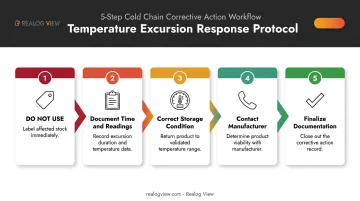
Continuous digital temperature logs make step two far more defensible than a handwritten note. A data logger with automatic PDF or CSV reporting timestamps every reading, so the excursion duration is never in question.
Skip that documentation step, and you've lost the evidence needed to make a defensible call later.
Factors That Cause Temperature Fluctuations in Real-World Pharmacy Operation
Lab-rated performance and day-to-day pharmacy conditions are two different things. A unit that holds steady in a manufacturer's test chamber can behave very differently once it's stocked, opened forty times a day, and sitting next to a heat-generating piece of equipment.
Design and load factors:
- Overcrowding restricts airflow, creating hot and cold pockets inside the cabinet
- Central-shelf placement, away from vents, walls, and the compressor coil, improves stability
Operational factors:
- Frequent door openings are the fastest, most common cause of temperature spikes
- Storing stock in door bins or compartments exposes it to the widest swings
Environmental and equipment factors:
- Ambient room temperature and HVAC failures can push a unit outside range for hours
- Power outages remove active cooling entirely, sometimes without staff noticing immediately
- Door seal degradation, frost build-up, and an aging compressor gradually reduce a unit's ability to hold setpoint
A dedicated, stand-alone pharmacy refrigerator is built to recover quickly after these disruptions. A home-style fridge/freezer combo, by contrast, is prone to fluctuation because it wasn't designed for constant traffic.
Continuous monitoring with a temperature data logger closes that detection gap, time-stamping every excursion the moment it happens rather than waiting for a manual spot-check. If your pharmacy is still running on a converted household unit, that alone is worth flagging to management.
How to Monitor, Measure, and Validate Pharmacy Refrigerator Temperature
Temperature monitoring is both a daily operational task and a documented compliance requirement. Regulators expect proof, not assurances.
Specification and Documentation Requirements
CDC guidance calls for readings at least every 30 minutes via continuous monitoring, plus a min/max check logged at the start of each workday. Sensors used for this should carry a recommended accuracy of ±0.5°C (±1°F) at calibration testing. A device that can't meet that at calibration should be replaced, not patched.
Manual vs. Digital Monitoring Methods
Manual checks, where staff read a min/max thermometer twice a day, have real limitations. Between readings, an excursion can happen and fully resolve without anyone knowing it occurred.
A 2020 simulation study published in PMC found that twice-daily current-temperature readings alone detected only 4.7% to 6.8% of simulated excursions. Adding a once-daily min/max review raised detection to a range of 27.5% to 96.3%, but no non-continuous method caught everything.
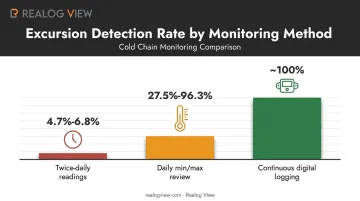
Digital, automated monitoring closes that gap with continuous logging, real-time alarms, and a tamper-resistant data trail. This is where Realog View's TempTrail™ line fits into pharmacy workflows:
- ±0.2°C accuracy with 0.1°C resolution across the standard -30°C to +70°C range
- Single-use models (TempTrail™ XL, TempTrail™ Display – S) ship with alarms pre-configured at <2°C and >8°C, matching the pharmaceutical cold chain standard
- Multi-use models, such as the TempTrail™ Display – M, allow user-configurable alarm thresholds and logging intervals for ongoing facility use
- Reports generate automatically as FDA 21 CFR Part 11-compliant PDF and CSV files upon USB connection, no external software needed
- IP67/IP68 waterproof ratings protect the internal electronics against the condensation that's common inside a refrigerated unit
One caveat: a sensor's rated accuracy in lab conditions can shift once it's installed inside a loaded, frequently opened refrigerator. Placement matters, so periodically verify that calibration holds up under actual working conditions rather than assuming the spec sheet number always applies.
Risks of Temperature Excursions and Common Pitfalls to Avoid
The chain of cause and effect here is direct: temperature deviation leads to degraded active ingredients, which leads to reduced potency, altered physical composition, and a shortened effective shelf life. None of that reverses itself once the exposure has happened.
The compliance side carries its own weight. A 2003 CDC review estimated that 17% to 37% of providers exposed vaccines to improper storage temperatures at some point, with refrigerators more often running too cold than too warm. Repeated or undocumented excursions can trigger regulatory findings, complicate insurance claims, and force mandatory disposal of otherwise usable stock.
Common Misinterpretations in Practice
A few mistakes show up again and again:
- Treating 2°C and 8°C as rigid pass/fail cutoffs. In reality, they define a range paired with a documented excursion-response policy, not a hard binary.
- Assuming a unit that "looks fine" is stable. A refrigerator can appear normal on a spot check while still showing poor recovery time after door openings or restocking, something only continuous data reveals.
- Relying on manual spot checks alone. Daily readings can miss brief excursions during door openings or power blips that a continuous temperature data logger would catch automatically.
Conclusion
Pharmacy refrigerator temperature is an actively governed compliance parameter that demands ongoing attention. The nominal range, the tolerance built into a 5°C setpoint, and the safety margin against brief excursions each protect patients and pharmacy operations from costly mistakes.
Continuous monitoring closes the gap between understanding these parameters and catching problems as they happen. Data loggers built for pharmaceutical cold chain use, like Realog View's FDA-compliant models, turn that understanding into consistent protection and cut risk considerably.
Frequently Asked Questions
What temperature should a pharmacy fridge be at?
Pharmacy refrigerators should maintain 2°C to 8°C (36°F to 46°F). Most facilities set the thermostat near the midpoint, around 5°C (41°F), to create a buffer against brief fluctuations.
What is the FDA temperature for a refrigerator?
FDA-aligned guidance, reflected in USP <659> and CDC standards, specifies 2°C to 8°C for refrigerated pharmaceuticals. Manufacturer labeling always takes precedence for specific products.
What temperature should a pharmacy freezer be at?
CDC's general vaccine freezer range is -50°C to -15°C, while USP defines a freezer as -25°C to -10°C. Some vaccines require ultra-low storage down to -90°C, so always check the product label.
How often should pharmacy refrigerator temperatures be checked?
At minimum, perform twice-daily manual checks with min/max readings. Automated data loggers add continuous monitoring on top of that, catching excursions that occur between manual checks.
What is the ideal setpoint temperature for a pharmacy fridge?
Setting the thermostat to 5°C (41°F) centers the unit within the 2–8°C range, but the setpoint alone doesn't guarantee compliance. Ongoing logging confirms the fridge actually holds that temperature day to day.
What should you do if a pharmacy fridge temperature goes out of range?
Document the excursion's duration and severity, separate the affected stock, and contact the manufacturer or a pharmacist reference for a stability determination before returning any product to use.