Introduction
A vaccine shipment sits in a warehouse corner for six hours during a summer heatwave. Nobody notices until the delivery truck arrives. Pharmaceutical warehouse managers know this scenario well, and it happens more often than most companies admit.
Vaccines, insulin, and biologics don't forgive temperature swings. The CDC warns that failure to maintain recommended storage conditions can destroy vaccine potency, sometimes with no visible sign of damage until a patient doesn't develop immunity (CDC, 2024). Insulin behaves the same way — frozen insulin is simply unusable.
Temperature monitoring in these facilities is mandated under GDP, GMP, FDA regulations, and USP <1079>. This guide covers the tools you need, three practical monitoring methods, how to read the data, and the mistakes that trigger audit findings.
Key Takeaways
- Confirm validated storage ranges with a mapping study before permanent monitoring starts
- Match logger type—standalone to wireless IoT—to your budget, precision, and scale needs
- Reading status (normal, minor deviation, or out-of-spec) drives product disposition decisions
- Poor sensor placement and weak documentation drive most compliance findings
- Tamper-proof, 21 CFR Part 11 compliant loggers with automatic reporting simplify audit readiness
What You Need for Pharmaceutical Warehouse Temperature Monitoring
Before a single sensor goes on a wall, you need the right equipment and a clear picture of your facility's monitoring points. Skipping this step is how warehouses end up with data that doesn't hold up during an audit.
Tools and Equipment Required
Your monitoring toolkit should include:
- Calibrated digital data loggers with PDF/CSV export for standalone, software-free recording
- Wireless IoT sensors/transmitters for continuous monitoring with automated alerts
- Backup analog thermometers or chart recorders as secondary verification during system downtime
- Zone-level loggers or sensors so larger warehouses can cover each distinct storage area
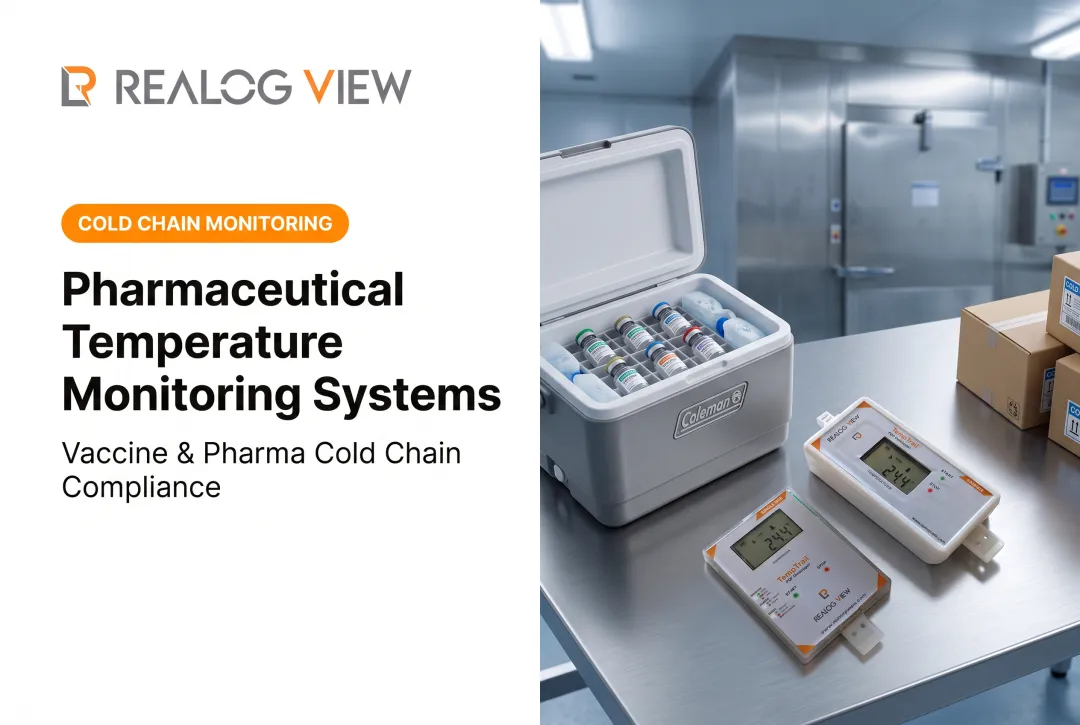
Realog View's TempTrail Humidity & Display loggers are one fit for this role. They cover −30°C to +70°C and 0–100% RH, and store up to 32,000 combined readings. USB export generates PDF and CSV reports with no external software, so staff can pull compliance-ready files without installing anything on a laptop.

Preconditions and Setup Requirements
Four things need to happen before sensors go live:
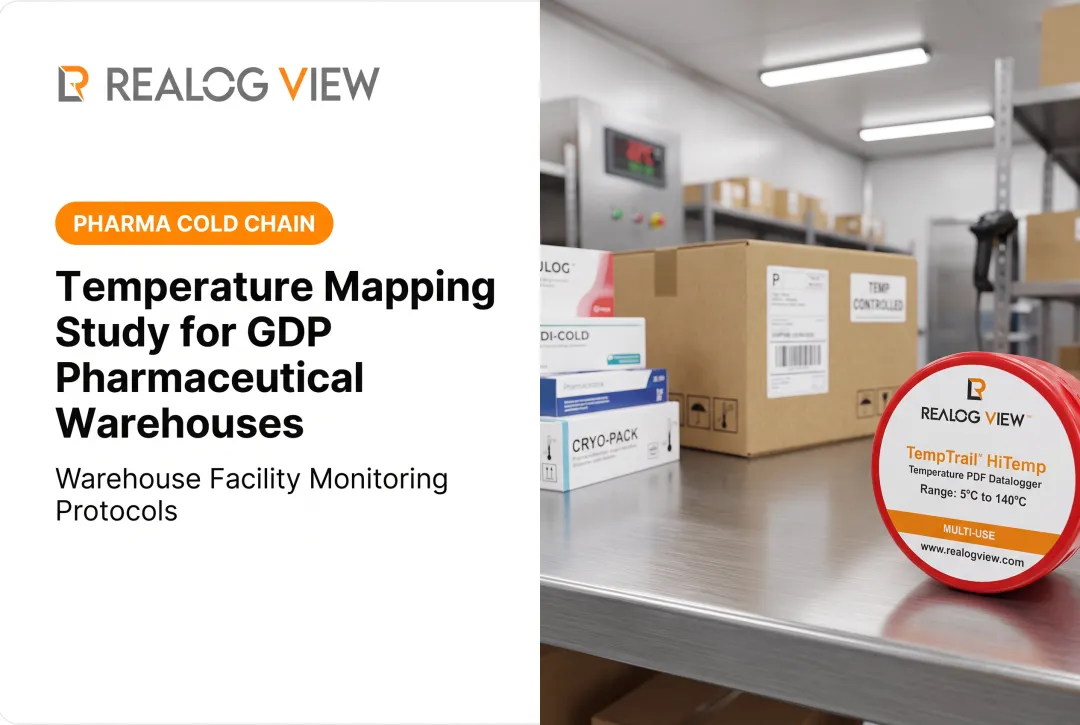
- Complete a temperature mapping study. Map hot and cold spots on a 3D grid per WHO cold room mapping guidance—fixed sensors at corners and vertical levels, continuous monitoring for at least 48 hours.
- Secure calibration documentation. Every sensor needs traceable calibration evidence before it goes into service. Request model-specific certificates from your vendor; Realog View's technical team provides this paperwork on request.
- Define power and connectivity. Battery-operated standalone loggers work fine for spot zones; WiFi or cellular sensors make sense where real-time transmission matters.
- Confirm visibility at retrieval points. LCD-equipped loggers let staff do a quick spot-check without a computer — useful for routine walk-throughs.
Methods to Monitor Temperature in a Pharmaceutical Warehouse
Not every warehouse needs the same setup. The right method depends on required precision, budget, and how much regulatory scrutiny the facility faces.
Method 1: Standalone/Manual Data Loggers
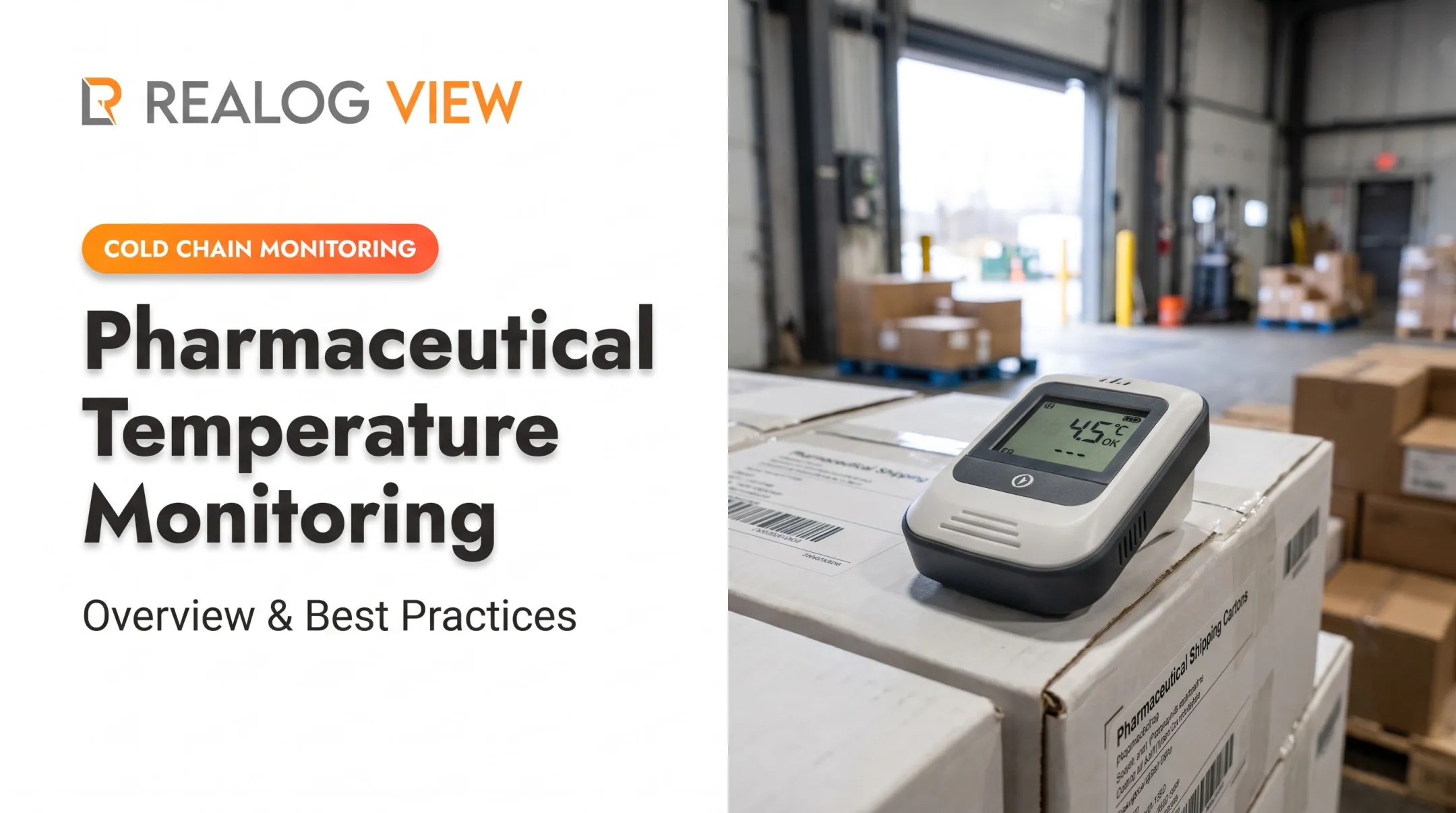
Battery-powered loggers sit at validated mapping points, recording temperature and humidity internally until someone retrieves them.
What you need: A calibrated logger with PDF/CSV output capability.
Setup steps:
- Program alarm thresholds, logging intervals, and units before deployment
- Install the logger at a previously validated mapping point
- Retrieve and export the report at defined review intervals
Pros: Cost-effective, simple, no external software required. Cons: No real-time alerts; depends on someone physically checking the device.
Method 2: Wireless/IoT Continuous Monitoring
Sensors transmit live readings to a centralized dashboard, giving instant visibility across one facility or multiple sites.
What you need: Wireless transmitters, a gateway or router, and cloud-based monitoring software.
Setup steps:
- Install sensors at critical points identified during mapping
- Configure alarm thresholds and escalation rules on the platform
- Monitor the live dashboard and respond to deviation alerts immediately
Pros: Instant alerts, remote access. Cons: Higher upfront cost; depends on network uptime.
Method 3: Temperature Mapping-Based Validation
This is a temporary deployment of multiple loggers to find variability before locking in permanent sensor placement.
What you need: Multiple calibrated loggers plus mapping analysis software.
Setup steps:
- Deploy loggers in a grid pattern covering doors, HVAC vents, and storage zones
- Record data across a full seasonal or operational cycle
- Analyze results to finalize permanent sensor locations and thresholds
Pros: Most accurate, risk-based placement, and what regulators expect to see. Cons: Time-intensive; needs periodic re-mapping.
WHO cites every three years as a reasonable re-mapping interval, or sooner if monitoring shows unexplained variability.
Multi-use loggers from Realog View fit this method well. They can be reconfigured and redeployed across multiple mapping cycles instead of being discarded after one use.

How to Interpret Warehouse Temperature Monitoring Results
A reading is only useful if you know what to do with it. Misreading the data risks product safety, triggers regulatory findings, or causes unnecessary product loss.
Normal/Acceptable: Readings stay within the validated label range. USP storage ranges are:
- Refrigerated: +2°C to +8°C
- Freezer: −25°C to −10°C
- Controlled room temperature (CRT): +20°C to +25°C
Staying within range means routine monitoring continues as scheduled.
Minor Deviations: USP <659> permits CRT excursions between +15°C and +30°C, with brief spikes up to +40°C tolerated for no more than 24 hours. These excursions should be:
- Logged with timestamps
- Assessed using mean kinetic temperature (MKT) to capture cumulative thermal stress, not a single peak
- Documented even though no immediate product risk exists
Out-of-Spec Excursions: Readings that exceed tolerance for an extended period require:
- Immediate product quarantine
- A formal investigation into cause and duration
- Corrective and Preventive Action (CAPA) documentation
- Potential regulatory reporting
FDA requires an NDA/ANDA Field Alert Report within 3 working days if a distributed batch fails to meet application specifications.
Treat each excursion in proportion to its severity. MKT exists so disposition decisions rest on cumulative thermal stress, not a single bad data point.
Common Errors and Best Practices for Compliance
Most audit findings trace back to a small set of preventable mistakes, not exotic regulatory gaps.
Common Pitfalls
- Convenient placement instead of mapped placement: Sensors sit where install is easy, not where mapping found hot or cold spots.
- Skipped or undocumented calibration: No traceable calibration record linked to the specific sensor.
- Over-sensitive alarm thresholds: Constant false alarms train staff to ignore real deviations.
EMA's GDP inspection report template flags uncalibrated probes and irregular record reviews as recurring findings. That is a clear cue to verify both before an auditor does it for you.
Regulatory Compliance Best Practices
- Anchor the program to GDP, GMP, and USP <1079>: Place monitors only after a completed mapping study, per EU GDP guidelines.
- Maintain electronic audit trails: Use time-stamped, access-controlled records that meet 21 CFR Part 11 expectations for secure, reconstructable data.
- Review data on a risk-based cadence: Set review frequency from product risk and process knowledge, then tune alarm thresholds as patterns emerge.
- Use tamper-proof, sealed loggers with automatic reporting: Automatic PDF/CSV output removes a manual step staff often skip on busy shifts. Realog View's IP67/IP68, FDA 21 CFR Part 11 compliant loggers are built for that workflow.

Conclusion
Accurate, well-placed temperature monitoring keeps a warehouse compliant and product integrity intact. Get there by combining three things: the right tools, a validated method matched to your facility's risk level, and correct interpretation of every reading.
None of this works as a one-time project. Consistent documentation, paired with equipment built for traceability, is what keeps monitoring reliable enough to protect patients over the long term.
Frequently Asked Questions
What is a pharmaceutical temperature monitoring system?
A pharmaceutical temperature monitoring system is a network of calibrated sensors and data loggers that continuously track and document temperature conditions during storage and transit. The goal is protecting product efficacy while creating a documented compliance trail.
What are the FDA requirements for temperature monitoring?
FDA's Q7A guidance expects appropriately controlled storage conditions, qualified and monitored equipment, scheduled calibration with retained records, and documented action when limits are exceeded. Records must meet 21 CFR Part 11 security standards.
What are the ISPE guidelines for temperature mapping in pharmaceutical storage?
ISPE recommends risk-based mapping before permanent monitoring begins, accounting for seasonal variability and HVAC performance. Sensors should be placed where product experiences maximum and minimum temperature and humidity extremes.
What temperature range should a pharmaceutical warehouse maintain?
Common USP ranges are +20°C to +25°C for controlled room temperature, +2°C to +8°C for refrigerated storage, and −25°C to −10°C for freezer storage. Always defer to the specific product's label requirements first.
How often should warehouse temperature monitoring data be reviewed?
FDA doesn't mandate a universal interval. Review frequency should be based on product risk and process knowledge. Many warehouses default to monthly or quarterly reviews, using trends to refine alarms and sensor placement.
What should be done if a temperature excursion occurs in the warehouse?
Quarantine the affected product immediately, then investigate using the time/temperature data and MKT calculations. Document corrective actions through CAPA and notify quality assurance for a final disposition decision.