Yet florists, growers, and even home gardeners routinely lose flowers to preventable temperature mistakes: a bucket left in a warm back room, water that's the wrong temperature for the bloom, seedlings planted two weeks too early. This guide breaks down the science behind why temperature matters so much, gives you flower-specific benchmarks for storage and water, and covers how to track temperature accurately from farm to vase.
Key Takeaways
- Cut flower respiration roughly doubles to quadruples for every 15-20°F rise in temperature, directly shortening vase life
- Most cut flowers store best between 33°F-40°F; tropical varieties need 50°F+ to avoid chilling injury
- Water temperature should match flower type, not a one-size-fits-all rule
- Continuous monitoring catches damaging temperature swings that spot-checks miss entirely
Why Temperature Directly Impacts Flower Freshness and Longevity
Cut flowers don't stop living the moment they're harvested. They keep respiring, pulling in oxygen and releasing carbon dioxide and heat, and that ongoing metabolic activity is the main engine of aging.
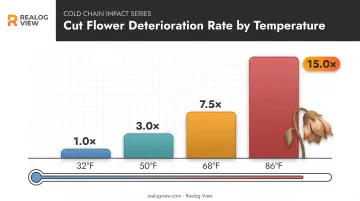
The relationship between temperature and deterioration isn't subtle. According to USDA's Agriculture Handbook 66, the relative deterioration rate climbs from 1.0 at 32°F to 3.0 at 50°F, 7.5 at 68°F, and 15.0 at 86°F. In practical terms, a flower held at room temperature can age more than seven times faster than one kept near freezing.
Respiration and Heat Buildup
Respiration generates measurable heat. Sealed boxes and poorly ventilated storage trap that heat, which accelerates carbohydrate depletion and speeds up wilting.
Research on carnations found respiratory heat output jumps from 89 BTU per ton per hour at 32°F to 14,718 BTU per ton per hour at 122°F, a difference of more than 150 times. Even smaller temperature swings inside a shipping box compound quickly when hundreds of stems are packed together.
Ethylene Gas Sensitivity and Temperature
Ethylene is a natural plant hormone, but in excess it causes petal drop, premature aging, and bud failure. Warmer temperatures make flowers far more vulnerable to it, lowering the concentration needed to cause damage.
Roses are particularly sensitive. UC Extension research found visible injury, including failed bud opening and petal drop, after just one day of exposure to ethylene concentrations as low as 20 parts per billion. Carnations and delphiniums show similar vulnerability, though exact thresholds shift with cultivar and exposure time.
Alongside temperature control, florists limit ethylene damage by:
- Pulsing stems with silver thiosulfate solutions before shipping
- Using ethylene-absorbing sachets or gas-based inhibitors in storage
- Keeping flowers in dedicated floral coolers, away from ripening fruit
- Minimizing exposure to vehicle exhaust and cigarette smoke during transit
Transpiration and Humidity Balance
Transpiration, water loss through the tiny pores on petals and leaves, speeds up as temperature rises. Left unchecked, it causes wilting even when the stem has plenty of water available at the base.
The fix is humidity, not just cold air. Commercial cold storage typically targets 90-95% relative humidity, which slows water loss from the flower's surface while still allowing normal uptake through the stem. Too little humidity dries flowers out; too much invites fungal growth.
Ideal Storage Temperatures for Cut Flowers by Type
There's no single "correct" cooler temperature for every flower. Most cut flowers store best between 33°F and 37°F, with atmospheric temperature never exceeding 40°F. Tropical and chilling-sensitive varieties are the exception. They need to stay above 50°F, or they'll suffer permanent tissue damage.
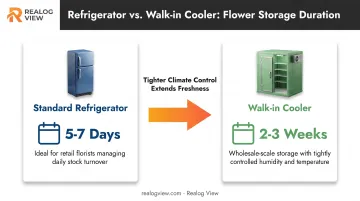
Storage duration also depends on setup. Standard refrigerator storage works for 5–7 days, which is common for retail florists managing daily stock. Walk-in cooler storage at wholesale operations can keep flowers fresh for 2–3 weeks when humidity and temperature stay tightly controlled.
Flower-Specific Storage Temperature Chart
| Flower Type | Storage Temperature | Notes |
|---|---|---|
| Roses | 32-34°F | Store dry, upright; up to 2 weeks near freezing |
| Tulips | 32-34°F | 85% RH, bulbs attached, upright storage |
| Carnations | 32-34°F | Open blooms last 2-4 weeks; bud-cut stems last longer |
| Lilies | 32-34°F | Up to 4 weeks with proper pretreatment; watch for leaf yellowing |
| Orchids | 32-55°F (varies) | Cymbidium and Phalaenopsis are highly ethylene-sensitive |
| Tropicals (anthurium, ginger, bird-of-paradise) | 50°F+ | Chilling injury risk below this range |
Why Consistent Atmospheric Temperature Matters
A cooler set to 34°F doesn't guarantee every flower box inside stays at 34°F. When the surrounding air temperature doesn't closely match the temperature inside packed boxes, you get condensation, uneven cooling, and localized heat pockets. Those conditions accelerate spoilage.
Short lapses seem harmless in isolation. But they compound. A cooler that drifts a few degrees warm for two hours during a busy delivery window can knock days off vase life. Wholesale operations should rely on continuous tracking rather than periodic spot-checks with a handheld thermometer.
Water Temperature for Flowers in a Vase: Cold vs. Lukewarm
So, is cold water better for flowers? It depends entirely on what you're arranging.
Cold water (roughly 50-59°F from the tap) slows bacterial growth and metabolic activity. It suits hardy, long-stemmed flowers such as:
- Tulips
- Daffodils
- Anemones
Lukewarm water (roughly 68-86°F) helps open stem pores for faster water absorption, which reduces shock after cutting. It works better for thirsty or delicate blooms like:
- Roses
- Hydrangeas
- Peonies
Stems that dried out in extended cold storage are a special case. A brief soak in colder water can help restore hydration by releasing trapped air in the stem.
Match water temperature to the flower type rather than one blanket rule. Always re-cut stems before placing them in fresh water.
Best Temperature to Plant Flowers Outdoors
Timing matters as much for garden flowers as it does for cut stems in a cooler. Match planting to soil temperature—not just the calendar:
- Tender annuals and perennials: Wait until after the last frost, when soil reaches roughly 60-70°F
- Cold-hardy types (pansies, snapdragons, many bulbs): Can go in earlier, around 40-50°F
A soil thermometer pushed to actual planting depth gives a far more reliable reading than air temperature alone.
A warm, sunny afternoon doesn't mean the danger has passed. Nighttime lows below 50°F can still cause frost damage to tender seedlings, even when daytime highs feel like summer. Wait for stable overnight temperatures before you plant.
Maintaining Precise Temperature Control From Farm to Vase
The floral supply chain runs through several temperature-sensitive checkpoints: farm cooling, packing, refrigerated transport, wholesale cold storage, and retail display. A lapse at any single stage compounds respiration and ethylene damage further down the line.
The scale of this problem is documented. An industry cold-chain study found flowers from 58 growers arrived averaging 51°F, well above the target range, and every grower's average temperature exceeded 43°F.
That same FTD cold-chain white paper measured the downstream effect: roses held five days at 32°F retained 11.5 days of vase life, while roses held five days at 50°F retained just 7.0 days, a 39% reduction.
That kind of damage is invisible at the receiving dock. It only shows up later, as flowers that wilt days earlier than expected. A handheld thermometer spot-check simply can't catch a warm patch that happened three hours into a truck ride.
Why Continuous Data Logging Matters for the Floral Cold Chain
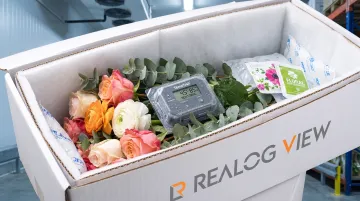
Pharmaceutical and vaccine logistics solved this problem years ago by placing temperature and humidity data loggers directly inside shipping containers, coolers, and trucks. The same approach applies directly to floral cold chains.
Realog View's TempTrail line supports continuous monitoring across floral routes:
- TempTrail Classic (single-use): up to 11,000 data points, -30°C to +70°C, automatic USB PDF report with no software install—suited to shorter floral shipments
- TempTrail XL: 32,000 data points and up to 220 days of logging for longer wholesale routes or international shipments
- TempTrail Humidity & Display: temperature plus 0–100% RH (±2% accuracy), covering the 90–95% RH flowers need in cold storage, with an LCD for quick warehouse checks
Every TempTrail model shares features that matter for floral QA:
- FDA 21 CFR Part 11 compliant reporting for tamper-proof, traceable records
- User-configurable alarms that flag excursions in real time
- IP67/IP68 sealed housings built for humid coolers and wet transport
- Operating ranges that cover standard floral cooler and transit conditions
For wholesalers dealing with quality disputes or insurance claims after a damaged shipment arrives, a time-stamped PDF report showing exactly when and where a temperature excursion happened is far stronger evidence than a memory of "it felt warm in the truck."
Frequently Asked Questions
Is cold water better for flowers?
It depends on the flower. Cold water suits hardy, long-stemmed varieties like tulips and daffodils, while lukewarm water works better for thirsty, delicate blooms such as roses and hydrangeas.
What is the ideal temperature to plant flowers?
Most flowers should go in once soil temperature reaches 60-70°F after the last frost. Cold-hardy varieties like pansies and snapdragons tolerate soil as cool as 40-50°F.
What is the 3:5:8 rule for flowers?
It's a Fibonacci-inspired floral design guideline where stems are grouped and arranged in proportional height ratios, such as 3:5:8 units, to create a visually balanced, naturally pleasing arrangement.
What temperature should cut flowers be stored at for maximum freshness?
Most cut flowers do best between 33°F and 37°F, with room temperature kept below 40°F. Tropical varieties need 50°F or warmer to avoid chilling injury.
How can florists and wholesalers monitor temperature during flower shipping?
Continuous-recording temperature and humidity data loggers placed inside shipping boxes or coolers give a full transit record. Software-free PDF-based loggers make it easy to verify cold chain compliance without extra tools.
Can flowers be damaged by storing them too cold?
Yes. Temperatures near or below freezing can cause chilling injury or tissue damage, especially in tropical species. Storage ranges need to match the specific flower type, not a single default setting.