Introduction
A truck full of day-old chicks needs warmth. A pallet of shell eggs needs the opposite. Both are "poultry," and both can fail a shipment if temperature drifts even a few degrees for too long.
Temperature monitoring for poultry transportation means continuously tracking temperature (and often humidity) of live birds, eggs, or processed poultry products throughout transit to keep them within a safe, product-specific range.
Hatcheries, live-haul carriers, processors, distributors, and QA teams all depend on it. Food safety, animal welfare, and regulatory compliance hinge on staying in range.
USDA attributes more than 23% of foodborne Salmonella illnesses to chicken and turkey, according to FSIS data. Yet most guides treat temperature monitoring as a checkbox rather than an operational process. This one explains how it actually works.
Key Takeaways
- Poultry temperature needs vary by product: chicks need 30-33°C; eggs and meat need 1-4°C or lower
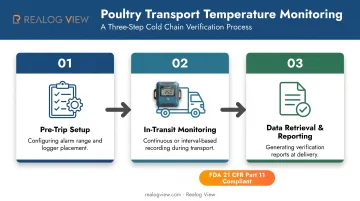
- Treat monitoring as a full cycle: setup, in-transit recording, and post-trip reporting
- HACCP and emerging FSMA 204 traceability rules make documented records a compliance necessity
- Logger placement, durability, and reporting method matter as much as the monitoring itself
What Is Temperature Monitoring for Poultry Transportation?
Temperature monitoring for poultry transportation means placing sensors or data loggers inside a transport vehicle or container to record temperature continuously from pickup to delivery. Some setups also track humidity, since that affects both egg quality and chick comfort.
The goal is simple: verifiable proof that a shipment stayed within a safe range the entire trip, not just at the loading dock and again at delivery. That record protects product quality, food safety, and live-bird welfare outcomes.
Poultry transport is unusual within cold chain logistics because it spans opposite temperature needs in the same industry. A refrigerated meat truck and a live-haul chick trailer share almost nothing in common temperature-wise, yet both fall under "poultry transport monitoring."
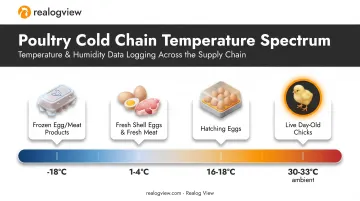
Temperature Requirements Vary by Poultry Product Type
Each poultry product category has its own accepted range, and mixing them up isn't a minor error: it can spoil a load or kill birds.
| Product Type | Target Range | Key Detail |
|---|---|---|
| Fresh shell eggs | 1-4°C (34-40°F) | US federal ceiling is 45°F (7.2°C); USDA consumer guidance recommends ≤40°F |
| Frozen/iced egg products | -18°C (0°F) or lower | Prevents thawing and preserves long-term shelf stability |
| Hatching/breeding eggs | 16-18°C (commonly used industry range) | Aviagen guidance calls for cooling below 24°C within four hours of collection |
| Day-old chicks (live haul) | 30-33°C ambient near chicks | EFSA notes a comfort zone around 30-35°C; below 30°C raises cold-stress risk |
| Fresh poultry meat | 0-4°C (32-39°F) | EU rule requires ≤4°C before and during transport |
| Frozen poultry meat | -18°C or lower | Matches EU quick-frozen food standards |
Notice how chicks sit at the opposite end of the spectrum from everything else on this list. That single fact drives most of the equipment and process decisions covered later in this guide.
Why Temperature Monitoring Is Critical in Poultry Transportation
Poultry is one of the most perishable proteins in the food supply chain. Bacteria like Salmonella and Campylobacter multiply fast once temperature climbs out of a safe zone. EFSA links broiler meat handling to 20-30% of human campylobacteriosis cases. Refrigeration failures during transport are direct food safety events, not minor paperwork issues.
For live-haul, the stakes shift to welfare and performance. Chicks are highly sensitive to temperature stress:
- EFSA cites a baseline commercial mortality rate of 0.055%, with investigation triggered above 0.1%
- Exposure to 38°C and 75% relative humidity pushed mortality above 6% in EFSA-reviewed data
- Aviagen research found chicks in cool environments suffered 2.7 times the losses of comfortable chicks; warm environments produced 1.5 times the losses
Beyond biology, regulation tightens the requirement further. HACCP plans under 9 CFR Part 417 require documented monitoring at critical control points. FSMA 204 adds traceability recordkeeping for shell eggs on the Food Traceability List, effective July 2028, according to FDA guidance.
Without monitoring, problems surface too late. A reefer that fails two hours into a six-hour trip won't show up until the truck arrives. By then, the entire load may need rejection. The industry is moving from manual paperwork checks toward continuous, sensor-based monitoring that flags issues before delivery, not after.
How Temperature Monitoring Works (Conceptual Flow)
The process itself isn't complicated. Teams place loggers at set points inside the transport unit, configure them for the product being shipped, and leave them to record from pickup through delivery.
Three inputs drive the outcome: the product itself (live birds vs. packaged eggs or meat), the vehicle environment, and the logging device positioned to capture representative readings. The device compares readings against pre-set thresholds (for example, 30-33°C for chicks or 1-4°C for eggs) and flags anything outside that band.
Step 1: Pre-Trip Setup
Before departure, loggers are configured for the product being shipped. Teams set the alarm range, recording interval, and measurement unit (°C or °F), then place units at appropriate monitoring points.
- Live-haul trucks often need multiple loggers at different trailer points, since airflow and temperature vary by location
- Refrigerated loads typically need loggers near the center of the pallet load, not just near the door
- High-density bird crates may need sensors at both upper and lower levels to catch heat stratification
Step 2: In-Transit Monitoring
Once activated, the logger records temperature (and humidity on dual-parameter models) continuously or at set intervals for the entire trip. Multi-use loggers, like Realog View's configurable TempTrail models, let teams set intervals anywhere from a few seconds to once every 24 hours depending on trip length and risk tolerance.
Connected devices can alert a driver or dispatcher in real time. Standalone loggers simply record everything for later review — still useful, but reactive rather than preventive.
Step 3: Data Retrieval & Reporting
At delivery, teams pull the recorded data and compile it into a report for verification against contract terms and regulatory expectations. This is where a lot of teams get stuck without dedicated IT support.
Software-free devices that generate automatic PDF and CSV reports, including Realog View's TempTrail loggers, simplify this step. Plug the logger into a USB port, and the report generates without installing anything. No dashboards or logins, and no waiting on an IT ticket.
Where Temperature Monitoring Is Applied & Key Factors That Affect It
Where It's Applied
Monitoring happens at every handoff point in the poultry chain:
- Hatchery-to-farm chick transport
- Farm or processing plant to distribution centers
- Cold storage warehousing
- Last-mile retail or foodservice delivery
Transport modes vary too: live-haul trucks for chicks, refrigerated trucks for eggs and meat, and occasionally air or ocean freight for international breeding stock. Monitoring is a recurring, per-shipment requirement, usually driven by buyer contracts or audit needs rather than convenience.
Key Factors That Affect Monitoring Effectiveness
A few variables decide whether the data actually reflects conditions inside the load:
- Live birds and packaged goods dissipate heat differently; load density changes how well one sensor represents the full shipment
- Ambient weather, reefer reliability, and trip duration all affect temperature stability
- Build quality, battery life, and seal rating matter in wet, dusty live-haul and reefer environments — prefer IP67/IP68 and DO-160G-tested loggers over consumer-grade sensors
- HACCP critical control points and FSMA 204 traceability rules shape what data must be captured and retained
Common Mistakes, Misconceptions & When Monitoring Alone Isn't Enough
A few misconceptions cause more spoiled loads than most people realize.
The thermostat isn't the product temperature. A reefer set to 4°C doesn't guarantee the load itself sits at 4°C: airflow gaps, door seals, and load placement all create variance between setpoint and actual product temperature.
Checking only at pickup and delivery misses the trip. Most spoilage and welfare issues happen mid-transit, not at the endpoints. A two-hour excursion in the middle of a six-hour haul won't show up in bookend readings.
Passive logging isn't the same as active prevention. Recording data for later review documents a failure. It doesn't stop one from happening. Real-time alerting allows intervention; standalone logging only allows a post-mortem.
Even flawless data can't fix an underlying problem:
- A failing reefer unit still damages product, regardless of how well it's monitored
- Poor loading practices block airflow that no logger can compensate for
- Driver error — leaving doors open, delaying departure — happens regardless of what the data shows
One reliable warning sign that monitoring has become "compliance theater": reports get generated and filed, but nobody looks at them until a rejection or complaint forces the issue.
Conclusion
Temperature monitoring protects poultry quality, food safety, animal welfare, and regulatory standing at every stage from hatchery to retail shelf. Owning a logger is only the start. Using the right thresholds, placing sensors correctly, and reviewing the data are what separate effective monitoring from paperwork.
Pair that discipline with reliable reporting tools, such as Realog View's software-free, FDA 21 CFR Part 11 compliant PDF and CSV data loggers. Poultry supply chain teams can turn raw temperature readings into audit-ready records without adding IT overhead.
Frequently Asked Questions
What is the correct temperature for shipping poultry?
It depends on the product. Fresh eggs need 1-4°C, frozen eggs -18°C or lower, hatching eggs 16-18°C, and live day-old chicks 30-33°C. Fresh meat needs 0-4°C; frozen meat needs -18°C.
What are some good temperature data loggers for shipping poultry?
Look for durability, tamper-proof sealing, a wide temperature range, and easy reporting. Realog View's software-free, FDA 21 CFR Part 11 compliant PDF/CSV loggers cover these needs, with models spanning -30°C to +140°C.
How often should temperature be recorded during poultry transport?
Continuous or short-interval recording (every few minutes rather than hourly) catches excursions promptly. Relying on single checkpoint readings at pickup and delivery misses most in-transit problems.
What happens if poultry temperature exceeds safe limits during transit?
Quality degrades, food safety risk increases, and for live chicks, mortality can rise sharply. Any excursion needs documentation for compliance and often follow-up for claims or corrective action.
Is temperature monitoring legally required for poultry transport?
HACCP plans require documented monitoring at critical control points, and FSMA 204 traceability rules are extending recordkeeping requirements for foods like shell eggs. In practice, documented temperature control isn't optional for most shippers.
Can the same data logger be used for both live birds and packaged poultry products?
Some loggers, like Realog View's configurable multi-use models, can cover both scenarios. But thresholds and placement differ significantly between warmth-focused live-haul and cold-focused packaged goods, so configuration must match the product.