That risk hasn't slowed the industry down. Refrigerated transport hit $125.6 billion in 2023 and is projected to grow at more than 6% annually through 2032, according to Global Market Insights. More perishable freight is moving farther, faster, and under tighter compliance rules than ever before.
Transporting perishable goods looks simple on paper: load it, cool it, ship it. In practice, outcomes swing wildly depending on packaging choices, transport mode, monitoring equipment, and handling discipline. This guide walks through the step-by-step process, what you need before you ship, the variables that cause spoilage, common mistakes, and how to choose between air, ground, and ocean freight.
Key Takeaways
- The cold chain must stay unbroken from pickup to final delivery, no exceptions
- Proper packaging, vehicle choice, and monitoring prevent most spoilage
- FDA, USDA, and IATA compliance is mandatory for food and pharma shipments
- Air, ground, and ocean freight each fit different shelf-life and budget scenarios
How to Transport Perishable Goods: Step-by-Step Process
Step 1: Assess Product Requirements and Plan the Shipment
Before booking any transport, nail down the product's ideal temperature range, humidity tolerance, and maximum shelf life. A crate of leafy greens and a box of frozen biologics have almost nothing in common once you get past "keep it cold."
Then check your regulatory obligations:
- Food shipments: FDA Food Code and FSMA Sanitary Transportation Rule requirements apply
- Meat and poultry: USDA-specific handling and documentation rules apply
- Air cargo: IATA Perishable Cargo Regulations (PCR) govern packaging, labeling, and documentation
Skipping this step is how shipments get rejected at the destination, not because the product spoiled, but because paperwork or temperature logs didn't match what the receiver needed.
Step 2: Select and Prepare Packaging
Match packaging to the product's actual temperature and duration requirements, not the cheapest option on the shelf. That means choosing between insulated containers, gel packs, dry ice, or vacuum-sealed packaging based on how long the product will be in transit and how much thermal buffering it needs.
Pre-cool or pre-heat the product before it ever touches the vehicle. Transport refrigeration units are built to maintain temperature, not rapidly pull down heat from a warm load. Loading warm product into a cold trailer forces the reefer to work overtime and often means product sits in the danger zone longer than anyone realizes.
Step 3: Choose the Transport Mode and Load Correctly
Match the shipment to the right vehicle: reefer truck, isothermal van, or air cargo container, based on distance, volume, and how much time sensitivity is involved.
Once the mode is chosen, loading technique matters just as much as the vehicle itself:
- Leave supply-air and return-air vents unobstructed
- Load below the maximum load line to preserve airflow channels
- Avoid overpacking, which blocks circulation and creates hot or cold spots
- Brace cargo without sealing off airflow paths
Step 4: Monitor, Document, and Hand Off the Shipment
Continuous temperature and humidity monitoring throughout transit, with alerts for any deviation, is what separates a defensible shipment from a guessing game. If something goes wrong, you need proof of when and where.
At handoff, generate time-stamped records showing chain-of-custody. These logs support customs clearance, receiving inspections, and any compliance audit that comes later. Without them, a rejected shipment has no paper trail to fall back on.
Automated data loggers simplify this step by generating the required documentation on their own. Realog View's FDA 21 CFR Part 11 compliant loggers, for example, produce time-stamped PDF or CSV reports directly from the device, so the paper trail exists without extra software or manual entry.

What You Need Before Transporting Perishable Goods
Preparation determines whether goods arrive fresh, compliant, and undamaged. Skipping any of the categories below tends to show up as a problem later, usually at the worst possible time.
Equipment and System Requirements
You need temperature-controlled vehicles or containers (reefers, isothermal units) with backup power in case of mechanical failure, plus a reliable, tamper-proof data logger to prove conditions were maintained.
Realog View's TempTrail™ line covers this need across different shipment types:
- TempTrail™ XL: Single-use logger for standard cold chain shipments (-30°C to +70°C), logging 32,000 points over 220 days with 2°C/8°C alarms
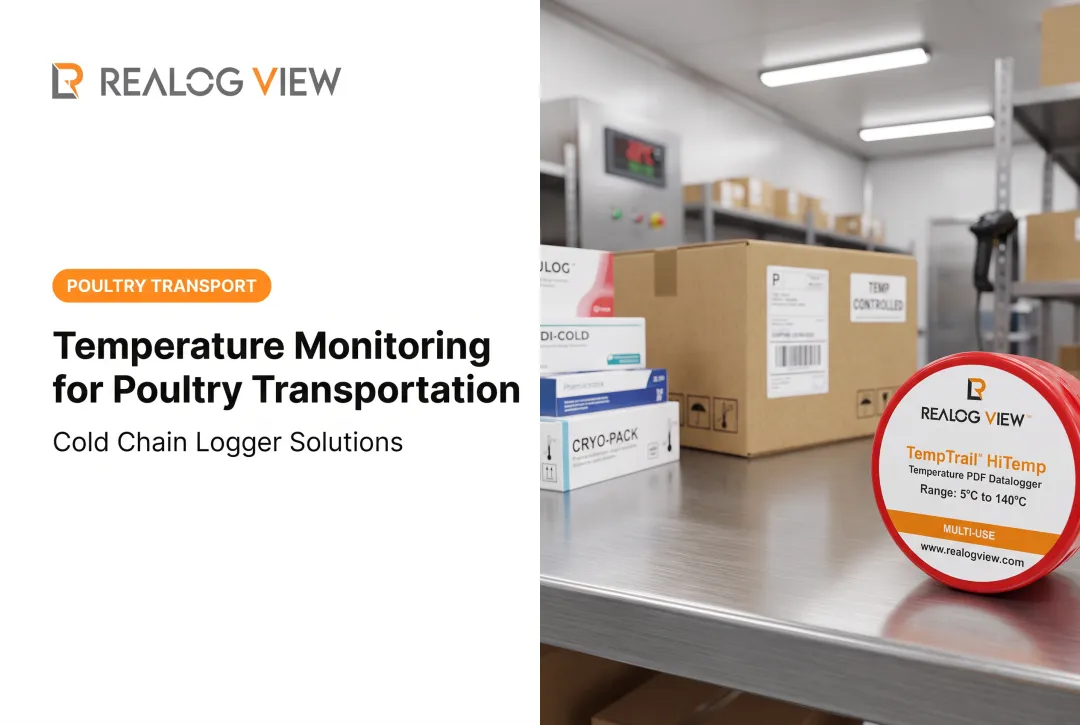
- TempTrail™ Glacial: Multi-use logger for pharma, biologics, and dry ice (-85°C to +70°C), with an integrated sensor and no external probes
Both generate automatic PDF and CSV reports via USB, with no software required. They're also FDA 21 CFR Part 11 compliant and DO-160G certified, built to survive real transport stress.
That combination matters most for pharma and cold chain customers who need court-ready compliance documentation without adding a probe or a laptop to the workflow.
Materials, Training, and Compliance Readiness
Beyond equipment, four readiness factors protect product quality and keep shipments compliant:
- Packaging materials rated for the product's specific temperature range and transit duration
- Clear, shared handling instructions between shipper, carrier, and receiver, in writing, not verbal agreements
- Driver and staff training on reefer operation, temperature checks at loading and unloading, and emergency protocols
- Verified certifications and documentation: FSMA sanitary transportation rules, USDA/FDA guidelines for food, or IATA PCR for air shipments
Key Parameters That Affect Perishable Goods During Transport
Outcomes hinge on tightly controlling a handful of variables. Picking the right vehicle is just the starting point.
Temperature Range and Consistency
Even brief excursions outside the safe range accelerate spoilage or bacterial growth. This isn't a minor risk: IQVIA's 2023 white paper cites a WHO estimate that up to 50% of vaccines globally are lost every year because storage temperatures weren't controlled properly.
That's an upper-bound figure, but it shows how unforgiving temperature-sensitive products can be.
Transit Time and Duration
Every product has a tolerable window before quality degrades, regardless of how well temperature is controlled. Longer transit increases risk exposure, especially for high-risk foods and biologics with short physiological half-lives.
Humidity Levels
Excess or insufficient humidity affects texture, mold growth, and packaging integrity. Most fresh produce needs 85%-95% relative humidity to limit dehydration, but push humidity too high and you invite condensation, mold, and weakened corrugated packaging. Getting temperature right doesn't help if humidity swings are left unchecked.
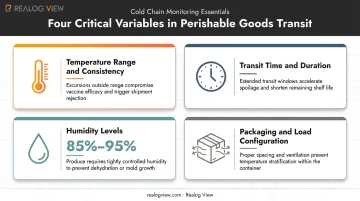
Packaging and Load Configuration
Poor stacking or overpacking restricts airflow, creating hot and cold spots inside the container. This is the sneaky one: the vehicle's overall temperature reading can look perfectly normal while product at the back or bottom of the load is quietly spoiling.
Placing a data logger at multiple points in the load, not just near the cab, catches these localized swings that a single sensor misses.
Common Mistakes to Avoid When Transporting Perishable Goods
Most spoilage incidents trace back to a small set of avoidable errors:
- Skipping pre-cooling before loading: forces the vehicle's cooling system to fight an uphill battle to reach target temperature mid-transit
- Choosing packaging on cost alone: ignores the product's actual temperature and duration requirements
- Overpacking the vehicle: blocks airflow vents and creates inconsistent temperatures throughout the load
- Failing to monitor or document continuously: leaves no proof of cold chain integrity if goods are rejected or a compliance audit occurs
That last one is the most costly in hindsight: a shipment can arrive in perfect condition and still get rejected because there's no data proving it stayed within range the whole way. FDA 21 CFR Part 11 compliant data loggers, like Realog View's, auto-generate timestamped PDF/CSV proof for every shipment.
Alternative Transport Methods for Perishable Goods
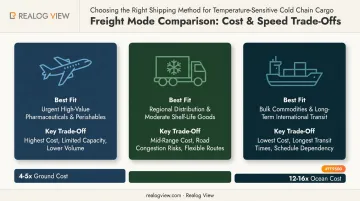
The best mode depends on shelf life, shipment size, budget, and destination, since no single option fits every shipment.
| Mode | Best Fit | Key Trade-Off |
|---|---|---|
| Air Freight | High-value, short shelf-life goods: fresh seafood, flowers, vaccines needing fast delivery | Fastest option, but generally 4-5x the cost of road and 12-16x the cost of sea freight (IATA) |
| Ground/Reefer Truck | Regional or domestic distribution needing flexibility and cost efficiency | Slower over long distances; exposed to traffic and border delays |
| Ocean/Sea Freight | Large-volume, longer shelf-life goods shipped internationally | Lowest cost per unit, but long transit demands continuous temperature monitoring to catch problems early |
Ground reefer transport remains the workhorse for most domestic food distribution because it balances cost and control. Ocean freight makes sense when volume is high and the product can tolerate weeks in transit.
Air freight earns its premium price tag only when speed genuinely outweighs cost, which is usually the case for biologics, cut flowers, or seafood with a shelf life measured in days. Whichever mode you choose, placing a data logger inside the shipment gives you a verifiable temperature record from pickup to delivery.
Frequently Asked Questions
What is the best transport for perishable goods?
It depends on shelf life and value. Air freight suits fast-spoiling, high-value goods, while ground reefer trucks and ocean freight work better for longer shelf-life or bulk shipments where cost efficiency matters more than speed.
What are the rules for shipping perishable food?
Shippers must comply with FDA and USDA food safety guidelines, the FSMA Sanitary Transportation Rule, and, for air shipments, IATA's Perishable Cargo Regulations covering packaging, labeling, and temperature control.
What temperature should perishable goods be kept at during transport?
Thresholds vary by product category. High-risk foods generally need to stay below 5°C (41°F) or frozen at 0°F (-18°C) or lower, while pharma products often require tighter, product-specific ranges.
How long can perishable goods be transported before they spoil?
Tolerable transit time depends on the product's physiological shelf life and how well temperature and humidity are controlled throughout the journey. Even well-refrigerated goods have a finite safe window.
What is the cold chain in perishable goods transportation?
The cold chain is the unbroken sequence of temperature-controlled storage and transport from origin to final delivery. Any break in this chain increases spoilage risk, even if the break is brief.
Do you need special certification to transport perishable goods?
Certification needs vary by product and mode. Food carriers follow FSMA and USDA-FDA rules, air shippers follow IATA PCR guidelines, and pharma shipments often require FDA 21 CFR Part 11-compliant temperature and humidity data loggers for validated monitoring documentation.