Introduction
Chocolate is a massive business. Global chocolate confectionery sales were forecast to top $128 billion by the end of 2024, according to Barry Callebaut's annual industry research. That's a lot of product riding on warehouse conditions.
Here's the problem: chocolate isn't like canned goods or dry pasta. Store it wrong, even briefly, and you'll see the damage.
Warehousing chocolate demands precise temperature control, humidity management, airflow planning, and constant monitoring, not just a cool room and good intentions.
This guide covers when dedicated chocolate warehousing actually matters and the exact steps to get it right. You'll also find the parameters that make or break quality, plus the mistakes that trip up even experienced operators.
TL;DR
- Keep temperature at 54-68°F (12-20°C) and humidity below 50% to prevent bloom or melting.
- Success requires facility setup, continuous monitoring, type-based organization, and protection from light and odors.
- Common failures include skipped inspections, manual spot-checks over continuous logging, and poor airflow causing contamination.
- No in-house climate control? Try third-party cold storage, retrofit zoning, or on-demand refrigerated capacity.
How to Warehouse Chocolate: Step-by-Step Process
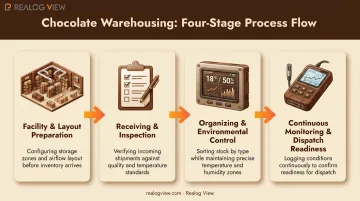
Step 1: Facility & Layout Preparation
Location matters before a single pallet arrives. Choose storage space away from loading docks, direct sunlight, and heat-generating equipment. Ground-level areas tend to have fewer temperature swings than mezzanine or rooftop-adjacent spaces.
Confectionery-specific storage guidance from Callebaut recommends 12-18°C (54-64°F) for pure chocolate, with a constant 18-20°C (64-68°F) range to slow fat bloom in finished products. Before committing a space to chocolate storage, verify your HVAC or refrigeration system can actually hold within that band without major swings, not just hit the target on paper.
Backup power isn't optional. A short outage during a heat wave can push storage temperatures past the safe range fast enough to trigger irreversible bloom. Generator systems or automated failover protect against exactly that scenario.
Step 2: Receiving & Inspection
Every incoming shipment needs a check before it enters inventory:
- Review transit temperature logs to confirm the product stayed within range during transport
- Inspect packaging integrity for tears, punctures, or condensation on the outside of cartons
- Verify expiration and production dates against purchase order specs
- Cross-check batch numbers, quantity, and grade against shipping documentation
Condensation on packaging is a red flag. It usually means the product experienced a temperature swing severe enough to cause moisture to form, and that moisture is often the trigger for sugar bloom later on. Quarantine or reject any batch showing these signs rather than accepting it into general inventory.
Step 3: Organizing & Environmental Control
Not all chocolate behaves the same way in storage. Dark, milk, and white chocolate each have different fat and sugar ratios, which means different tolerance for temperature swings. Segment your storage zones accordingly, and organize each zone by batch and expiration date to support FIFO (first in, first out) rotation.
A few placement rules matter more than people expect:
- Maintain clear airflow paths around pallets. Blocked airflow creates pockets of uneven temperature
- Never store chocolate near strong-smelling goods. Chocolate absorbs surrounding odors readily, according to Callebaut's storage guidance
- Use opaque coverings or shaded racking to limit light exposure, which accelerates flavor degradation, particularly in white chocolate
Step 4: Continuous Monitoring & Dispatch Readiness
Manual spot-checks miss the short spikes that do the most damage. A temperature excursion lasting even 30 minutes near a loading dock can be enough to start bloom formation, and a once-a-shift walkthrough won't catch it.
Continuous data logging solves this gap. Placing temperature and humidity loggers throughout storage zones gives you real-time visibility and an audit-ready paper trail.
Devices like Realog View's TempTrail™ Humidity & Display loggers fit directly into this workflow. They capture both temperature (-30°C to +70°C) and relative humidity (0-100% RH) continuously, storing up to 32,000 data points per unit. Reports generate automatically as FDA 21 CFR Part 11 compliant PDF and CSV files via USB, with no external software or probes required.
Before dispatch, run a final check:
- Confirm product temperature falls within your target range
- Inspect packaging for damage or moisture
- Verify batch documentation matches the outgoing order
- Pull logger data for the storage period as a compliance record
Key Parameters That Affect Chocolate Storage Quality
Chocolate warehousing quality comes down to controlling four specific variables, each with its own failure mode.
Temperature
Cocoa butter is polymorphic, meaning it can crystallize into six different structural forms. Outside the ideal range, those crystals shift form or migrate, and that's the mechanism behind fat bloom. Temperature cycling, product moving repeatedly in and out of the target range, is a recognized trigger for this migration.
Humidity compounds the risk. When heat and moisture combine, surface sugar dissolves. Once conditions stabilize, that dissolved sugar recrystallizes into the dusty white coating known as sugar bloom.
Humidity
Blommer's technical guidance targets 40-60% relative humidity for chocolate storage, while Callebaut sets 70% as a hard ceiling. The exact number matters less than the mechanism. Moisture becomes damaging near the condensing point, where water vapor turns to liquid on the product surface, rather than at any single fixed percentage.
Keep humidity below 50% as a working target, and pay closer attention during seasonal transitions when outdoor humidity shifts fastest. Continuous tracking with a dual-parameter temperature and humidity data logger, such as those Realog View manufactures, flags these seasonal swings before they turn into sugar bloom.
Airflow & Odor Control
Chocolate absorbs odors from its surroundings. Store it near onions, cleaning chemicals, or strongly scented packaging materials, and that flavor transfer is often permanent.
- Segregate chocolate storage zones from odorous inventory entirely
- Keep pallets loosely spaced to allow air circulation
- Avoid racking materials that retain smells over time
Light Exposure & Packaging
Light-induced flavor degradation is well documented, especially in white chocolate, which lacks the natural antioxidants that protect dark chocolate. Multi-layer packaging, foil combined with plastic film, blocks light and moisture simultaneously. This layered barrier is part of why properly wrapped dark chocolate can hold quality for 1-2 years, while unwrapped or poorly protected product degrades much faster.

What You Need Before Warehousing Chocolate
Getting equipment, materials, and staff training in place before chocolate arrives determines whether it holds quality through the storage period.
Equipment & System Requirements
- Climate control systems capable of holding setpoint within the 54-68°F range without major drift
- Continuous data loggers for temperature and humidity tracking, such as Realog View's dual-parameter units with alarms configurable to your 54-68°F range
- Tamper-resistant housing (IP67-rated units hold up better in demanding warehouse conditions than exposed sensors)
Inputs, Materials & Conditions
- Multi-layer packaging (foil plus plastic film) that resists humidity and blocks light
- Racking and pallet setups that don't retain odors and allow airflow around stored goods
- Clean, dry, draft-free storage zones separated from ambient warehouse traffic
Skill & Compliance Readiness
- Staff trained in FIFO rotation and recognizing early bloom or moisture signs
- Documentation processes that support traceability during audits, particularly relevant under FDA 21 CFR Part 117 requirements for facilities handling temperature-sensitive packaged food
Common Mistakes & Troubleshooting When Warehousing Chocolate
Even well-intentioned operations fall into predictable traps:
- Skipping pre-storage inspection and accepting shipments without reviewing transit temperature logs
- Mixing chocolate types in one zone without accounting for the different tolerances of dark, milk, and white chocolate
- Overloading pallets or blocking airflow paths, which increases odor absorption risk and creates uneven cooling
- Relying on manual spot-checks instead of continuous monitoring, missing brief but damaging spikes entirely
Troubleshooting Guide
| Problem | Likely Cause | What to Check |
|---|---|---|
| Dusty white coating (sugar bloom) | Temperature/humidity fluctuation near the condensing point | Review logged data for spikes, verify HVAC calibration, relocate stock away from doors and vents |
| Off-flavors or absorbed odors | Storage near strong-smelling goods, poor airflow | Inspect pallet placement, increase ventilation, segregate from odorous inventory |
If bloom shows up repeatedly in the same zone, the storage conditions are the likely cause. Pull logger data covering the past few weeks before assuming it's a supplier issue.
When to Use Dedicated Cold Storage vs. Alternatives
Not every operation needs a purpose-built chocolate warehouse. Scale, budget, and volume dictate the right setup.
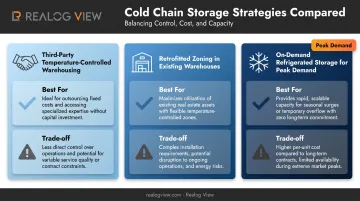
| Storage Approach | Best For | Trade-off |
|---|---|---|
| Third-Party Temperature-Controlled Warehousing | Smaller producers without capital for in-house climate infrastructure | Less direct control over monitoring and compliance; the business depends on the provider's service levels |
| Retrofitted Zoning in Existing Ambient Warehouses | Mid-size operations phasing investment gradually rather than building dedicated facilities | Requires careful zoning to prevent temperature bleed from uncontrolled areas |
| On-Demand Refrigerated Storage for Peak Demand | Businesses facing seasonal spikes, such as the winter holidays, which alone accounted for $7.5 billion in confectionery sales in 2024 | Higher per-unit cost and added logistics moving inventory in and out |
Whichever model you choose, independent monitoring closes the compliance gap that outsourcing creates. FDA 21 CFR Part 11-compliant data loggers, such as those from Realog View, generate their own temperature records regardless of the provider's monitoring system.
Refrigerated warehouse costs have been climbing industry-wide, which makes the outsourcing decision less about convenience and more about a genuine cost-versus-control tradeoff. Run the numbers on both sides before committing to either path.
Frequently Asked Questions
Successful chocolate warehousing depends on tight temperature and humidity control, paired with proper airflow and continuous monitoring to catch issues before they affect product quality.
Can chocolate be stored in a warehouse?
Yes. Chocolate can be warehoused long-term when temperature (54-68°F) and humidity (below 50%) are controlled consistently, with proper airflow and light protection in place.
What is the ideal temperature and humidity for warehousing chocolate?
Aim for 54-68°F (12-20°C), with 64-68°F often cited as optimal for slowing fat bloom. Keep humidity below 50% relative humidity.
How long can chocolate be stored before it loses quality?
Dark chocolate can last 1-2 years when properly wrapped and stored. Milk and white chocolate have a shorter window, typically 8-10 months, due to their higher dairy fat content.
Does chocolate need to be refrigerated in warehouse storage?
No. Chocolate needs a cool, climate-controlled space, not freezer temperatures. Refrigerators create high-humidity conditions that risk condensation and bloom when product is removed.
How can businesses monitor warehouse conditions to protect chocolate inventory?
Continuous data logging with certified temperature and humidity loggers, such as Realog View's FDA-compliant models, provides real-time visibility and an audit trail. This catches short-term spikes that manual spot-checks routinely miss.
What causes chocolate bloom during storage?
Fat bloom results from cocoa butter crystals migrating and reforming, often triggered by temperature cycling. Sugar bloom happens when surface moisture dissolves sugar, which later recrystallizes into a dusty coating.