Introduction
Moving temperature-sensitive goods from origin to destination sounds straightforward — until a vaccine shipment arrives at 12°C instead of 6°C, or a frozen biologics batch lacks any documented temperature history. At that point, the entire consignment may be quarantined regardless of whether it was actually compromised.
Controlled temperature transport is the process of moving goods within a continuously maintained, pre-defined temperature envelope — from pickup to delivery — using specialized vehicles, containers, packaging, and monitoring systems. The goal is delivering products in the same physical, chemical, or biological state they were in at origin — not simply keeping them cold.
This guide is written for logistics managers, pharmaceutical and food industry professionals, and cold chain operators who need practical, operational detail. The global cold-chain market is valued at $371.1 billion in 2025 and projected to reach $1.6 trillion by 2033. Despite that scale, many operators still struggle with the mechanics that sit between booking and delivery.
What follows covers temperature control methods, vehicle and container requirements, monitoring and documentation standards, and the regulatory frameworks that govern compliant cold chain operations.
Key Takeaways
- Controlled temperature transport spans chilled, frozen, ambient, and ultra-cold ranges across far more than standard refrigeration
- Each stage of the process carries its own failure risk; the weakest link determines outcome
- Active systems adjust dynamically to changing conditions; passive systems rely on a finite, pre-validated hold time
- Regulatory compliance requires a continuous, documented temperature history — gap-free records, not just in-range readings
- Most failures happen at transition points: loading docks, carrier handoffs, and unplanned delays
What Is Controlled Temperature Transport?
Controlled temperature transport refers to the conveyance of goods within a pre-defined temperature envelope, maintained continuously from pickup to delivery, using specialized vehicles, containers, packaging, and monitoring systems.
The goal is preserving the specific physical, chemical, or biological state of a product that degrades outside its acceptable temperature range. That covers a broad range of regulated and perishable goods:
- Pharmaceuticals and vaccines — where stability data defines the exact required range
- Biologics — including mRNA products requiring ultra-cold conditions
- Food — across chilled, frozen, and ambient requirements
- Reactive or hazardous chemicals — those with defined temperature thresholds for safe handling
How This Differs From Cold Storage
Static cold storage is a controlled environment. Transport is not. Every vehicle movement, loading dock transfer, route change, and carrier handoff introduces dynamic risk that a warehouse never faces.
Multi-modal shipments compound this further. Each mode transition introduces three compounding risks:
- A potential gap in the continuous temperature record
- A physical excursion point where ambient exposure is highest
- A documentation handoff that may not be reconciled until delivery
This is why transport monitoring requires active, timestamped data — not just a pre-shipment check and a post-delivery inspection.
How Controlled Temperature Transport Works
The chain begins before the vehicle moves and doesn't end until the product's temperature history is documented at delivery. Every stage is interdependent. A failure at any single point can compromise the entire shipment.
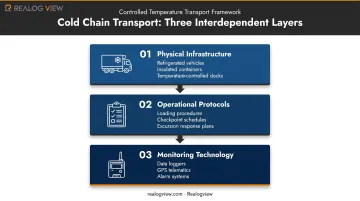
The process is controlled through three layers:
- Physical infrastructure — refrigerated vehicles, insulated containers, temperature-controlled docks
- Operational protocols — loading procedures, checkpoint schedules, excursion response plans
- Monitoring technology — data loggers, GPS telematics, alarm systems
Step 1: Pre-Transport Planning and Equipment Pre-Conditioning
The shipper defines the required temperature range from approved stability and label data — not from a generic cold-chain assumption. WHO guidelines require both the product and the refrigerated vehicle cargo area to reach the required transport temperature before loading begins.
This is one of the most common failure points in practice. Pre-conditioning must be verified and recorded before the load doors open — not assumed based on the unit's setpoint display.
Step 2: Controlled Loading
WHO requires loading without delay, payload doors opened only for loading or unloading, and bays protected from direct sun, rain, and temperature extremes. Goods should never be staged in open or ambient-temperature areas before loading.
Proper stowage also matters: blocked airflow around cargo creates uneven cooling within the load, generating hot or cold spots that may not be detected by a single probe at the return air sensor.
Step 3: In-Transit Temperature Maintenance and Active Monitoring
During transit, mechanical refrigeration units (or passive coolant materials in passive systems) maintain the temperature envelope. The critical distinction: temperature must be continuously recorded, not just periodically checked at stops.
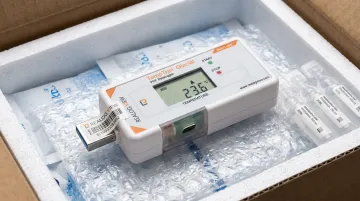
Regulatory compliance in pharmaceutical and food industries requires a complete, tamper-evident audit trail. Realogview's TempTrail data loggers are FDA 21 CFR Part 11 compliant and automatically generate PDF and CSV reports on USB connection — no external software, installation, or manual data entry required. Any recipient in the chain can plug the device into a Windows PC and immediately access the full, time-stamped temperature record.
Step 4: Checkpoint Verification and Exception Response
EU GDP guidelines require that excursions be reported to the distributor and recipient, with a documented investigation procedure. GPS alarm systems and data logger alerts allow real-time detection of deviations — but a response protocol must be defined before the shipment departs.
Without a predefined response plan, teams lose critical response time while the product continues to degrade.
Step 5: Unloading and Delivery Documentation
Unloading carries the same ambient exposure risk as loading. Delivery must include documentation of the product's complete temperature history — typically a data logger report confirming the temperature remained within specification for the entirety of the journey.
This report isn't administrative formality. It's the evidence required for:
- Regulatory submissions and batch release
- GDP and FDA inspection readiness
- Carrier dispute resolution
- Quality management records
Types of Controlled Temperature Transport
Controlled temperature transport spans multiple temperature bands and uses fundamentally different system types. Matching the system to the shipment is a core operational decision, not an arbitrary default.
Active vs. Passive Shipping Systems
Active systems use powered mechanical cooling to maintain temperature continuously. They can respond to external temperature changes, sustain set points over long durations, and are used for most pharmaceutical, frozen, and long-haul food transport.
Passive systems — insulated packaging, dry ice boxes, gel-pack containers — maintain temperature through thermal mass and insulation rather than refrigeration. They have a finite hold time after which temperature cannot be guaranteed.
WHO's PQS E004/CB05 testing specifies minimum cold-life requirements of 48 hours (short-range) and 96 hours (long-range) for prequalified vaccine cold boxes at +43°C ambient. These are validated specifications for specific device classes, not universal benchmarks for passive shippers generally. The hold time of any passive system depends on:
WHO's PQS E004/CB05 testing specifies minimum cold-life requirements of 48 hours (short-range) and 96 hours (long-range) for prequalified vaccine cold boxes at +43°C ambient. These are validated specifications for specific device classes, not universal benchmarks for passive shippers generally. The hold time of any passive system depends on:
- Coolant conditioning and pack-out configuration
- Ambient temperature profile during transit
- Total transit duration
Temperature Ranges and Applications
| Temperature Band | Range | Typical Applications |
|---|---|---|
| Chilled | +2°C to +8°C | Pharmaceuticals, vaccines, dairy, fresh produce |
| Controlled room temperature | +15°C to +25°C | Certain chemicals, semi-finished goods |
| Frozen | -18°C and below | Frozen food, meat, fish |
| Ultra-cold | -60°C to -85°C | Cryogenic biologics, mRNA vaccines, laboratory cultures |
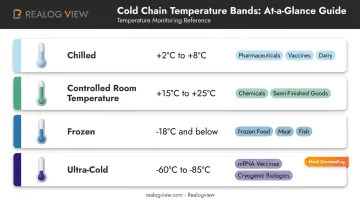
Each band is product-specific. A product labeled for +2°C to +8°C storage requires that range based on approved stability data — not because it's a standard cold-chain default.
Ultra-cold shipments — particularly dry ice transport where temperatures approach -78.5°C — require data loggers rated for cryogenic ranges. Realogview's TempTrail Glacial covers -85°C to +70°C for this application. For standard pharmaceutical chilled transport (+2°C to +8°C), the TempTrail XL comes factory-configured with alarm thresholds at those exact limits.
Transport Modes
- Road — Refrigerated trucks offer point-to-point control and are the primary mode for domestic and regional cold chain
- Air — Air freight prioritizes speed for time-sensitive biologics and vaccines; IATA's Temperature Control Regulations (TCR) govern pharmaceutical acceptance, packaging, and handling
- Sea — Reefer containers handle large-volume international shipments; longer transit times demand robust monitoring and validated passive hold periods
- Multi-modal — Every mode transition is a handoff risk; consistent temperature documentation across carriers is required, and WHO guidelines call for minimizing tarmac and wharf exposure at transfer points
Key Factors That Affect Temperature Control in Logistics
Cargo Characteristics
A product's temperature sensitivity — narrow vs. wide acceptable range — determines how much operational tolerance exists. Some biologics degrade measurably within minutes of excursion; some food products tolerate brief deviations. Knowing which you're dealing with changes every downstream decision.
External Environmental Conditions
Ambient temperature at origin, destination, and along the route directly loads refrigeration systems. Hot climates, seasonal variation, and elevation all affect how hard equipment works to maintain set points. WHO requires vehicle qualification under anticipated ambient extremes, including seasonal variation — meaning a summer qualification may not cover winter risk and vice versa.
Equipment Specification and Maintenance
Poorly maintained refrigeration equipment is a leading cause of mid-transit excursions. Key variables:
- Refrigeration unit performance and calibration
- Insulation quality and door seal integrity
- Pre-conditioning verification before each shipment
- Current service records and scheduled preventive maintenance
EU GDP requires monitoring equipment to be maintained and calibrated at regular intervals. Uncalibrated transport monitors were cited among the major deficiencies in MHRA's 2016 GDP inspection data — and an in-range delivery does not cure a deficient calibration record.
Monitoring and Data Integrity
The choice of data logger directly determines whether a shipment can be released or accepted. Key requirements:
- Continuous recording — not periodic spot checks
- Tamper-evident records — physically sealed devices with no external probe vulnerabilities
- Compliance certification — FDA 21 CFR Part 11 for pharmaceutical electronic records
- Automatic report generation — eliminating manual reporting gaps
Each of these requirements ties directly to the device design. Realogview's TempTrail loggers address the external probe vulnerability by housing the sensor fully inside the sealed, IP67-rated device body — no exposed components that can be disconnected or manipulated during transit. Automatic PDF/CSV generation and Part 11 compliance mean the record is ready for regulatory review at the point of release decision, not reconstructed after the fact.
Common Misconceptions About Controlled Temperature Transport
Misconception 1: Temperature maintenance equals regulatory compliance.
A shipment that stayed within range but lacks a continuous, tamper-evident data record can still fail inspection or batch release. FDA 21 CFR Part 11 requires more than a number within specification — it mandates:
- Validated electronic records and accurate copies
- Time-stamped audit trails proving no alterations occurred
- Access controls documenting who handled the data
A standard logger captures what happened. A Part 11-compliant logger proves what happened, when, and that the record is legally defensible for regulatory review.
Misconception 2: Passive systems are a cost-saving substitute for active systems on longer shipments.
Passive containers have a finite, validated hold time that's frequently underestimated — particularly when ambient conditions exceed design assumptions. They work well for short-duration shipments or as supplemental protection inside active systems. Once a shipment exceeds the validated hold period for a specific pack-out configuration, passive packaging is no longer a viable substitute for active refrigeration.
Misconception 3: Controlled temperature transport is always the right solution.
Not every product that ends up in cold chain actually requires it. If a product's temperature sensitivity profile has never been validated, the temperature range being maintained may not reflect a real product requirement. For goods that are genuinely stable at ambient temperatures — or for very short last-mile deliveries where validated insulated packaging provides sufficient protection — defaulting to active refrigeration adds cost without reducing risk.
Frequently Asked Questions
What is temperature-controlled transport?
Temperature-controlled transport is the movement of goods within a continuously maintained, pre-defined temperature range — using refrigerated vehicles, containers, monitoring systems, and documented protocols — to preserve product integrity from pickup to delivery.
What is CCM in logistics?
CCM stands for Controlled Condition Management in logistics. It refers to the systematic management of environmental conditions — primarily temperature and humidity — across the entire supply chain to ensure goods arrive meeting quality and regulatory specifications.
How do you ship temperature-controlled items?
Shipping temperature-controlled items requires five core steps:
- Define the required temperature range from product stability data
- Select an active or passive system matched to shipment duration and mode
- Pre-condition equipment before loading
- Monitor temperature continuously with a compliant data logger
- Obtain a documented temperature report upon delivery
What are active vs. passive temperature-controlled shipping systems?
Active systems use powered refrigeration to maintain set temperatures and are best suited for long-haul or high-value cargo. Passive systems rely on insulation and coolants with a finite hold time, making them appropriate for short-duration shipments or supplemental protection only.
What regulations apply to pharmaceutical temperature-controlled transport?
GDP (Good Distribution Practice) guidelines, WHO temperature storage requirements, and FDA 21 CFR Part 11 for electronic data integrity all apply. FDA 21 CFR Part 11 specifically mandates audit trails, access controls, and electronic records that cannot be altered without detection — meaning data logger compliance is as critical as physical temperature control.
What happens if a temperature excursion occurs during transport?
The excursion must be documented, assessed against the product's stability data, and reported to the distributor and recipient. Depending on severity, the shipment may be quarantined, rejected, or released with a documented risk assessment. Establishing pre-defined response protocols before shipment — not after — is what separates recoverable excursions from costly product losses.