
Introduction
A single contamination event can trigger a product recall, generate regulatory penalties, and permanently erode consumer trust. Yet many food operations still rely on reactive quality checks — inspecting finished products after problems occur rather than controlling hazards before they do.
According to the CDC, the US experiences approximately 800 foodborne outbreaks annually, resulting in 15,000 illnesses and 800 hospitalizations. Meanwhile, FSIS recorded 85 recalls in 2024 alone — spanning pathogen contamination, undeclared allergens, and foreign material. These are predictable outcomes when systematic prevention is absent.
HACCP — Hazard Analysis and Critical Control Points — is the internationally recognized framework that shifts food safety from reaction to prevention. This guide covers:
- What HACCP means and the three hazard categories it targets
- Its 7 core principles and how to build a compliant plan
- How temperature monitoring tools maintain Critical Control Points
Key Takeaways
- HACCP (Hazard Analysis and Critical Control Points) is a science-based, preventive system applied across every stage of food production, handling, and distribution
- Built on 7 core principles — from hazard analysis through record-keeping — each requiring documentation in a written HACCP plan
- Legally required in the US for meat, poultry, seafood, and juice processors
- Underpins major global food safety certifications including BRCGS, FSSC 22000, IFS, and SQF
- Temperature monitoring is central to most HACCP plans — automated data loggers reduce documentation gaps and speed up audit preparation
What Is HACCP? Definition, History, and Key Concepts
HACCP stands for Hazard Analysis and Critical Control Points — a systematic, science-based approach to identifying, evaluating, and controlling food safety hazards throughout the supply chain, from raw material receipt through final distribution.
Unlike end-product testing, HACCP builds controls directly into the production process. Hazards are identified and addressed before contamination reaches the consumer.
Origins: From Space Food to Global Standard
HACCP was developed in the early 1960s through a collaboration between NASA, Pillsbury, and the US Army Natick Laboratories. The mission required food that could be guaranteed safe — astronauts experiencing foodborne illness mid-flight was not an acceptable outcome.
Pillsbury publicly introduced the HACCP concept at the 1971 National Conference on Food Protection. The Codex Alimentarius Commission (FAO/WHO) formally adopted HACCP guidelines in 1993 and then integrated them into the General Principles of Food Hygiene (CXC 1-1969), now the primary international reference for food safety standards across most countries.
Two Core Concepts in the Acronym
Understanding HACCP starts with its two foundational elements:
- Hazard Analysis — systematic identification and evaluation of biological, chemical, and physical risks at each step of a production process, assessing both likelihood of occurrence and severity of consequence
- Critical Control Points (CCPs) — specific steps where a control measure can be applied to prevent, eliminate, or reduce a hazard to an acceptable level
Both elements must be documented in writing. A complete HACCP plan includes the hazard analysis records, identified CCPs, critical limits, monitoring procedures, corrective actions, and verification activities for each control point.
Three Types of Hazards HACCP Identifies and Controls
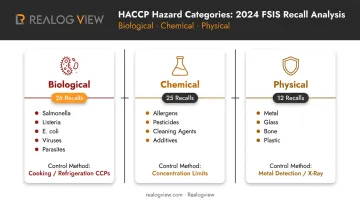
Every HACCP plan must address three categories of food safety hazards. FSIS recorded all three types in its 2024 recall data — 26 pathogen-related, 25 allergen-related, and 12 foreign-material recalls — confirming that biological risks alone don't tell the full story.
Biological Hazards
The most common and highest-risk category. These include:
- Bacteria: Salmonella, Listeria monocytogenes, E. coli O157:H7
- Viruses: Hepatitis A, norovirus
- Parasites: Cryptosporidium, Toxoplasma
FSIS FY2023 verification sampling found Salmonella in 8.54% of chicken parts sampled — a figure that explains why cooking temperature CCPs are a non-negotiable control point. Biological hazards are typically managed through kill-step CCPs like cooking, pasteurization, or refrigeration to inhibit bacterial growth.
Chemical Hazards
Chemical hazards span a wider range than many HACCP teams initially account for:
- Naturally occurring toxins: Mycotoxins, allergens
- Agricultural residues: Pesticides, veterinary drug residues
- Processing chemicals: Cleaning agents, sanitizers that could contaminate product
- Additives used in excess: Preservatives or color agents exceeding permitted levels
FDA identified undeclared allergens as the leading cause of Class I food recalls for at least three years running. Critical limits for chemical hazards typically involve concentration thresholds and ingredient control procedures.
Physical Hazards
Foreign objects that enter food and can cause injury:
- Metal fragments from equipment wear
- Glass from broken containers or light fixtures
- Bone fragments in meat products
- Plastic from packaging materials
- Stones or other field debris in raw ingredients
Physical CCPs typically involve metal detectors, X-ray inspection systems, or sieving at defined production points.
Each hazard category requires its own set of controls, critical limits, and monitoring procedures within the HACCP plan. Addressing all three — not just the most visible biological risks — is what separates a compliant plan from an effective one.
Why HACCP Matters: Regulatory Requirements and Business Benefits
Regulatory and Legal Basis
HACCP is not optional for several major food sectors in the US:
| Regulation | Scope | Effective |
|---|---|---|
| USDA 9 CFR Part 417 | Meat and poultry processors | Phased 1998–2000 |
| FDA 21 CFR Part 123 | Seafood processors and importers | December 1997 |
| FDA 21 CFR Part 120 | Juice processors and importers | January 2002 |
| FDA 21 CFR Part 117 | Broader food facilities (FSMA preventive controls) | September 2015 |
Internationally, the Codex Alimentarius HACCP principles form the basis of food safety legislation across most countries. ISO 22000:2018 integrates HACCP with prerequisite programs into a structured management system, though it remains voluntary unless contractually or legally required.
Major global certification programs recognized by the Global Food Safety Initiative (GFSI) — including BRCGS, FSSC 22000, IFS, and SQF — all require a documented and implemented HACCP plan as a non-negotiable audit requirement. BRCGS Food Safety Issue 9 alone is accepted by leading brands and retailers across more than 22,000 certified sites in 130+ countries.
Business Benefits of HACCP
Compliance is the floor, not the ceiling. HACCP delivers measurable operational value that reaches well into profitability:
- Reduced recall risk — systematic controls catch deviations before product ships
- Market access — major retailers and foodservice buyers routinely require GFSI certification
- Improved operational efficiency — the process review required to build a HACCP plan often surfaces waste and inefficiency
- Regulatory goodwill — documented, functioning HACCP systems reduce the likelihood of facility shutdowns during inspections
- Consumer trust — brands with verifiable safety programs build stronger reputations
The USDA estimates US foodborne illness costs $74.7 billion annually in 2023 dollars. At that scale, proactive food safety controls protect far more than regulatory standing — they protect revenue, market access, and brand equity.
The 7 Principles of HACCP Explained
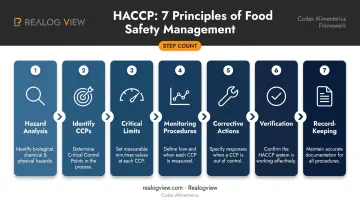
The 7 principles — codified by the Codex Alimentarius Commission and adopted by US regulatory agencies — form the backbone of every written HACCP plan. Each principle builds on the last, and all must be documented to be enforceable.
Principle 1: Conduct a Hazard Analysis
The HACCP team evaluates every production step, from raw material receipt to finished product dispatch, to identify all potential biological, chemical, and physical hazards. Each hazard is then assessed for likelihood and severity to determine whether it is "significant" and requires a specific control measure.
Principle 2: Identify Critical Control Points (CCPs)
A CCP is a step where a control measure can be applied to prevent, eliminate, or reduce a food safety hazard to an acceptable level. Codex provides a CCP decision tree as an example tool for making this determination, though it functions as a guide rather than a mandatory algorithm.
Common CCPs include:
- Cooking to a target internal temperature
- Refrigerated storage at or below a defined limit
- Metal detection after filling operations
- Pasteurization of liquid products
Principle 3: Establish Critical Limits
Each CCP must have a defined critical limit: the measurable value (temperature, time, pH, water activity, etc.) that separates safe from potentially unsafe product. Critical limits must be scientifically justified, typically drawn from regulatory guidance or published research. For example, the FDA Food Code specifies 165°F (74°C) for poultry in retail and foodservice contexts, though any value drawn from guidance must be validated for the specific industrial process before it can serve as a formal critical limit.
Principle 4: Establish Monitoring Procedures
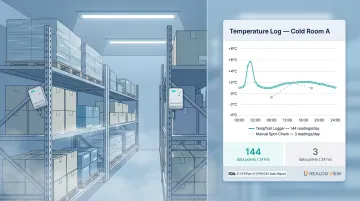
Monitoring procedures define what is measured, how, how frequently, and by whom at each CCP. FDA/NACMCF guidance states that monitoring should ideally be continuous where feasible, because continuous monitoring creates a complete excursion history while periodic spot-checks leave gaps where deviations could go undetected.
This is where automated temperature data loggers become particularly valuable. A manual check performed three times daily leaves roughly 8-hour gaps in the temperature record. A logger configured at a 10-minute interval generates 144 data points per day, providing comprehensive, audit-ready documentation that the CCP remained within limits throughout every hour of operation.
Principle 5: Establish Corrective Actions
Corrective actions are pre-defined responses to a CCP deviation, established in advance so personnel know exactly what to do when a deviation occurs. They must address:
- Product disposition — hold, rework, or discard
- Root cause identification and correction
- Documentation of the event
Without pre-defined responses, deviations become judgment calls made under pressure — which is precisely when errors in product disposition happen.
Principle 6: Establish Verification Procedures
Verification is distinct from monitoring. It confirms the overall HACCP system is working as intended. Verification activities include:
- Calibration of monitoring devices
- Periodic internal audits
- Finished product testing
- Third-party HACCP plan reviews
All verification activities should be scheduled and documented.
Principle 7: Establish Record-Keeping and Documentation
Records are the legal and operational evidence that HACCP controls are functioning. Required documentation includes:
- Hazard analysis results
- CCP determinations and critical limits
- Monitoring logs
- Corrective action records
- Verification activity reports
The industry principle is unambiguous: if it was not written down, it did not happen.
How to Build a HACCP Plan: Preliminary Steps
Before applying the 7 principles, five preparatory steps establish the foundation on which the formal plan is built.
Assemble a Multidisciplinary HACCP Team
The team should include individuals with knowledge across microbiology, engineering, production, quality assurance, and sanitation. External food safety consultants can supplement the team — but a HACCP plan built entirely by a consultant and left in a binder is ineffective. In-house involvement is essential.
Describe the Product and Identify Intended Use
Each product description should document:
- Ingredients and composition
- Packaging type and shelf life
- Storage and handling requirements
- Intended consumer and distribution channel
Vulnerable groups — infants, elderly, or immunocompromised individuals — require particular attention. Hazards acceptable for healthy adults may not be acceptable for high-risk populations.
Develop and Verify a Process Flow Diagram
The flow diagram maps every production step from raw material intake through distribution. The HACCP team must verify it on the production floor — not just in a conference room. Real processes often differ from documented ones, and a plan built on an inaccurate flow diagram will miss hazards.
Confirm Prerequisite Programs Are in Place
The following prerequisite programs (PRPs) must be functional before HACCP is applied:
- Good Manufacturing Practices (GMPs)
- Sanitation Standard Operating Procedures (SSOPs)
- Pest control programs
- Supplier verification protocols
- Employee hygiene programs
PRPs control background conditions and directly reduce the number of CCPs required in the formal HACCP plan. Without them in place, the HACCP analysis will be overloaded with hazards that should already be managed at the facility level.
How Temperature Monitoring Tools Support HACCP Compliance
Temperature is one of the most frequently monitored parameters in food safety HACCP plans — governing storage, transport, cooking, cooling, and holding CCPs. Among 2,677 outbreaks with identified contributing factors studied by the CDC between 2014 and 2022, inadequate temperature control appeared across preparation, service, cooling, cooking, and reheating stages.
Manual temperature checks create documentation gaps that fail regulatory audits. Automated data loggers close those gaps with continuous, tamper-evident records.
Realogview TempTrail™ Loggers by CCP Type
Realogview's TempTrail™ line maps specific models to each CCP type found in a food safety plan:
| HACCP Application | Recommended Model | Key Capability |
|---|---|---|
| Cold storage monitoring | TempTrail™ Display (Multi-use) | ±0.2°C accuracy, user-configurable alarms, real-time LCD display |
| Cold chain transport (long-haul) | TempTrail™ XL | 32,000 data points, up to 220 days at 10-min intervals, 20g compact |
| Cold chain transport (short-haul) | TempTrail™ Classic | 11,000 data points, up to 75 days, pre-set 2°C–8°C alarms |
| Cooking/cooling CCPs | TempTrail™ HiTemp | +5°C to +140°C, IP68 submersible, 5-second logging intervals |
| Combined temp + humidity | TempTrail™ Humidity & Display | Dual-parameter, 32,000 data points, HACCP-ready reports |
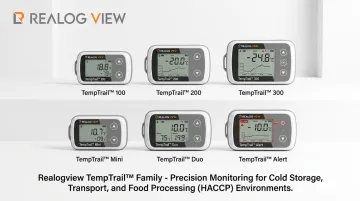
How These Loggers Satisfy HACCP Principles 4 and 7
Every model in the TempTrail™ lineup automatically generates PDF and CSV reports upon USB connection — no external software required. This directly satisfies Principle 7's documentation requirements and means audit-ready records are available immediately during unannounced inspections.
For Principle 4 monitoring, configurable logging intervals ranging from 5 seconds to 24 hours (on multi-use models) eliminate the gaps common in manual spot-check schedules. A 10-minute logging interval captures any temperature excursion lasting longer than 10 minutes — compared to manual checks that may leave 8-hour windows unmonitored.
All Realogview TempTrail™ loggers are FDA 21 CFR Part 11 compliant, meaning records are secure, traceable, and tamper-evident.
Single-use models like the TempTrail™ XL ship pre-configured with 2°C–8°C alarm thresholds that map directly to standard refrigerated food safety critical limits — making them ready to deploy immediately. Multi-use models offer fully user-defined thresholds to match facility-specific HACCP plans.
The IP67/IP68-sealed, DO-160G certified construction ensures devices survive cold storage condensation, refrigerated transport vibration, and wet processing environments without compromising data integrity.
Frequently Asked Questions
What are the 7 principles of HACCP?
The 7 principles are: (1) conduct a hazard analysis, (2) identify critical control points, (3) establish critical limits, (4) establish monitoring procedures, (5) establish corrective actions, (6) establish verification procedures, and (7) establish record-keeping and documentation. Each must be addressed in sequence and captured in a written HACCP plan.
What are the three types of HACCP?
The term refers to the three hazard categories HACCP addresses: biological (bacteria, viruses, parasites), chemical (toxins, allergens, pesticide residues), and physical (foreign objects such as metal fragments or glass). A complete HACCP plan must evaluate all three.
What are the 5 basic food safety rules?
The five core practices are: clean (wash hands and surfaces), separate (prevent cross-contamination), cook (reach safe internal temperatures), chill (refrigerate promptly), and check (monitor and verify conditions). HACCP provides the systematic framework for applying and documenting these practices at commercial scale.
Is HACCP a legal requirement for food businesses in the United States?
HACCP is mandatory for US meat and poultry processors (USDA, 9 CFR Part 417) and for juice and seafood producers (FDA, 21 CFR Parts 120 and 123). It is not universally mandated for all food businesses, but it is widely required by major retailers and all GFSI-recognized certification programs.
What is the difference between a Critical Control Point and a control point in HACCP?
A CCP is a step where losing control creates an unacceptable food safety risk; it requires a defined critical limit and active monitoring. A control point (CP) is any step where control is applied, but failure there does not pose a significant hazard. Only CCPs require the full Principle 3–7 treatment.