It's a fair question, and the answer is more nuanced than most product pages let on. IP67 is a real, tested standard — not a marketing claim — but it comes with specific limits that matter in industrial and regulated environments.
This article decodes both digits of the IP67 rating, explains where the standard's protection ends, and shows how IP67 compares to IP65, IP66, and IP68 so you can match the right rating to your application.
Key Takeaways
- IP67 means fully dust-tight (digit 6) and protected against temporary water immersion up to 1 meter for 30 minutes (digit 7), per IEC 60529
- IP67 is legitimately "waterproof" for most uses, but it does not cover high-pressure jets, continuous submersion, saltwater, or chemical exposure
- IP67 offers stronger immersion protection than IP65/IP66, but IP68 is required for continuous or deep submersion
- IP ratings are tested in fresh water under lab conditions — aging, chemicals, and seal wear reduce real-world protection over time
- Realogview's TempTrail lineup carries IP67 across most models, with IP68 on the TempTrail HiTemp for autoclave and sterilization use
What Is an IP Rating and Why Does It Matter?
IP stands for International Protection — formally defined by the International Electrotechnical Commission under IEC 60529:1989+AMD2:2013, Edition 2.2. Despite the common shorthand "Ingress Protection," IEC's own clause 4.1 formally uses "International Protection." The standard is also widely referenced as a method for ingress protection testing.
The rating is not a brand claim or manufacturer self-assessment. It's a two-digit code system built around specific, testable criteria:
- First digit (0–6): Rates protection against solid particles — dust, debris, and physical contact
- Second digit (0–9): Rates protection against liquids — covering volume, pressure, and exposure duration
- "X" in either position means that criterion simply wasn't tested, not that the device failed it
Why does this matter? Terms like "waterproof" and "water-resistant" carry no standardized benchmark buyers can compare. IP ratings do. Two devices from different manufacturers with the same IP code passed identical test protocols, making direct comparison straightforward.
Breaking Down IP67: What the "6" and "7" Actually Mean
The First Digit: Dust-Tight
The "6" is the highest rating on the solid particle scale. Per IEC 60529, it means no ingress of dust — not reduced ingress, not limited ingress. The enclosure provides complete protection against fine particles, sand, and debris under the prescribed test conditions.
This matters in practice. Warehouses, dry-goods storage, manufacturing floors, and pharmaceutical packaging areas all generate airborne particulate. A device rated 6 on the solid scale won't accumulate dust in its housing over time.
The Second Digit: Temporary Immersion
The "7" means the device has been tested against temporary immersion under these exact IEC 60529 test conditions:
- Enclosures under 850 mm tall: lowest point submerged 1,000 mm below the water surface
- Enclosures 850 mm tall or taller: highest point 150 mm below the surface
- Duration: exactly 30 minutes
- Water temperature: no more than 5 K different from the device temperature
- Liquid: fresh water (the standard does not specify "still" water — a sealed immersion tank establishes the pressure)
The test is pass/fail under those exact conditions — 1 meter depth, 30 minutes, fresh water. Nothing more, nothing less.
The Full Liquid Protection Scale
Here's where IP67 sits in the IEC 60529 hierarchy:
| Digit | Protection Level |
|---|---|
| 0 | No protection |
| 1 | Vertically falling water drops |
| 2 | Drops with enclosure tilted up to 15° |
| 3 | Spraying water |
| 4 | Splashing water |
| 5 | Water jets |
| 6 | Powerful water jets |
| 7 | Temporary immersion |
| 8 | Continuous immersion |
| 9 | High-pressure, high-temperature jets |
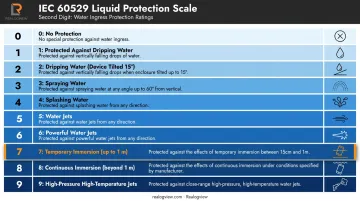
IEC 60529 ends at digit 9, not "9K." The "9K" designation comes from a separate standard — when referencing IEC 60529 specifically, the correct designation is IP69.
Self-Declaration vs. Third-Party Certification
IEC 60529 specifies type tests but does not mandate an accredited third-party laboratory. IEC recognizes manufacturer self-declaration as a valid first-party conformity assessment — though this carries less assurance than independent certification.
When purchasing IP-rated equipment for regulated environments, request the underlying test report before purchasing.
Is IP67 Truly Waterproof? Understanding the Real Limits
Yes — IP67 devices are correctly described as waterproof for most practical purposes. Rain, splashing, accidental drops in shallow water, brief submersion during cleaning: IP67 handles all of these.
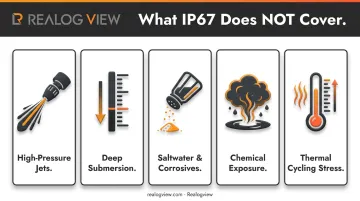
But "waterproof" in this context means something bounded. Here's what IP67 does not cover:
- High-pressure water jets — jet protection (digits 5 and 6) is a separate test. An IP67 device is not rated for hose-down washdown unless it also carries an IP65 or IP66 designation
- Continuous or deep submersion — that's IP68 territory
- Saltwater and chlorinated water — the test uses only fresh water; salt and chlorine accelerate seal and housing corrosion
- Steam and chemical cleaning agents — not part of the IEC 60529 test protocol
- Rapid thermal cycling — pressure differentials from temperature swings can stress seals over time
The Aging Problem
A 2025 peer-reviewed study found that IEC 60529's water tests don't account for seal aging, mechanical wear, repeated impacts, or temperature-humidity cycling over a device's service life. The IP67 rating reflects performance at the time of testing — not after two years in the field.
Physical wear, repeated drops, or improper reassembly after battery replacement can degrade actual protection below the original certified level. For multi-use devices in particular, periodic seal inspection and adherence to manufacturer maintenance schedules are the practical safeguard.
The Warranty Reality
Realogview's 1-year limited warranty explicitly excludes water immersion damage, including on IP67 and IP68-rated models. That exclusion is standard across the industry. IP ratings confirm a device passed a specific lab test under controlled conditions — real-world deployments introduce variables the test doesn't replicate. Review warranty terms before deploying devices in consistently wet environments.
IP67 vs. IP65, IP66, and IP68: A Clear Comparison
| Rating | Dust Protection | Water Protection | Typical Use Case |
|---|---|---|---|
| IP65 | Dust-tight | Low-pressure water jets from any direction | Outdoor stationary equipment, rain exposure |
| IP66 | Dust-tight | Powerful water jets (hose-down) | Industrial washdown, food-grade manufacturing |
| IP67 | Dust-tight | Temporary immersion up to 1 m for 30 min | Cold chain transport, pharmaceutical monitoring, wet handling |
| IP68 | Dust-tight | Continuous immersion beyond 1 m (conditions defined by manufacturer) | Submersion applications, autoclave environments |
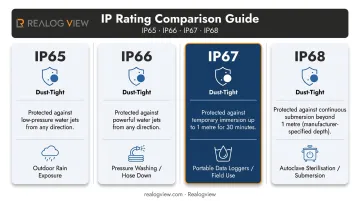
The table looks straightforward, but two distinctions trip up buyers more than any others:
- IP67 does not cover IP66 scenarios. Jet resistance and immersion resistance are separate IEC tests. A device rated only IP67 has never been tested against powerful water jets — if your application involves hose-down washdown, you need IP66 or a dual rating.
- IP68 depth and duration are manufacturer-defined. IEC 60529 only requires that IP68 conditions exceed IP67's parameters. The actual depth and time are agreed between manufacturer and user, so always request the specific test values from the datasheet, not just the IP68 label.
Why IP67 Rating Matters for Industrial and Regulated Applications
The Moisture Problem in Regulated Environments
Pharmaceutical facilities, cold chain logistics operations, and food processing plants all expose equipment to moisture as a matter of routine. Common sources include:
- Condensation when cold product transitions to ambient air
- Liquid exposure during cleaning and sanitization protocols
- Ice melt during freezer defrost cycles
A data logger without adequate ingress protection can fail silently in these conditions, damaging the hardware and creating gaps in temperature records that trigger compliance issues during audits.
Data Integrity and 21 CFR Part 11
FDA 21 CFR Part 11 governs electronic records and signatures in pharmaceutical environments. Its core requirement is that data remains authentic, reliable, and protected from unauthorized alteration. A sealed, tamper-proof enclosure directly supports this: moisture or dust ingress that corrupts sensor data or internal storage undermines the entire audit trail.
Realogview's TempTrail lineup pairs IP-rated enclosures with FDA 21 CFR Part 11 compliance on every model. The TempTrail HiTemp (IP68) is engineered specifically for autoclave validation and sterilization monitoring — environments involving pressurized steam and full submersion where IP67 is not sufficient. All other TempTrail models carry IP67 ratings, suited for cold chain transport, pharmaceutical storage, and warehouse monitoring. Automatic PDF and CSV report generation without external software simplifies audit preparation.
Sanitization in Hygiene-Sensitive Environments
IP67-rated enclosures can be wiped down or briefly rinsed without risking internal damage — a practical advantage in food processing plants and pharmaceutical cleanrooms where surfaces require routine disinfection. The TempTrail HiTemp (IP68) is rated sanitizable and suitable for hygiene-critical environments where cleaning protocols are more aggressive.
For specific cleaning agents and approved sanitization procedures, contact Realogview at support@realogview.com for model-specific guidance.
Frequently Asked Questions
Which is better, IP67 or IP68?
IP68 provides stronger water protection: it's rated for continuous immersion beyond 1 meter for manufacturer-specified durations, compared to IP67's 30-minute limit at 1 meter. Both offer full dust protection. IP67 suits incidental or temporary water exposure; IP68 is the right call when the device will be regularly or continuously submerged.
What does IP67 mean for waterproof?
IP67 certifies the device withstood immersion in fresh water to 1 meter for 30 minutes without harmful ingress under IEC 60529 test conditions. "Waterproof" is accurate for everyday use, but the rating does not cover continuous submersion, pressurized jets, saltwater, or chemical solutions.
Is IP67 fully submersible?
Temporarily, yes — up to 1 meter for up to 30 minutes. It is not designed for continuous or deep submersion. For extended underwater use or applications involving regular submersion, IP68 is the appropriate choice.
Can an IP67 device be used in saltwater?
Not reliably. IEC 60529 testing uses fresh water only. Saltwater, chlorinated water, and cleaning chemicals are more corrosive and can compromise seals not specifically engineered for those exposures. For marine or chemical environments, look for material and corrosion resistance specifications beyond the IP rating itself.
Does IP67 also protect against dust?
Yes. The "6" (first digit) represents the maximum dust protection level under IEC 60529 — complete prevention of dust ingress. This makes IP67-rated devices suitable for dusty warehouses, dry-goods storage, and manufacturing floors.
Does an IP67 rating last forever?
No. The rating reflects performance at the time of testing under controlled conditions. Seal aging, repeated impacts, and improper reassembly after battery replacement can all reduce protection over time. Regular seal inspection and following the manufacturer's maintenance guidance help preserve ingress protection across the device's service life.