The operational problem most fleet operators face isn't awareness. It's understanding. Many know that reefer monitoring matters but misunderstand how the system actually works end-to-end — leading to single-sensor blind spots, compliance gaps, and rejected loads that documentation could have prevented.
This guide breaks down exactly how reefer trailer temperature monitoring works in practice: the hardware, the data flow, the alert logic, and the compliance output. Whether you're running food or pharmaceutical loads, the goal is the same — a system that protects cargo and holds up under regulatory scrutiny.
Key Takeaways
- A complete monitoring system captures readings across multiple thermal zones, not just a single point near the evaporator.
- Readings are logged at set intervals and either stored for post-trip review or transmitted in real time for immediate alerting.
- Automated alerts give dispatchers a window to intervene before a temperature deviation becomes a full load loss.
- Compliance-ready PDF/CSV logs support FSMA, FDA 21 CFR Part 11, and audit documentation requirements.
- System selection comes down to priority: choose real-time telematics when mid-trip intervention matters, or a data logger when post-trip documentation is the goal.
What Is Reefer Trailer Temperature Monitoring?
Reefer trailer temperature monitoring is the consistent use of sensors and logging devices to measure, record, and communicate temperature — and sometimes humidity — conditions inside refrigerated trailers throughout transit and storage. It replaces manual driver checks with automated, continuous data collection.
The core problem it solves: a reefer unit maintains a set-point temperature at the cooling unit, but conditions vary significantly across a 53-foot trailer. A 2021 refrigerated-truck study found a 1.4°C modeled difference between front-middle and rear-middle positions under one loading pattern, and a 4.5°C gap between supplied cold air and the coldest measured box.
Those gaps compound in real trips. A 2025 road-trailer citrus study documented fruit temperatures increasing 3.1°C at pallet centers during a single trip. Zone placement, cargo stacking pattern, door-open frequency, and ambient heat absorption all drive that variation.
One critical distinction: reefer monitoring is not the reefer unit's built-in thermostat or controller display. That display shows the unit's output temperature — not the actual condition of cargo at various points in the trailer.
The Three Main Approaches
| Approach | How It Works | Best For |
|---|---|---|
| Manual checks | Driver records reefer display reading on paper | Low-value, low-risk loads |
| Data loggers | Standalone device records at set intervals; downloaded at delivery | Compliance documentation without live alerting |
| Real-time telematics | Sensors transmit live readings via cellular gateway to cloud dashboard | High-value cargo requiring mid-trip intervention |
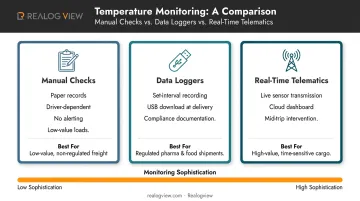
The right choice depends on your cargo risk profile, regulatory requirements, and whether you need to act on temperature data mid-trip or only after delivery.
How Does Reefer Trailer Temperature Monitoring Work?
Reefer monitoring operates through a defined sequence: sensor deployment, continuous data capture, transmission or storage, threshold-based alerting, and compliance-ready output. Each stage contributes to the final goal of verifiable cargo protection.
Sensor Deployment and Activation
Sensors are placed at the key thermal zones of the trailer — typically the nose (near the evaporator), the midpoint, and the door zone. Each area experiences different temperature conditions due to airflow dynamics, cargo stacking, and door-open events. A single sensor at the nose creates a blind spot for the rest of the load.
Monitoring initiation can be:
- Manual — driver activates the logger before departure
- Automated — sensor begins logging upon trailer power-up or when a threshold drop is detected
- Continuous — sensor logs around the clock regardless of trip status
At this stage, operators configure logging interval, alarm thresholds, measurement units, and start delay. These settings directly affect data granularity, battery life, and the compliance value of the record. On Realogview's TempTrail multi-use models, all of these parameters are fully configurable before each deployment. Single-use models ship with pre-set 10-minute intervals and a 30-minute start delay, with alarm thresholds fixed at >8°C and <2°C.
Sensors placed incorrectly at the start of a shipment produce records that don't represent the full load, which weakens both operational decisions and compliance documentation.
Data Capture and Transmission
Sensors measure temperature at pre-set intervals using an internal probe or integrated sensor element, convert the reading to a digital value, and either store it in onboard memory or transmit it wirelessly through a BLE, cellular, or Wi-Fi gateway to a cloud platform. Each data point is timestamped and tied to the sensor's location.
How this differs by system type:
- Data logger setup: All readings stored onboard, downloaded via USB at delivery. Realogview's TempTrail XL, for example, stores up to 32,000 data points at ±0.2°C accuracy — enough for up to 220 days of continuous monitoring at a 10-minute interval.
- Real-time telematics setup: Readings flow from the sensor through a cellular gateway to a cloud dashboard, giving dispatchers live visibility from any device.
Three variables determine performance:
- Logging interval — shorter intervals produce a more detailed record, which matters when excursions are brief or cargo is sensitive
- Sensor accuracy — the CDC's 2024 Vaccine Storage and Handling Toolkit recommends ±0.5°C uncertainty for digital data loggers, with a logging interval programmable to at least every 30 minutes; Realogview's TempTrail line meets and exceeds this at ±0.2°C
- Connectivity reliability — determines whether real-time alerts reach someone in time to act
Alerts and Compliance Output
When a sensor reading crosses a pre-configured upper or lower limit, the system triggers an automated notification — SMS, email, in-app alert, or on-device indicator — to the dispatcher, fleet manager, or driver. That alert creates a window to intervene before cargo is lost.
On Realogview's TempTrail devices, excursions are flagged immediately on the device itself:
- LED-based models (Classic, XL): A bright red LED activates when thresholds are breached
- Display models (Display, Humidity & Display, Glacial Display): A bell icon appears on the LCD screen alongside the current reading
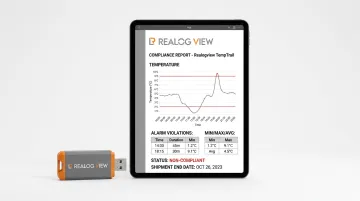
At delivery, the system produces a complete, timestamped temperature log — automatically generated as a PDF and CSV file upon USB connection, with no external software required. Reports include the full temperature history, alarm violation data, device configuration details, min/max/average values, and total monitoring duration.
That documentation serves three parties at once: auditors get a verifiable chain-of-custody, receivers get documented proof of temperature control, and carriers get defensible evidence if a spoilage dispute arises.
Types of Reefer Monitoring Systems
Manual Monitoring
The driver checks the reefer unit's display and records the reading on paper or a spreadsheet. No real-time alerting, dependent entirely on driver compliance, and produces records with significant data gaps. Difficult to use in audits and offers no intervention window during transit. This approach is rarely accepted under FSMA or pharmaceutical audit requirements.
Data Loggers
Standalone devices that record temperature at set intervals, with data downloaded and reviewed at delivery. They meet compliance documentation requirements for food safety and pharmaceutical applications under FDA 21 CFR Part 11, making them the practical entry point for operators who need verifiable records without building out a full telematics infrastructure.
Realogview's TempTrail product line is purpose-built for this use case. Key features across the line:
- Generates PDF and CSV reports via USB with no external software, drivers, or proprietary apps
- FDA 21 CFR Part 11 compliant — tamper-proof physical design, secure time-stamped records, and audit-ready output
- DO-160G certified for vibration, temperature shock, humidity, and other transport stressors typical of reefer environments
- IP67 waterproof rating protects against condensation, splashing, and trailer washdowns
For most reefer applications in food and pharmaceutical cold chain, the TempTrail Humidity & Display (Rh-M multi-use model) tracks both temperature and relative humidity — critical for produce, seafood, and pharmaceutical shipments where moisture levels matter alongside temperature. The TempTrail XL covers temperature-only monitoring across up to 220 days, making it well-suited for long-haul routes.
Real-Time Telematics Monitoring
Where data loggers capture a complete record after the fact, telematics systems act during the trip. These platforms combine live temperature readings from BLE or wired sensors with GPS location data and alert notifications through a cellular gateway and cloud platform. They're standard for fleets with active compliance requirements or high-value cargo where catching an excursion mid-route matters. The tradeoff is higher infrastructure cost and setup complexity compared to data loggers — but they provide live visibility across every refrigerated asset in the fleet.
Benefits of Reefer Trailer Temperature Monitoring
Prevents Cargo Spoilage and Load Rejections
Real-time alerts give dispatchers and drivers a window to intervene — adjusting reefer settings, checking door seals, or rerouting — before a temperature deviation becomes a full load loss. According to TT Club, temperature-controlled cargo claims commonly arise from deviations caused by inaccurate communication, operational errors, or equipment breakdowns. A single rejected reefer load of pharmaceuticals or fresh produce can represent thousands of dollars in product loss. The cost of a monitoring system is a fraction of that exposure.
Ensures FSMA and Regulatory Compliance
The FDA's FSMA Sanitary Transportation Rule (21 CFR Part 1, Subpart O) requires shippers to specify temperature conditions and carriers to demonstrate those conditions were maintained when requested. Automated, timestamped temperature logs satisfy this documentation requirement in a way that manual records cannot.
For pharmaceutical and life sciences operators, FDA 21 CFR Part 11 requires tamper-evident electronic records with complete data integrity and traceability. Realogview's TempTrail loggers are built to these standards. Each auto-generated PDF report captures a non-editable record of:
- Complete temperature history across the shipment
- Alarm violations with precise timing and duration
- Device configuration at the time of logging
Reports are ready for regulatory review with no additional steps required.
Reduces Insurance Liability and Dispute Exposure
Continuous temperature documentation provides clear evidence of proper cargo handling from pickup to delivery. In the event of a spoilage claim, timestamped logs allow carriers to demonstrate due diligence — turning what was previously a "he said/she said" dispute into a documented record. TempTrail reports capture the full temperature timeline including precise excursion timing and duration, which is exactly the kind of evidence that resolves cargo claims.
Improves Operational Visibility
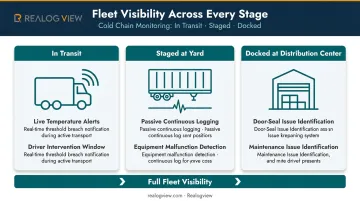
A centralized monitoring approach gives fleet managers visibility across all refrigerated assets — in transit, staged at a yard, or docked at a distribution center — without manual check-in calls. This visibility supports:
- Faster response to equipment malfunctions
- Smarter dispatching based on actual asset conditions
- Earlier identification of reefer units running harder than necessary (often a signal of a door-seal problem or maintenance issue before it becomes a cargo event)
A Verifiable Record Shippers Can Require
Shippers increasingly require carriers to provide documented temperature control as a contract condition. Presenting a complete, verifiable temperature report at delivery — rather than a handwritten log — strengthens carrier credibility and gives carriers a concrete edge when bidding on pharmaceutical, food safety, or high-value logistics contracts.
Realogview's certification portfolio supports this directly. Both credentials are verifiable by prospective shippers during the bidding process:
- FDA 21 CFR Part 11 — baseline requirement for pharmaceutical contracts, confirming tamper-evident data integrity
- DO-160G — third-party hardware certification demonstrating reliability under real-world transport conditions
Frequently Asked Questions
What is the proper temperature for a refrigerated delivery truck?
Requirements vary by cargo type. Fresh produce typically requires 34°F–40°F (1°C–4°C), frozen goods 0°F (-18°C) or below, and pharmaceuticals follow USP-defined ranges of 2°C–8°C for controlled cold temperature products. Your data logger should support custom alarm threshold configuration for each load type.
What should be used to monitor fridge temperatures continuously?
Data loggers are the standard choice for most cold chain shipments — they record at set intervals, store readings onboard, and generate compliance-ready PDF/CSV reports at delivery without any external software. Real-time telematics sensors add live cellular transmission for mid-trip alerts, but are better suited to high-value cargo requiring active in-transit oversight.
What are the main components of a reefer trailer temperature monitoring system?
Three components make up a complete system:
- Sensors placed at key thermal zones inside the trailer
- A data logger or gateway to record or transmit readings
- A reporting interface — auto-generated PDF/CSV or cloud dashboard — for compliance documentation
How often should temperature be recorded in a refrigerated trailer?
Common intervals range from every 15 to 30 minutes, depending on cargo sensitivity. The CDC recommends a programmable interval of at least every 30 minutes for vaccine transport; shorter intervals yield more granular records but draw more battery and storage.
What regulations govern reefer trailer temperature monitoring in the U.S.?
Two primary frameworks apply: FSMA's Sanitary Transportation Rule (21 CFR Part 1, Subpart O) for food carriers, and FDA 21 CFR Part 11 for pharmaceutical and life sciences operators requiring tamper-evident, traceable electronic records. Records under FSMA must generally be retained for 12 months.
What is the difference between a data logger and a real-time telematics monitoring system?
Data loggers record temperature at set intervals, store readings onboard, and generate compliance reports at delivery — no in-transit alerting required. Real-time telematics systems transmit live readings via cellular gateway and trigger immediate alerts, enabling intervention before a load is compromised.