
Introduction
Not every product can share the same roof. A warehouse storing flat-pack furniture operates under entirely different rules than one holding vaccines or insulin — and choosing the wrong environment has real consequences.
Temperature-sensitive industries face a cascading problem: product loss, regulatory penalties, and customer trust damage all hit at once when storage conditions fail. Cold-chain medicines represented $384 billion — or 35% — of the global pharmaceutical market in 2022, according to IQVIA, yet these products account for only 0.2% of total pharmaceutical volume. The value concentration alone explains why a single storage failure can be catastrophic.
This guide covers what separates temperature-controlled from ambient warehouses, which industries rely on each, and how to select the right setup for your operation.
Key Takeaways
- Temperature-controlled warehouses use active refrigeration or heating to maintain defined ranges; ambient warehouses rely on prevailing room conditions.
- Product labeling and regulatory requirements — not operational preference — determine which warehouse type is required.
- Refrigerated warehouse construction runs $240–$350 per sq. ft. — roughly 2–3× the cost of dry storage (CBRE Midwest, 2025).
- Continuous monitoring and documented data logging are compliance requirements in temperature-controlled environments.
- Ambient storage suits shelf-stable goods; temperature-controlled storage is non-negotiable for pharmaceuticals, vaccines, biologics, and fresh food.
Temperature-Controlled vs. Ambient Warehouses: Quick Comparison
The table below captures the core differences at a glance. Use it as a starting point — the sections that follow explain each factor in depth.
| Factor | Temperature-Controlled | Ambient |
|---|---|---|
| Storage conditions | Active refrigeration/heating maintains precise ranges (2–8°C chilled; –25 to –10°C frozen; 20–25°C CRT) | Prevailing room conditions; no active thermal control |
| Infrastructure | Specialized HVAC, refrigeration units, insulation, backup power, sensor networks | Standard construction; basic HVAC for occupant comfort only |
| Construction cost | $240–$350/sq. ft. (Midwest, CBRE 2025); typically 2–3× dry-warehouse | Lower baseline; no refrigeration infrastructure required |
| Regulatory burden | FDA 21 CFR Part 211, USDA HACCP, USP <659>, WHO GDP guidance; requires documented records | Standard health, safety, and fire codes |
| Best for | Pharmaceuticals, vaccines, biologics, fresh produce, dairy, certain cosmetics | Packaged foods, canned goods, clothing, electronics, furniture |
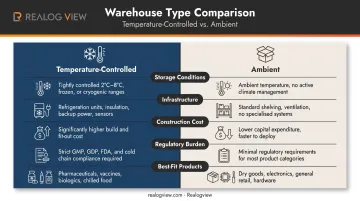
The right choice depends heavily on your product's sensitivity and your compliance obligations — both of which are covered in the sections below.
What Is a Temperature-Controlled Warehouse?
A temperature-controlled warehouse is a storage facility that uses active heating, cooling, or both to maintain interior conditions within a defined range — 24 hours a day, regardless of outdoor conditions. In many cases, humidity control is layered on top of temperature management. Product integrity depends on these environmental parameters being maintained consistently, not just approximately.
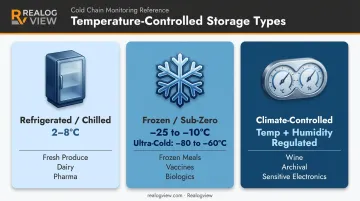
The Three Main Storage Sub-Types
1. Refrigerated/Chilled (2–8°C) Used for fresh produce, dairy, and pharmaceutical products with a refrigerated label requirement. USP <659> defines the refrigerator storage band as 2–8°C, and this is the range that governs most pharmaceutical cold chain deployments.
2. Frozen/Sub-Zero (–25 to –10°C; –80 to –60°C for ultra-cold) Frozen meals, certain vaccines, and biological samples fall here. WHO guidance supports program-specific ranges of –15 to –25°C for standard frozen vaccines and –80 to –60°C for ultra-cold products like the first WHO-listed COVID-19 vaccine. Each range is product-specific. There is no single universal frozen band.
3. Climate-Controlled (Temperature + Humidity) Fine wines, archival materials, sensitive pharmaceuticals, and certain electronics require management of multiple environmental factors simultaneously — temperature, humidity, and sometimes air quality. This is a distinct category from simple refrigeration.
The Compliance Dimension
Regulatory requirements set the floor for what temperature-controlled warehouses must document:
- FDA 21 CFR 211.142 requires written warehousing procedures with appropriate temperature, humidity, and light conditions for drug storage
- WHO's GDP model guidance recommends calibrated continuous monitoring systems for all temperature-controlled rooms
Meeting these requirements means continuous, verifiable data capture — not periodic manual checks. Realogview's TempTrail™ data loggers are FDA 21 CFR Part 11 compliant and automatically generate locked PDF and CSV reports the moment a device is connected to a USB port. No external software, no proprietary reader hardware. For pharmaceutical and cold chain operators, audit-ready documentation becomes a byproduct of normal operations rather than a separate compliance task.
Use Cases for Temperature-Controlled Warehouses
| Industry | Storage requirement |
|---|---|
| Pharmaceutical | APIs and finished drugs at 2–8°C; CRT products at 20–25°C |
| Vaccine distribution | Refrigerated (2–8°C) to ultra-cold (–80 to –60°C) depending on product |
| Food & beverage | Fresh produce, dairy, frozen SKUs at various controlled ranges |
| Biotech/laboratory | Biological samples, cryogenic materials at sub-zero to ultra-low temperatures |
| Cosmetics | Active-ingredient formulations (retinol, vitamin C) sensitive to heat degradation |
What Is an Ambient Warehouse?
An ambient warehouse stores goods at prevailing room temperature — no refrigeration, no active climate control beyond basic HVAC for occupant comfort. "Ambient" does not mean unmanaged. Quality facilities monitor interior conditions to prevent extreme seasonal spikes, but the goal is a stable room-temperature environment — not a precisely engineered one.
That informal definition has a formal counterpart. Under USP <659>, ambient temperature refers to the prevailing room temperature — distinct from Controlled Room Temperature (CRT), which is a thermostatically maintained 20–25°C environment. For pharmaceutical operators, this is a meaningful regulatory distinction, not a technicality.
Why Ambient Storage Makes Sense for Most Consumer Goods
- Lower infrastructure cost — no refrigeration equipment, lower energy consumption, simpler maintenance
- Fewer failure points — no compressors, no backup power systems for climate control
- Lighter regulatory burden — standard health, safety, and fire codes rather than FDA or USDA frameworks
- Adequate for the vast majority of goods — packaged foods, textiles, electronics, and furniture don't require active thermal management
Use Cases for Ambient Warehouses
Ambient storage is appropriate for:
- E-commerce retailers with packaged consumer goods
- Clothing and apparel brands
- Food distributors handling canned goods, dry grains, and shelf-stable snacks
- Electronics manufacturers storing packaged devices
- General retail distribution centers with non-perishable inventory
Note on CRT products: Some ambient facilities can accommodate pharmaceutical products labeled for 20–25°C storage with supplemental controls. This still differs from full refrigerated storage. Always let the product label — not the facility's approximate capability — determine the storage decision.
Which Warehouse Type Does Your Business Need?
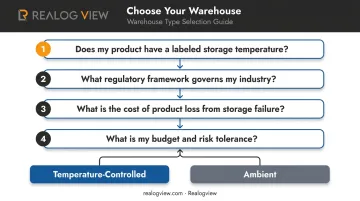
Four Questions to Ask Before Choosing
- Does my product carry a labeled storage temperature? If yes, that label defines your facility requirement. No exceptions.
- What regulatory framework governs my industry? Pharmaceuticals, biologics, and meat/poultry products each operate under distinct binding rules — FDA cGMP, USDA HACCP, USP standards.
- What is the cost of product loss if storage conditions fail? High-value, low-volume products (like cold-chain pharmaceuticals) make temperature-controlled investment obvious. Shelf-stable goods with no spoilage risk don't justify the premium.
- What is my budget, and what risk am I mitigating? Temperature-controlled infrastructure is a risk management tool, not a cost center, for businesses where storage failure triggers product loss, regulatory action, or both.
Clear Recommendations by Situation
Choose temperature-controlled warehousing if you handle:
- Pharmaceuticals with a labeled refrigerated or frozen storage requirement
- Vaccines at any temperature band (refrigerated through ultra-cold)
- Biologics, blood products, or cryogenic materials
- Fresh or frozen food requiring active temperature maintenance
- Any product where the label specifies a storage temperature
Choose ambient warehousing if you handle:
- Packaged shelf-stable foods with no temperature specification
- Standard consumer electronics in factory packaging
- Clothing, textiles, and furniture
- Canned goods, dry grains, and non-perishable household products
The Monitoring Imperative for Temperature-Controlled Facilities
Once you've confirmed a temperature-controlled facility is required, the compliance obligations don't stop at the building itself. Continuous monitoring and documented logging are mandatory in regulated industries — and the standards are specific.
FDA 21 CFR 211.68 requires routine calibration and written records for monitoring equipment. WHO GDP guidance calls for continuous monitoring systems in temperature-controlled rooms. Both frameworks expect more than a single sensor at the facility entrance; multiple monitoring points distributed across storage zones are the baseline expectation.
For warehouse operators, this means selecting equipment that supports extended continuous recording and generates audit-ready documentation automatically. Realogview's TempTrail™ Display, for example, handles warehouse-scale monitoring with user-configurable alarm thresholds, a large LCD for instant visual checks, and 32,000 data points for long-duration recording. Where moisture-sensitive pharmaceuticals or biologics are stored, the TempTrail™ Humidity & Display adds simultaneous relative humidity tracking to the same unit.
Both models output automatic PDF and CSV reports via standard USB connection, satisfying the audit trail requirements that temperature-controlled facility operators face during regulatory inspections.
Conclusion
Temperature-controlled and ambient warehouses are not competing options — they serve fundamentally different product categories. The choice is determined by the product label, the applicable regulatory framework, and the cost of getting it wrong.
Getting that choice right reduces spoilage losses, maintains regulatory standing, and protects brand reputation. For businesses in temperature-sensitive industries, the investment in controlled infrastructure — along with the continuous monitoring tools that document excursions, generate audit-ready reports, and create an unbroken chain of custody — is a risk management decision, not a line item to minimize.
If your product has a temperature on the label, it belongs in a temperature-controlled facility, monitored continuously, with records ready for any audit that follows.
Frequently Asked Questions
What is a temperature-controlled warehouse?
A temperature-controlled warehouse uses active refrigeration, heating, or climate management systems to keep interior conditions within a defined temperature and sometimes humidity range, around the clock. These facilities protect temperature-sensitive goods — pharmaceuticals, vaccines, biologics, and perishable foods — throughout storage and distribution.
What distinguishes temperature-controlled warehouses from climate-controlled warehouses?
Temperature-controlled warehouses focus specifically on maintaining defined temperature bands — refrigerated, frozen, or chilled. Climate-controlled warehouses manage multiple environmental factors , including temperature, humidity, and sometimes air quality, making them appropriate for wine, artwork, archival materials, and pharmaceuticals with combined temperature and humidity requirements.
What industries commonly use climate-controlled warehouses?
Climate-controlled warehouses are used by wine producers and distributors, fine art galleries and museums, archival storage facilities, specialty electronics manufacturers, and pharmaceutical companies handling products that require both temperature and humidity management at once.
What products can be stored in an ambient warehouse?
Canned foods, packaged snacks, dry goods, clothing and textiles, standard consumer electronics, furniture, and most household products are all suitable for ambient storage: anything shelf-stable with no defined temperature storage requirement on its label.
How is temperature monitoring handled in temperature-controlled warehouses?
Facilities use sensor networks and data loggers placed throughout storage zones to continuously track temperature and humidity. These devices generate time-stamped logs that form the regulatory audit trail. Many modern loggers automatically produce PDF and CSV reports via USB — no external software needed.
What are the cost differences between temperature-controlled and ambient warehouses?
CBRE reported in 2025 that Midwest refrigerated warehouse construction averaged $240–$350 per sq. ft. and was typically 2–3× the cost of dry-warehouse construction, due to specialized refrigeration infrastructure, higher energy consumption, and increased maintenance requirements.