
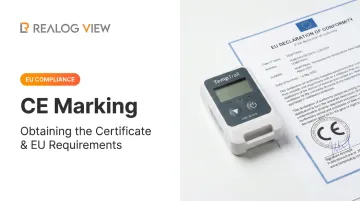
This article is written for manufacturers, importers, and distributors in regulated sectors — pharmaceuticals, cold chain logistics, medical devices, electronics — who need a clear operational picture of what CE marking requires, not just what it means.
Key Takeaways
- CE marking is a manufacturer's legal declaration of conformity, not a government-issued certificate or quality seal
- No single EU authority grants CE certification — manufacturers complete the conformity assessment themselves
- Higher-risk products require an accredited Notified Body; lower-risk categories permit self-declaration
- Every CE-marked product needs an EU Declaration of Conformity and a supporting technical file, retained for at least 10 years
- CE marking is mandatory — not optional — for covered product categories across 30 EEA countries
What Is CE Marking?
CE stands for Conformité Européenne — European Conformity. As defined under Regulation 765/2008, it is "a marking by which the manufacturer indicates that the product is in conformity with the applicable requirements set out in Union harmonisation legislation providing for its affixing." Affixing the mark transfers legal responsibility to the manufacturer.
CE marking is not a product quality seal, EU government approval, or a certificate issued by a central authority.
The manufacturer evaluates conformity, drafts the documentation, signs the declaration, and affixes the mark. The EU's role is to set the rules and enforce them — not to approve individual products before they reach the market.
How CE Differs From Related Marks
| Mark | Jurisdiction | Issued By |
|---|---|---|
| CE | EU / EEA (30 countries) | Self-declaration by manufacturer |
| UKCA | Great Britain (post-Brexit) | Self-declaration under UK rules |
| FDA Clearance | United States | US Food and Drug Administration |
The UKCA mark replaced CE for Great Britain after Brexit, and products placed on the UK market now require UKCA compliance under separate UK legislation. CE marking and FDA clearance operate in entirely separate frameworks with no mutual recognition.
The claim that CE stands for "China Export" is false. The European Commission has confirmed there is no official "China Export" mark — the letters refer solely to European Conformity.
Understanding what CE marking is — and what it isn't — sets the foundation for navigating the compliance process itself.
Why CE Marking Matters for Manufacturers in Regulated Industries
Market Access Across 30 Countries
CE marking is the legal prerequisite for placing covered products on the market across 30 EEA countries — the 27 EU member states plus Iceland, Liechtenstein, and Norway. Without it, products subject to EU harmonised legislation cannot legally be sold in any of those markets.
Turkey operates under a separate arrangement. The EU-Turkey Customs Union aligns CE requirements for industrial goods through Turkish technical legislation, but Turkey is not an EEA member.
For manufacturers in sectors like pharmaceuticals, cold chain logistics, and electronics, this single mark provides access to a market of 450+ million consumers. Getting the process right determines whether you can sell there at all.
Industry-Specific Stakes
Regulated industries face compounding compliance demands. Electronic temperature monitoring equipment used in pharmaceutical cold chains, for example, may need to satisfy the EMC Directive (electromagnetic compatibility), the RoHS Directive (hazardous substances), and potentially the Radio Equipment Directive if wireless-enabled. Each directive adds requirements to the conformity assessment.
Realogview's TempTrail data loggers — designed for pharmaceutical, vaccine transport, and cold chain applications — carry CE and RoHS certifications as part of a broader compliance framework. The TempTrail Display, for instance, also holds FCC, FDA 21 CFR Part 11, and DO-160G certifications simultaneously.
That combination is typical for regulated monitoring equipment sold across multiple jurisdictions: EU market access requires CE; US distribution requires FCC and FDA alignment; aviation and harsh-environment use adds DO-160G.
Consequences of Non-Compliance
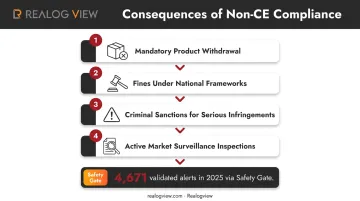
Selling a CE-required product without the mark carries real enforcement consequences:
- Mandatory product withdrawal from the EU market
- Fines under national penalty frameworks (EU law requires penalties to be "effective, proportionate and dissuasive")
- Potential criminal sanctions for serious infringements
- Market surveillance authorities in each member state actively inspect and act on non-compliant products
Safety Gate, the EU's rapid alert system, recorded 4,671 validated alerts for dangerous non-food products in 2025, illustrating the scale of active market surveillance across the bloc.
How to Obtain CE Marking: A Step-by-Step Process
There is no application to file with an EU body. CE marking is obtained by working through a defined conformity assessment process — the manufacturer manages it, documents it, and signs off on it.
Step 1: Identify Applicable EU Directives
The first task is determining which directives apply to the product. This matters because:
- A single product can fall under multiple directives simultaneously
- Each directive specifies its own essential requirements
- The CE mark cannot be affixed until all applicable directives are satisfied
An electronic data logger, for example, will typically fall under the EMC Directive (2014/30/EU) because it is electrical/electronic apparatus that can create or be affected by electromagnetic disturbance. If it incorporates Bluetooth or Wi-Fi, the Radio Equipment Directive (2014/53/EU) becomes relevant.
RoHS (2011/65/EU) applies broadly to electrical and electronic equipment. Low Voltage Directive (2014/35/EU) applies only within specific voltage ranges; many battery-powered loggers fall below the threshold.
The EU's official CE marking legislation list is the reference point. Start there, then examine each directive's scope section carefully.
Step 2: Determine the Conformity Assessment Route
Each directive specifies one or more assessment modules (defined in Decision 768/2008). The module determines whether a Notified Body must be involved.
| Module | Mechanism | Notified Body? |
|---|---|---|
| A | Internal production control | No |
| B + C/D/E/F | Type examination + production control | Yes (for type examination) |
| G | Unit verification | Yes |
| H | Full quality assurance (design + production) | Yes |
Module A is self-assessment: the manufacturer evaluates conformity internally. Module H requires a Notified Body to approve and surveil the full quality system. The applicable directive, not a general risk judgment, determines which modules are permitted.
Medical devices are a clear example of how this escalates: under MDR 2017/745, Class IIa, IIb, and Class III devices require Notified Body involvement. Lower-classification products may use different routes. The NANDO database lists all accredited Notified Bodies by legislation and scope.
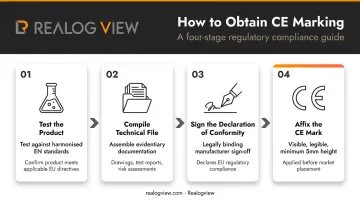
Step 3: Test, Document, and Affix the Mark
With the applicable directives identified and the assessment route confirmed:
- Test the product against relevant harmonised European (EN) standards. Standards published in the EU Official Journal carry a "presumption of conformity" to the directive's essential requirements
- Compile the technical file — this is the evidentiary record supporting the CE declaration (see next section for required content)
- Draft and sign the EU Declaration of Conformity: a legally binding document the manufacturer signs
- Affix the CE mark visibly, legibly, and indelibly on the product or packaging; minimum height 5mm; if a Notified Body was involved in the production phase, their 4-digit identification number must appear beside the mark
Key EU Requirements and Documentation
EU Declaration of Conformity (DoC)
The DoC is the manufacturer's legal claim of compliance. It must include:
- Manufacturer's name and address
- Product identification (name, model, batch/serial number)
- List of all applicable EU directives and harmonised standards
- Notified Body name and certificate number (where applicable)
- Date of issue
- Legally binding signature with name and function of signatory
A single DoC can cover multiple applicable EU acts. It must be kept current — if product design changes, applicable legislation updates, or contact details change, the DoC must be reviewed and reissued.
Technical File
The technical file is the evidence that backs the DoC. It must contain:
- Technical description and design/manufacturing drawings
- Material specifications and component declarations
- Risk assessment
- Test reports and calculations
- Labels and instructions for use
- Notified Body documentation (where applicable)
Retention requirement: Both the DoC and technical file must be retained for at least 10 years after the product is last placed on the market, and made available to national competent authorities upon request.
Multi-Directive Compliance in Practice
When a product falls under more than one directive, all applicable essential requirements must be satisfied before the mark is affixed. For temperature and humidity data loggers with wireless capability, this means addressing multiple directives at once. A Bluetooth-enabled temperature data logger for pharmaceutical use, for example, would typically fall under:
- EMC Directive (2014/30/EU) — electromagnetic compatibility
- RED (2014/53/EU) — radio equipment (governs the wireless aspects)
- RoHS (2011/65/EU) — restriction of hazardous substances
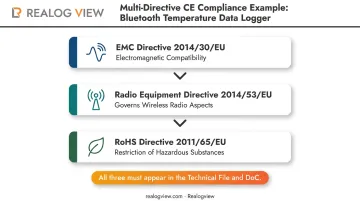
All three directives would need to be addressed in the technical file and listed in the DoC. Products sold in both EU and US markets face this same layered requirement across both frameworks — which is why devices like Realogview's data loggers carry CE, RoHS, and FCC certifications on a single product.
Common CE Marking Misconceptions and Pitfalls
Misconception 1: CE Marking Means Independent Testing
CE marking means the manufacturer has declared conformity, not that a government body or independent lab has verified it. For many product categories, self-declaration under Module A is entirely legal. The mark's reliability depends on how rigorously the manufacturer conducted its assessment — which is why national market surveillance authorities conduct post-market inspections.
Misconception 2: Voluntary CE Certificates Are Legitimate
Your Europe's official guidance explicitly warns that paid "voluntary CE certificates" carry no legal recognition. Some organizations issue them without proper product testing and beyond their legal competence. Purchasing one of these certificates does not satisfy the legally mandated conformity assessment. The CE mark may only be affixed after that process is complete.
Misconception 3: The CE Mark Itself Is Straightforward to Replicate
Counterfeit or incorrectly proportioned CE marks are an active enforcement issue across EEA member states. The mark must conform to the prescribed dimensions (minimum 5mm height, correct proportions). Affixing a CE mark to a non-compliant product, or using a lookalike symbol with incorrect proportions, violates Regulation 765/2008. National penalties range from fines to criminal sanctions for serious infringements.
Key enforcement risks to avoid:
- Purchasing "voluntary CE certificates" that carry no legal standing
- Affixing the mark before completing the required conformity assessment
- Using incorrectly scaled or counterfeit CE symbols on product packaging
Frequently Asked Questions
What does CE certified mean?
CE marking is a manufacturer's self-declaration that a product meets all applicable EU health, safety, and environmental directives — allowing it to be marketed across the EEA. It is not a quality certificate or government-issued approval; the manufacturer assumes full legal responsibility for conformity.
Is CE certification accepted in the US?
No. CE marking has no legal status in the United States. US market access requires separate compliance with federal rules — FCC for electronics, FDA for medical devices and pharmaceuticals, OSHA for safety equipment. CE and US compliance frameworks operate independently with no mutual recognition.
What products require CE marking?
Key categories include electronics, medical devices, machinery, toys, personal protective equipment, measuring instruments, pressure equipment, and radio equipment. Not all products require it — products outside EU harmonised legislation must not carry the CE mark.
Can a US manufacturer obtain CE marking?
Yes. Non-EU manufacturers — including US companies — can self-certify where the directive permits, or engage an accredited Notified Body where third-party verification is required. For regulated categories like medical devices under MDR, a non-EU manufacturer must also appoint an EU Authorised Representative to manage compliance documentation with market surveillance authorities.
What happens if a product is sold in the EU without CE marking?
Selling a CE-required product without the mark is a compliance violation that national market surveillance authorities actively enforce. Consequences include mandatory product withdrawal, fines, and — for serious infringements — potential criminal sanctions under national law.
Is CE certification good?
CE marking is essential for selling covered products in EU/EEA markets. It signals regulatory compliance to buyers, distributors, and regulators. That said, the mark is only as credible as the conformity assessment behind it — self-declaration without independent verification is permitted for many categories, so rigour varies by manufacturer.