Introduction
Temperature control failures in the cold chain carry real consequences. According to CDC analysis of foodborne illness outbreaks from 2014–2022, inadequate cold holding was a contributing factor in 10.2% of outbreaks where factors were identified, with prolonged time outside temperature control accounting for another 13.1%.
The pharmaceutical sector faces equally steep costs. A single shipping excursion prompted Sandoz to recall an entire lot of enoxaparin sodium in 2021. McKesson paid $18 million to resolve allegations tied to improperly set temperature monitors in vaccine shipments.
Each of these failures traces back to the same root problem: a gap somewhere in the cold chain. The cold chain is the unbroken sequence of temperature-controlled environments that keeps perishable products safe from production to final destination. Temperature monitoring is what keeps that sequence intact — without it, there's no way to know when or where a breach occurred.
This guide breaks down how cold chain monitoring works, what regulations govern it, and how to select the right tools for your operation — whether you're shipping vaccines, perishable food, or biological samples.
Key Takeaways
- Temperature excursions during transit and storage cause product loss, regulatory penalties, and brand damage across pharmaceuticals and food logistics
- Passive data loggers and active wireless sensors serve different supply chain stages; using the wrong type creates compliance gaps
- FDA 21 CFR Part 11, FSMA, HACCP, and EU GDP impose specific documentation and audit trail requirements on temperature records
- Device selection must match your product's temperature range, compliance needs, and operational environment
- Generating compliance reports without external software eliminates IT barriers at delivery and makes verification immediate
What Is Cold Chain Temperature Monitoring?
Cold chain temperature monitoring is the systematic process of continuously tracking and recording environmental conditions — primarily temperature, and in some cases humidity — across every stage of a product's journey from production to final destination. Understanding how these systems work helps clarify which approach fits your operation.
How Monitoring Systems Work
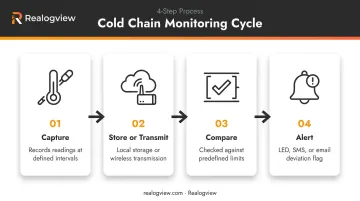
The process follows four steps:
- Capture — Sensors or data loggers record temperature readings at defined intervals (every 5 seconds to every 24 hours, depending on configuration)
- Store or transmit — Readings are stored locally on the device or transmitted wirelessly to a central platform
- Compare — Readings are checked against predefined thresholds for acceptable temperature ranges
- Alert — When readings fall outside acceptable bounds, the system flags the deviation via LED alarm, display notification, SMS, or email
Passive vs. Active Monitoring
The two broad categories of monitoring differ in how and when data becomes actionable:
| Type | How It Works | Best Use Case |
|---|---|---|
| Passive (data loggers) | Records data internally; reviewed after the shipment via USB download or PDF report | Closed in-transit shipments, regulatory documentation |
| Active (wireless sensors) | Transmits data in real time via Wi-Fi, cellular, or Bluetooth to a remote platform | Stationary storage facilities, continuous facility monitoring |
Both have legitimate roles. Passive loggers are well-suited for individual shipments where regulatory documentation is the priority. Active systems make more sense for warehouses or distribution centers where instant remote alerts can prevent overnight failures.
For example, Realogview's TempTrail™ line uses the passive approach: each logger stores data locally and generates PDF and CSV reports automatically when connected via USB — no external software needed. Select models add LCD displays and LED indicators for on-device alerts during transit.
Why Cold Chain Temperature Monitoring Matters
Product Safety and Regulatory Liability
The stakes vary by product, but the principle is consistent: brief temperature excursions can render medications ineffective, accelerate bacterial growth in food, or degrade biologics beyond recovery.
A 2020 peer-reviewed study monitoring 213 vaccine storage devices found that temperatures fell below 2°C — outside the safe refrigerated range — during 32.6% of 59,039.7 monitored storage hours. That's not a data point about damaged vaccines specifically, but it illustrates how frequently storage conditions deviate from specifications, even in monitored environments.
On the regulatory side, failure to document temperature conditions isn't just an operational problem — it's a legal one. FDA 21 CFR Part 11 requires that electronic records be secure, auditable, and tamper-evident. Non-compliance can trigger warning letters, product seizure, or recalls. The $18 million McKesson settlement demonstrates that enforcement is real, not theoretical.
Financial Cost and Brand Risk
Those regulatory risks carry direct financial consequences. Cold chain failures create exposure across multiple fronts:
- Discard or recall spoiled inventory at full replacement cost
- Absorb fines, remediation costs, and recall logistics expenses
- Lose customer trust after a high-profile failure — especially damaging in pharmaceuticals or premium food
Beyond avoiding losses, accurate monitoring also reduces unnecessary waste. Continuous, reliable records let quality teams assess borderline excursions confidently — rather than discarding entire lots out of precaution.
The Three Stages of Cold Chain Temperature Monitoring
Manufacturing and Processing
Temperature-sensitive raw materials — biological drug substances, fermented food ingredients, active pharmaceutical ingredients — must be monitored at the production stage before the product even enters the supply chain. If processing conditions deviate from specification, the problem is embedded in the product from the start. Monitoring at this stage catches issues early, when corrective action is still possible.
Shipping and Transportation
Transit is where the greatest variability occurs. Products move through changing climates, multiple vehicle handoffs, and different handling environments — sometimes across multiple countries. IQVIA notes that temperature problems occur more frequently during the final distribution stage, from local distribution centers to the end recipient.
Key monitoring requirements during transit include:
- Logs continuously at defined intervals to capture the full temperature history, not just spot checks
- Displays on-device alerts via LED indicators or LCD screens so handlers can identify excursions without waiting for a data download
- Provides sufficient data capacity for the full shipment duration — the TempTrail™ XL supports up to 220 days, covering even the longest international routes
For applications with strict traceability requirements, continuous temperature history across every transit leg — not just origin and destination readings — is the baseline expectation for regulatory documentation.
Storage
Storage monitoring applies at every node: manufacturer warehouses, distribution centers, hospital refrigerators, retail cold rooms. Continuity is the key requirement — spot checks miss the failures that happen at 2 a.m. on a Saturday.
Common storage risks that continuous monitoring catches in time to act:
- Equipment malfunctions that develop gradually overnight
- Doors left open after restocking, triggering a slow but sustained excursion
- Power outages that go unnoticed until the next shift
- Refrigeration units cycling outside their setpoint without triggering a visible alarm
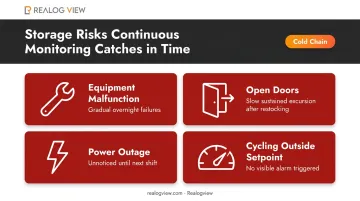
Automated alerts and continuous logging ensure none of these events go undetected until the inventory is already compromised.
Key Components of a Cold Chain Temperature Monitoring System
Temperature Sensors and Data Loggers
The three main device types serve different roles:
- Standalone data loggers — self-contained devices that record at set intervals and generate reports upon USB connection; ideal for closed shipments requiring regulatory documentation
- Wireless sensors — transmit live data via Wi-Fi, Bluetooth, or cellular; best suited for stationary facility monitoring where remote visibility is needed
- Probe thermometers — handheld spot-checking tools; useful for verification but not for continuous audit-ready monitoring
Within the data logger category, PDF/automated-report loggers offer a compliance-specific advantage: they generate tamper-evident PDF and CSV reports automatically upon USB connection, with no external software required.
Every model in Realogview's TempTrail™ line — Classic, XL, Display, Glacial, and HiTemp — follows this approach. Any recipient with a standard PC and Adobe Reader can open a full compliance report immediately upon delivery, without IT involvement.
Dashboards, Reporting, and Audit Trails
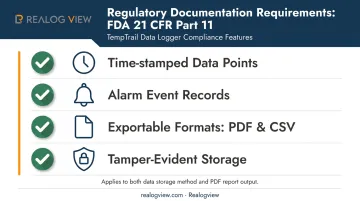
A complete monitoring system must produce records that satisfy regulatory inspection requirements:
- Time-stamped data points covering the full shipment duration
- Alarm event records documenting when and how long thresholds were exceeded
- Exportable formats (PDF, CSV) that can be submitted to regulators or quality teams
- Tamper-evident storage that prevents post-trip editing
For pharmaceutical applications governed by 21 CFR Part 11, electronic records must meet specific integrity and access-control standards. The format and certification of the reporting mechanism matters as much as sensor accuracy. Realogview's TempTrail™ line is FDA 21 CFR Part 11 compliant across every model — covering both the data storage method and the PDF report output — so the chain of custody holds up under regulatory inspection.
Ruggedness and Environmental Protection
Cold chain monitoring hardware faces harsh conditions: freezer environments, cryogenic storage, condensation, vibration, and rough handling during transit.
IP ratings define how well a device is sealed against dust and water — two practical threats in cold chain environments:
- IP67 — dust-tight, protected against temporary immersion up to 1 meter for 30 minutes
- IP68 — dust-tight, protected against continuous submersion under manufacturer-specified conditions
Most TempTrail™ models carry IP67 ratings; the TempTrail™ HiTemp carries IP68, reflecting its use in autoclave sterilization environments where full submersion is routine.
Physical sealing handles liquid exposure, but transit introduces a different set of stresses. DO-160G certification (RTCA aviation-grade environmental testing) validates device durability under temperature variation, vibration, and humidity stress — conditions common in air freight and ground logistics. This certification appears across most of Realogview's TempTrail™ lineup, confirming consistent performance in demanding transit and storage conditions.
Cold Chain Compliance: Regulations You Need to Know
US Pharmaceutical Compliance (FDA 21 CFR Part 11 and USP)
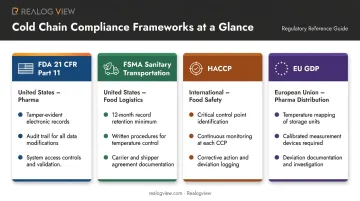
FDA 21 CFR Part 11 governs electronic records and signatures in pharmaceutical environments. Key requirements include:
- Secure, auditable, and tamper-evident data storage
- Time-stamped audit trails
- Access controls and validation documentation
Non-compliance can result in FDA warning letters, product seizure, or recall actions. USP guidelines (including USP <659>) set specific temperature ranges by product category:
- Cold storage: not exceeding 8°C
- Refrigerator storage: 2°C–8°C
- Freezer storage: −25°C to −10°C
Food Safety Regulations (FSMA and HACCP)
FSMA's Sanitary Transportation rule requires shippers and carriers handling temperature-sensitive food to document that required conditions were maintained. Records must generally be retained for 12 months after the procedures they document are last used.
HACCP frameworks require validated critical limits at each control point. Key monitoring system obligations include:
- Detecting loss of control at every critical control point
- Validating critical limits before and during operation
- Maintaining continuous monitoring as the preferred approach for most facilities
Global Standards (EU GDP and EN 12830)
EU Good Distribution Practice guidelines set clear obligations for anyone moving temperature-sensitive goods across EU supply chains:
- Temperature mapping completed before equipment enters service
- Calibrated monitoring devices with traceability to national or international standards
- Active alarm systems for excursion detection
- Documented investigation of every temperature deviation
EN 12830:2018 establishes performance requirements for temperature recorders used in food and pharmaceutical cold chains, covering −80°C to +85°C. CE and RoHS certifications confirm device conformance for EU market access.
How to Choose the Right Cold Chain Temperature Monitoring Device
Match Device Specs to Your Product Requirements
Start with your product's required temperature range:
| Product Type | Required Range | Recommended Device Type |
|---|---|---|
| Standard vaccines, pharmaceuticals | 2°C to 8°C | Standard cold chain logger (e.g., TempTrail™ Classic) |
| Frozen biologics, mRNA vaccines | −20°C storage | Standard freezer-range logger (e.g., TempTrail™ XL) |
| Ultra-low biologics, dry ice shipments | −80°C or below | Cryogenic logger (e.g., TempTrail™ Glacial, rated to −85°C) |
| Autoclave validation | +5°C to +140°C | High-temp logger (e.g., TempTrail™ HiTemp) |
A device with a wide operating range — such as the TempTrail™ Glacial's −85°C to +70°C span — offers flexibility across multiple applications without requiring separate equipment for different product lines.
Evaluate Compliance Certifications and Data Integrity Features
Verify that any device you consider carries the certifications your regulatory environment requires:
- FDA 21 CFR Part 11 for pharmaceutical electronic records
- HACCP-compatible documentation for food safety applications
- CE and RoHS for EU market access and international distribution
- DO-160G for transit durability validation
Also verify that the report format — PDF, CSV, or cloud dashboard — meets the audit trail standards you'll face during inspections. A tamper-evident PDF generated directly by the device gives inspectors a complete, unbroken audit trail — no third-party exports, no gaps in the record.
Consider Total Cost of Ownership and Operational Simplicity
The single-use vs. reusable decision affects both cost structure and operational workflow:
- Single-use loggers (TempTrail™ Classic, XL, Display Model S, RH Model S) — eliminate cross-contamination risk, simplify per-shipment tracking, require no reconfiguration between uses
- Reusable loggers (TempTrail™ Glacial, HiTemp, Display Model M, RH Model M) — lower per-shipment cost over time, user-replaceable batteries, user-configurable parameters for flexible deployment
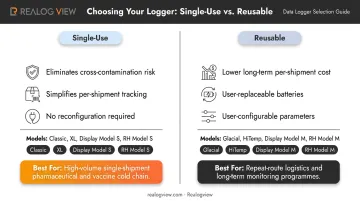
Software-free report generation is worth factoring into this decision. When a recipient at a pharmacy, food distribution center, or medical lab plugs in a USB logger and pulls a compliance-ready PDF — without calling IT or installing anything — that removes a real friction point at scale.
Frequently Asked Questions
What temperature range is required for pharmaceutical cold chain monitoring?
Requirements vary by product type. Standard vaccines and many pharmaceuticals require 2°C to 8°C refrigerated storage. Frozen biologics typically require −20°C, while some mRNA vaccines and ultra-low biologics require −80°C or below. USP <659> and FDA CFR Title 21 define specific ranges per product category, and product labels carry the controlling requirement.
What is the difference between a data logger and a wireless temperature sensor?
Data loggers record temperature at set intervals and store data internally until retrieved via USB after the shipment concludes. Wireless sensors transmit data in real time to a central platform, enabling remote alerts. Data loggers suit closed in-transit shipments needing tamper-evident documentation; wireless sensors are better for continuous facility monitoring.
How often should cold chain temperature monitoring devices be calibrated?
Calibration frequency depends on your regulatory framework — EU GDP mandates risk-based intervals, CDC requires a current calibration certificate for each vaccine data logger, and pharmaceutical companies typically calibrate annually through ISO/IEC 17025-accredited labs. Contact your device manufacturer or regulatory affairs team for product-specific requirements.
What happens when a temperature excursion is detected?
Real-time alerts notify responsible parties immediately, and predefined SOPs guide the response — typically rerouting the load, servicing equipment, or quarantining affected product for a stability assessment. Documented excursion response procedures are a regulatory requirement under most cold chain frameworks.
What regulations govern cold chain temperature monitoring in the United States?
The primary frameworks are FDA 21 CFR Part 11 (pharmaceutical electronic records), FSMA Sanitary Transportation (food logistics), HACCP (food processing critical control points), and USP guidelines for drug storage temperatures. Each imposes specific requirements on temperature documentation, audit trail format, and equipment standards.
Do cold chain temperature monitoring devices need to be replaced after each shipment?
Single-use loggers are designed for one shipment and simplify per-consignment tracking without reconfiguration. Multi-use loggers can be reset and redeployed, lowering per-shipment costs when proper sanitization and calibration protocols are followed between deployments.