Introduction
CDC estimates roughly 48 million Americans experience foodborne illness each year, resulting in 128,000 hospitalizations and 3,000 deaths. Transport is where that burden multiplies fastest — a single temperature failure can expose hundreds of recipients to unsafe food before anyone detects the problem.
When that failure happens, the fallout hits fast: product recalls, FSMA penalties, civil liability, and customer relationships that take years to rebuild.
Under 21 CFR Part 1, Subpart O, evidence of a material temperature-control failure can halt distribution of an entire load until a qualified individual confirms the food remained safe.
This guide covers FDA Food Code cold and hot holding thresholds, FSMA transport responsibilities by party, the two-step cooling rule, and the operational practices required to keep TCS food safe from loading dock to receiving bay.
Key Takeaways
- Cold TCS food must stay at 41°F (5°C) or below; hot TCS food at 135°F (57°C) or above throughout transport
- The four-hour time-control rule is conditional — written procedures, a verified starting temperature, and time marking are all required
- Pre-cool the vehicle to the correct set-point before loading; refrigeration units maintain temperature, they don't recover it efficiently
- FSMA assigns distinct duties to shippers, loaders, carriers, and receivers — compliance is shared across every party
- Temperature records must be audit-ready; documentation gaps invite regulatory action and legal risk
What Makes TCS Food Transport Uniquely Risky
TCS vs. "Perishable": A Critical Distinction
The FDA Food Code defines TCS (Time/Temperature Control for Safety) foods specifically by their need for temperature control to limit pathogenic microorganism growth or toxin formation. That's different from the common use of "perishable," which often refers to shelf life or quality. A food can lose quality without posing a safety risk — TCS foods can become dangerous while still looking and smelling fine.
The FDA TCS job aid identifies these primary categories:
- Raw or heat-treated animal food (meat, poultry, fish, eggs, dairy)
- Heat-treated plant food (cooked vegetables, cooked grains)
- Raw seed sprouts
- Cut melons, cut leafy greens, cut tomatoes
- Garlic-in-oil mixtures not modified to prevent pathogen growth
What these foods have in common: high moisture content, low-to-neutral acidity, and enough available nutrients to support rapid bacterial growth when temperatures drift out of range. That vulnerability doesn't disappear once food leaves the facility — it intensifies.
Why Transport Is the Most Vulnerable Phase
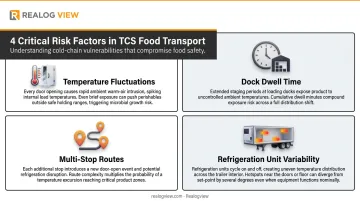
Static refrigerated storage is relatively stable — the environment is controlled, monitored, and rarely disturbed. Transport introduces variables that static storage doesn't have:
- Temperature fluctuations during loading and unloading expose product to ambient air
- Dock dwell time in hot climates can spike container temperatures significantly before the doors close
- Multi-stop routes extend cumulative exposure time across the entire cold chain
- Refrigeration unit variability — spatial temperature distribution within a trailer body varies across the trailer, and research on refrigerated truck bodies shows that loading patterns significantly alter airflow and create hotspots even when the set-point appears correct
Transport safety isn't a one-time setup. Active monitoring and documentation at every stage — from pre-loading through final delivery — are what separate compliant operations from correctable ones.
TCS Temperature Requirements: What the FDA Food Code Says
The FDA Food Code establishes the holding thresholds that define safe versus unsafe conditions for TCS foods. These apply throughout storage and, by extension, transport.
| Food State | FDA Food Code Requirement |
|---|---|
| Cold TCS food | 41°F (5°C) or below (Food Code 3-501.16) |
| Hot TCS food | 135°F (57°C) or above (Food Code 3-501.16) |
| Refrigerated receiving | Generally 41°F or below (raw shell eggs and certain milk products may arrive at 45°F under specific subsequent-cooling conditions) |
| Frozen food receiving | Must be received frozen — Food Code 3-202.11 does not impose a specific 0°F receiving mandate |
The range between 41°F and 135°F is where bacterial growth accelerates. Commonly called the temperature danger zone, those boundaries follow directly from the cold and hot holding limits above.
Understanding where those limits apply during transport starts with the time-temperature control provisions built into the Food Code.
The Temperature Danger Zone in Transport
Food Code Section 3-501.19 establishes conditional time-control provisions. The four-hour option allows TCS food to be served, cooked, or discarded within four hours, but only when:
- Cold TCS food starts at 41°F or below, or hot TCS food starts at 135°F or above
- Written procedures are in place before the option is used
- Food is marked with the time it was removed from temperature control
- Food is discarded at the four-hour mark if not served or cooked
The six-hour option for cold foods works similarly: food held below 70°F may be served for up to six hours, but must be discarded if it exceeds 70°F at any point. Neither provision is an unconditional transport allowance. Misapplying them as blanket rules is one of the most common compliance errors operators make.
The Two-Step Cooling Process
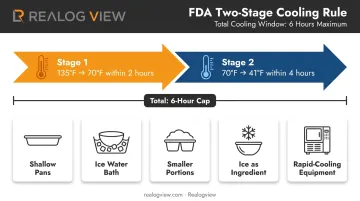
When TCS food is cooled before or after transport, the FDA Food Code two-stage cooling rule applies (Section 3-501.14):
- 135°F to 70°F within 2 hours
- 70°F to 41°F within 4 additional hours (total cooling time not to exceed 6 hours)
FDA Section 3-501.15 specifies approved cooling methods:
- Shallow pans arranged to maximize heat transfer
- Ice water baths with stirring
- Dividing food into smaller or thinner portions
- Adding ice as an ingredient
- Rapid-cooling equipment
Large, covered containers slow heat transfer significantly. They extend the time food spends in the danger zone and increase the risk of missing the two-step timeline.
Safety Guidelines for Transporting TCS Foods
Pre-Transport Preparation
The most consequential decision in TCS transport happens before a single product is loaded: whether the vehicle is properly pre-cooled.
Refrigeration units in transport vehicles are designed to maintain a temperature set-point, not to pull product temperature down efficiently. Loading TCS food into a warm trailer and expecting the refrigeration unit to compensate is one of the most common causes of in-transit temperature excursions.
Pre-loading checklist:
- Pre-chill the trailer or container to the correct operating temperature before opening for loading
- Inspect trailer walls, door seals, and insulation for damage that could allow heat penetration
- Confirm the correct refrigeration mode is selected for the product type
- Verify the refrigeration unit is functional before loading begins
USDA guidance notes that trailer stabilization can take two or more hours in hot summer weather — plan accordingly rather than rushing into loading.
Safety During Loading and In-Transit Operations
Loading practices that matter:
- Keep pallets away from trailer walls — heat conducts through metal wall surfaces and can warm product in contact with them
- Do not stack product in ways that block conditioned airflow; unobstructed circulation is what keeps temperatures uniform
- Move TCS food directly from a temperature-controlled environment to the vehicle — eliminate dock exposure gaps entirely
In-transit temperature monitoring:
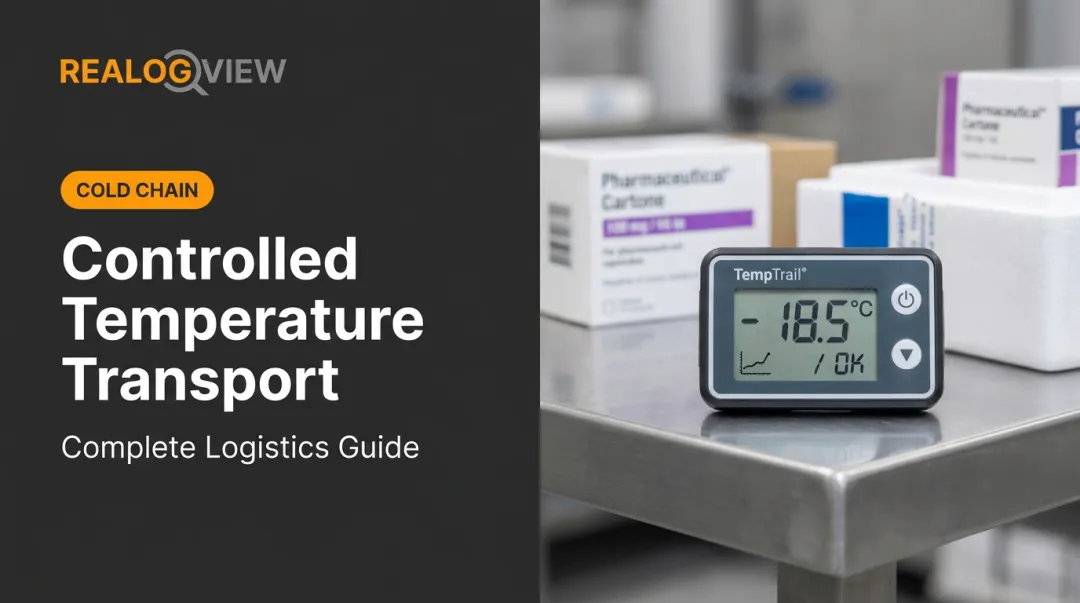
Continuous monitoring throughout transit provides the documentation layer that spot checks cannot. Realogview's TempTrail loggers record at pre-set 10-minute intervals and automatically generate FDA 21 CFR Part 11-compliant PDF and CSV reports when connected to any Windows PC via USB at delivery. Two models cover most food transport needs: the TempTrail Classic stores 11,000 data points over up to 75 days, while the TempTrail XL stores 32,000 data points over up to 220 days. No proprietary software, drivers, or cloud account required.
The TempTrail Display models add a real-time LCD screen, so drivers or receiving staff can check current temperature and alarm status at a glance without connecting to a computer.
Safety at Receiving and Unloading
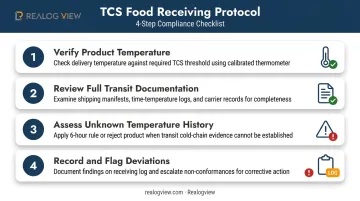
Receiving is where the temperature record gets validated — or where problems surface too late. Every TCS food shipment should be temperature-verified against FDA thresholds upon arrival.
Receiving protocol:
- Check product temperature immediately upon arrival — refrigerated foods above 41°F, or hot foods below 135°F, require corrective action
- Review temperature documentation for the full transit duration, not just the point-of-delivery reading
- Treat any shipment with an unknown temperature history as having potentially failed the four-hour time-control rule
- Document receiving temperatures and flag deviations before accepting the shipment
With Realogview's TempTrail loggers, receiving staff plug the device into a laptop and generate the complete transit temperature report in seconds. The report includes alarm events, min/max readings, and time-stamped data points — an immediate, audit-ready record without manual data entry.
Common TCS Transport Safety Mistakes to Avoid
1. Skipping Vehicle Pre-Cooling
Loading TCS food into an unchilled trailer starts the clock on product temperature rise before the vehicle even moves. The refrigeration unit will run at capacity trying to compensate — often unsuccessfully for bulk loads. Beyond the product safety risk, this creates direct compliance exposure under FSMA's loader duty requirements in 21 CFR 1.908.
2. Treating Each Transit Leg as a Separate Four-Hour Clock
The time-control provisions don't reset between stops. Any time TCS food spends outside proper temperature control — during receiving, loading, transit, unloading, and dock staging — counts toward the same cumulative clock. Multi-stop routes with repeated door openings are particularly vulnerable to this error.
3. Relying on Manual Spot Checks for Documentation
Regulatory inspections and recall investigations require proof that temperature control was maintained throughout transit. A single reading at origin and a single reading at destination leaves the entire journey undocumented. Under FSMA (21 CFR 1.912), temperature condition records must be made available to FDA upon request.
Automatic data loggers close this gap by recording continuous temperature data for every minute of transit. Realogview's TempTrail XL, for example, captures up to 32,000 data points and generates both PDF and CSV reports on delivery — no manual input, no missing intervals, and a complete audit trail ready for FDA review.
Frequently Asked Questions
What is the maximum temperature you can store a cold TCS food?
Cold TCS foods must be held at 41°F (5°C) or below per FDA Food Code 3-501.16. Under the six-hour time-control option, food that exceeds 70°F at any point must be discarded immediately, regardless of how long it has been out of refrigeration.
What is the best method for transporting TCS food from one store to another?
Use a pre-cooled, insulated container or refrigerated vehicle and transfer food directly without dock exposure. Monitor temperature with a calibrated thermometer or data logger throughout the transfer, and verify on arrival that food remains at or below 41°F.
What should be done when cooling TCS food?
Follow the FDA two-step method: cool from 135°F to 70°F within two hours, then from 70°F to 41°F within four additional hours. Use shallow pans, ice baths, or divided portions to accelerate heat transfer — large covered containers slow the process and increase risk.
What foods are considered TCS foods?
TCS foods include:
- Meat, poultry, fish, and shellfish
- Dairy products and eggs
- Cooked vegetables and grains
- Cut fruits, leafy greens, tofu, and raw sprouts
- Garlic-in-oil mixtures
These categories share high moisture content, low-to-neutral acidity, and nutrient profiles that support bacterial growth.
How long can TCS food be in the temperature danger zone?
Under the FDA Food Code's conditional time-control provisions, TCS food may be held outside temperature control for a maximum of four hours. Written procedures must be in place, food must start at the correct temperature, and each item must be time-marked. After four hours, discard regardless of appearance.
What documentation is required for TCS food transport compliance?
FSMA (21 CFR 1.908 and 1.912) requires written temperature specifications, operating procedures, and transport records. Both shippers and carriers must retain documentation for 12 months. Data loggers that generate time-stamped PDF reports satisfy these requirements and simplify audit readiness.
Conclusion
TCS food transport safety comes down to disciplined execution at every handoff — pre-cooled vehicles, proper loading procedures, continuous in-transit monitoring, and thorough receiving verification. Any single gap can compromise an entire shipment, and the consequences run from product loss to regulatory action.
The strongest safeguard is treating temperature control as an ongoing operational standard with automatic documentation built in by default. When every trip generates a complete, verified temperature record without requiring manual effort from transport staff, regulatory readiness is the result of every normal delivery — not a separate task that kicks in before an audit.