The stakes are straightforward: if the data supporting a product's safety or efficacy cannot be trusted, neither can the product itself.
This article covers the FDA's definition of data integrity, the five core ALCOA principles that all pharma records must satisfy, why violations occur, and what a practical compliance approach looks like — including how monitoring equipment can either support or undermine your compliance posture.
Key Takeaways
- The FDA defines data integrity as "the completeness, consistency, and accuracy of data" across the full data lifecycle
- All pharma records must satisfy five ALCOA principles: Attributable, Legible, Contemporaneous, Original, Accurate
- Most data integrity failures are structural — shared logins, missing audit trails, unvalidated hybrid systems
- FDA explicitly holds senior management accountable for data integrity culture
- FDA 21 CFR Part 11 compliant instruments prevent post-capture data manipulation at the source
What Is Data Integrity in Pharma?
The FDA's 2018 CGMP guidance defines data integrity as "the completeness, consistency, and accuracy of data." That definition applies across the full data lifecycle — from initial creation through modification, archival, and final disposition — and covers both paper and electronic records without distinction.
The Pharmaceutical Inspection Co-operation Scheme (PIC/S) expands on this, defining data integrity as "the degree to which data are complete, consistent, accurate, trustworthy, reliable and that these characteristics of the data are maintained throughout the data life cycle."
Scope: Where Data Integrity Applies
Data integrity requirements extend across every GxP function:
- R&D and clinical trials: study records, informed consent documentation, clinical data
- Manufacturing: batch records, process parameters, deviation reports
- Laboratory testing: raw instrument data, OOS investigations, stability data
- Regulatory submissions: all data supporting safety and efficacy claims
Why It Matters
If a regulator cannot trust that a batch record accurately reflects what happened during manufacturing, or that a lab result reflects what the instrument actually measured, the product's approval basis is in question. The FDA has documented real consequences: Warning Letters, import alerts, and consent decrees that halt distribution and require costly remediation before operations resume.
The Regulatory Framework: FDA CGMP and 21 CFR Part 11
Two regulatory pillars govern pharma data integrity in the US: CGMP regulations under 21 CFR Parts 211 and 212, and 21 CFR Part 11 for electronic records and signatures. Together, they define what compliant data looks like — from how it's created and stored to who can access and modify it.
21 CFR Part 11: Electronic Records and Signatures
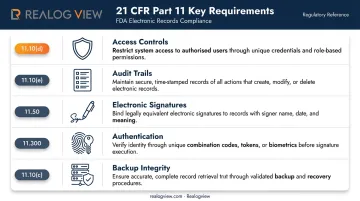
Part 11 governs any electronic records and electronic signatures used in FDA-regulated environments. Its core requirements include:
- Access controls [11.10(d)]: System access is restricted to authorized individuals only
- Audit trails [11.10(e)]: Secure, computer-generated, time-stamped logs record every record creation, modification, or deletion — without obscuring prior entries
- Electronic signatures [11.100(a)]: Each signature must be unique to one individual and can never be reused or reassigned
- Authentication [11.200(a)(1) and 11.300(a)]: At least two components required (such as an ID code and password), with each combination unique to one user
- Backup integrity [211.68(b)]: Record changes must be made only by authorized personnel; backup data must be "exact and complete" and protected from alteration
Beyond US requirements, pharma operations with global reach must also satisfy a set of converging international standards.
Other Applicable Frameworks
| Framework | Key Requirements |
|---|---|
| EU GMP Annex 11 | Risk management throughout the lifecycle, audit trails for GMP-relevant changes, operator identity recording with date and time |
| PIC/S PI 041-1 (2021) | ALCOA+ throughout the data lifecycle; administrator rights must not be assigned to normal users |
| WHO TRS 1033 Annex 4 (2021) | ALCOA+ applied to all GxP data in paper, electronic, and hybrid systems |
Senior management accountability is explicit, not implied. The FDA's CGMP guidance states directly: "It is the role of management with executive responsibility to create a quality culture where employees understand that data integrity is an organizational core value."
The Five Key Principles of Pharma Data Integrity
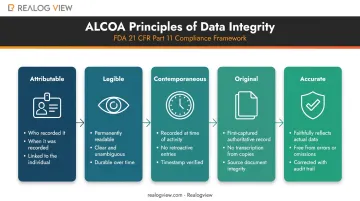
The FDA's CGMP guidance operationalizes data integrity through five foundational attributes: Attributable, Legible, Contemporaneous, Original, and Accurate — collectively known as ALCOA. Industry practice has extended these to ALCOA+ (adding Complete, Consistent, Enduring, and Available), but the original five remain the compliance baseline the FDA inspects against.
Attributable
Every data entry must clearly identify who recorded it and when. This requires individual electronic or physical authentication — not departmental logins, not shared credentials.
The FDA's guidance is explicit: shared login accounts cannot support attributable actions because "a unique individual cannot be identified through the login." This is one of the most consistently cited failure modes in FDA Warning Letters, precisely because shared credentials are often a system design choice rather than an individual infraction.
Every CGMP system must have documented, individual-level access controls.
Legible
Records must be permanently readable, understandable, and free from ambiguity — not just at the time of recording, but throughout their entire retention period.
Common legibility failures include:
- Faded or overwritten handwritten entries
- Corrupted electronic file formats with no accessible reader
- Data stored in legacy software that cannot be opened on current systems
- Scanned images of insufficient resolution to read clearly
Legibility applies to the full record lifecycle. A record that was readable in 2015 but cannot be accessed during a 2025 inspection fails this requirement.
Contemporaneous
Data must be recorded at the time the activity occurs. Pre-recording, reconstructing from memory, or backdating all violate this principle.
The regulatory basis is direct: 21 CFR §§211.100(b) and 211.160(a) both state that production and laboratory control procedures "shall be documented at the time of performance."
This requirement exists because contemporaneous recording is the only mechanism that ensures data reflects the actual sequence of events — not a later reconstruction shaped by the known outcome.
Original
The first-captured record is the authoritative source. Discarding raw data and retaining only transcribed summaries destroys the original and violates CGMP.
A paper printout of a dynamic electronic record does not substitute for retaining the original electronic record — a point the FDA's guidance addresses directly. Static printouts cannot preserve reprocessing capability and therefore cannot replace the dynamic electronic original. This has direct implications for chromatography data — every reprocessing result must be retained, per FDA guidance on OOS investigations.
Accurate
Data must faithfully reflect what actually occurred. This means:
- No correction fluid or unauthorized deletions
- No selective exclusion of out-of-specification results
- No rounding values toward desired outcomes
- All results — including failed runs, anomalous readings, and voided entries — must be reported as observed
The FDA's OOS guidance is clear: without an identified laboratory or calculation error, there is no scientific basis for invalidating an initial OOS result in favor of passing retests. In practice, accuracy failures — falsified results, deleted runs, manipulated values — are among the leading causes of FDA import alerts and consent decrees.
Why Data Integrity Failures Happen in Pharma
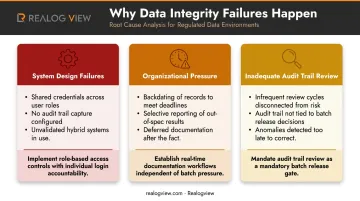
Most violations are structural. They reflect how systems were designed, not individual dishonesty — and that distinction matters for how you fix them.
System Design Failures
Three design failures appear repeatedly in FDA enforcement actions:
- Shared credentials make individual attribution technically impossible, regardless of intent
- Instruments that allow data overwrite without audit trail capture destroy original records by design — the 2019 Enprani Warning Letter documented that HPLC users could overwrite, delete, copy, and rename raw data with audit trails disabled
- Unvalidated hybrid systems (partial paper, partial electronic) create gaps where data can be altered between capture and entry, with no mechanism to detect the change
The 2021 Adamson Analytical Laboratories Warning Letter found analysts with administrator privileges and HPLC/GC audit trails inactive for nearly three years — not because someone disabled them maliciously, but because the system was never configured correctly in the first place.
Organizational Pressure
Production timelines create real incentives for shortcuts. PIC/S identifies "undue pressure" and productivity incentives exceeding process capability as documented risk factors for data integrity failures. Common examples include:
- Backdating entries to match expected completion times
- Selecting favorable results from multiple runs
- Deferring documentation until end of shift
Because these pressures are organizational, so is the FDA's response — accountability sits at the top. Quality culture cannot be delegated to the compliance team.
Inadequate Audit Trail Review
The 2023 Intas Pharmaceuticals Warning Letter found that QA did not review audit trails during batch record review to identify discrepancies. This is inspectable.
The FDA specifies that audit trail review must occur at the same frequency as the underlying data review — including before batch release under 21 CFR §211.192. Treating audit trail review as a periodic IT maintenance task rather than a routine quality function is a compliance gap.
How to Maintain Data Integrity in Practice
Compliance failures don't usually come from bad intentions — they come from gaps in system design and daily practice. These five steps address the most common failure modes.
1. Map the Full Data Lifecycle
Document every point where data is generated, transferred, processed, or archived. This mapping identifies where access controls are weakest and where data is most vulnerable to alteration or loss — before an inspector finds it.
2. Implement Role-Based Access and Segregation of Duties
No single user should be able to create, approve, and release their own records. Per FDA guidance, system administrator rights must be assigned to personnel independent of those responsible for record content. Document authorized access privileges for each CGMP system in use, as required under §211.68(b).
3. Deploy Purpose-Built, Validated Data Capture Tools
For data types requiring real-time, tamper-evident recording — particularly temperature and humidity monitoring in pharmaceutical storage and cold chain environments — the ALCOA principles of Attributable, Contemporaneous, Original, and Accurate are most difficult to satisfy with general-purpose tools. Instruments designed for compliance from the ground up remove much of that risk.
Realogview's TempTrail data loggers address this directly. Each model automatically generates PDF and CSV records upon USB connection — no external software required — and is FDA 21 CFR Part 11 compliant. Key models include:
- TempTrail XL: 32,000 data points, 220-day log cycle for extended single-use deployments
- TempTrail Humidity & Display: Simultaneous temperature and humidity capture at ±0.2°C and ±2% RH accuracy
- TempTrail Glacial: Ultra-low range (-85°C to +70°C) covering cryogenic, dry ice, and ultra-cold vaccine storage
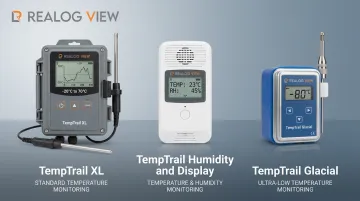
Single-use models ship pre-configured with locked parameters, eliminating any possibility of mid-cycle adjustment.
4. Build Audit Trail Review Into Quality Operations
Schedule audit trail review as a routine quality function, not a periodic IT task. Review frequency must match data criticality — audit trails supporting batch release must be reviewed before release per §211.192.
5. Train Personnel on ALCOA and Reporting Expectations
Under 21 CFR §§211.25 and 212.10, personnel must have the training and experience to perform their assigned duties. The FDA explicitly includes data integrity training in this requirement — covering prevention and detection of data integrity problems. Staff must know the five principles, understand the consequences of violations, and know how to identify and escalate concerns.
Frequently Asked Questions
What are the key principles of pharmaceutical data integrity?
The five core principles are Attributable, Legible, Contemporaneous, Original, and Accurate — collectively known as ALCOA. These are embedded in FDA CGMP guidance, PIC/S PI 041-1, and WHO TRS 1033 Annex 4, and form the baseline compliance standard for all pharma data records.
What is 21 CFR Part 11 and data integrity?
21 CFR Part 11 is the FDA regulation governing electronic records and electronic signatures. It requires unique user authentication, system-generated audit trails, and controls preventing unauthorized record alteration — all of which directly enforce data integrity requirements for electronic records in regulated environments.
What is data integrity as per the US FDA?
The FDA's 2018 CGMP guidance defines data integrity as "the completeness, consistency, and accuracy of data" across the full data lifecycle. The FDA operationalizes this through the ALCOA framework, applied to all CGMP records regardless of whether they are paper or electronic.
What is the difference between ALCOA and ALCOA+ in pharma?
The original five ALCOA principles represent the FDA CGMP baseline. ALCOA+ adds Complete, Consistent, Enduring, and Available — attributes developed by PIC/S and WHO to address the complexity of electronic systems and global data lifecycle management. "ALCOA++" is industry terminology with no formal harmonized regulatory definition.
What are the most common data integrity violations cited by the FDA?
Recurring violations cited in FDA Warning Letters include:
- Shared login credentials (violating Attributable)
- Deletion or overwriting of raw data without audit trail capture (violating Original)
- Inactive audit trails (Enprani and Adamson Warning Letters)
- Failure to review audit trails before batch release (Intas Warning Letter)
How does temperature monitoring equipment support data integrity in pharma?
FDA 21 CFR Part 11 compliant data loggers automatically generate time-stamped, tamper-evident records at the point of capture, satisfying the Contemporaneous, Original, Attributable, and Accurate principles for temperature and humidity data. Realogview's TempTrail line removes the manual transcription step, cutting out the main opportunity for post-capture manipulation in cold chain and storage monitoring.