The consequences of poor storage go beyond wasted doses. VFC program providers can face dose-for-dose restitution, suspended ordering privileges, and terminated program agreements. Clinics risk compliance violations, reputational damage, and — most critically — administering a compromised vaccine to a patient.
This guide covers current Spikevax temperature requirements by storage phase, safe thawing procedures, excursion response protocols, and the monitoring documentation practices that keep providers audit-ready.
Key Takeaways
- Spikevax must be stored frozen at -50°C to -15°C for long-term storage, or refrigerated at 2°C to 8°C for up to 60 days
- Unpunctured syringes may remain at room temperature (up to 25°C) for a maximum of 12 hours
- Thawed vaccine must never be refrozen under any circumstances
- Temperature excursions require immediate quarantine, documentation, and assessment via Moderna's excursion tool before administering or discarding doses
- Continuous data logging is required for VFC providers and strongly recommended for all storage operations
Why Proper Moderna Vaccine Storage Conditions Are Critical
The mRNA Sensitivity Problem
Spikevax is a single-dose prefilled syringe containing mRNA encapsulated in lipid nanoparticles (LNPs). That structure is the vulnerability. The mRNA phosphodiester backbone undergoes hydrolytic cleavage at elevated temperatures, reducing the amount of intact, translatable RNA. The LNP shell can similarly degrade through oxidation or physical changes like aggregation. Once that happens, potency is compromised — and there's no way to reverse it.
That biological fragility is precisely what drives the strict cold chain requirements spanning manufacturing, distribution, and point-of-care administration.
Regulatory and Liability Stakes
Providers handling Spikevax must meet requirements from several regulatory sources:
- FDA prescribing information — defines approved storage temperatures, thaw times, and inspection requirements for the current prefilled syringe presentation
- CDC Vaccine Storage and Handling Toolkit (March 2024 edition) — establishes national monitoring, documentation, and excursion response best practices
- VFC Program Operations Guide — binding conditions for providers receiving publicly funded vaccine, including continuous monitoring requirements, 3-year log retention, and financial restitution obligations
VFC providers who lose vaccine through negligence owe dose-for-dose replacement within 90 days. Program coordinators can impose corrective action plans, suspend ordering, or terminate enrollment entirely.
The Practical Cost
Beyond program penalties, storage failures create immediate operational problems:
- Wasted doses and disrupted clinic schedules
- Staff time spent on excursion investigations and reporting
- Patient trust erosion if staff inadvertently administer compromised vaccine
- Audit exposure if documentation is incomplete
Each of these failures is preventable — and the sections below cover exactly what proper storage looks like in practice.
Moderna Vaccine Temperature Requirements by Storage Phase
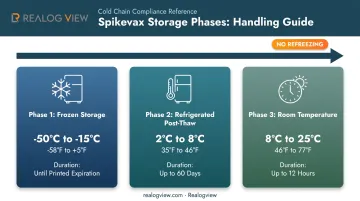
Spikevax moves through distinct temperature phases from the freezer to the patient. Each phase has specific requirements that must be followed in sequence.
Frozen Storage (Long-Term)
The current U.S. Spikevax presentation — a single-dose prefilled syringe — requires frozen storage at -50°C to -15°C (-58°F to 5°F). Storage continues until the printed expiration date; no fixed frozen shelf-life duration is stated in the current FDA prescribing information.
Critical note: This frozen range is broader on the lower end than older vial-era guidance. Freezer calibration matters — settings that worked for previous presentations may not prevent temperatures from dropping below -50°C, which risks degrading vaccine efficacy.
Refrigerated Storage (Short-Term)
Once thawed, Spikevax may be stored refrigerated at 2°C to 8°C (36°F to 46°F) for up to 60 days, provided the printed expiration date is not exceeded.
The CDC Vaccine Storage and Handling Toolkit recommends applying a Beyond Use Date (BUD) label when a storage condition creates a use-by date earlier than the printed expiration. For Spikevax, apply the BUD as follows:
- Calculate the BUD as the thaw date plus 60 days
- Cap the date at the printed expiration if it falls earlier
- Write the calculated date and your initials directly on the product label
Room Temperature Handling
The current FDA label allows 8°C to 25°C (46°F to 77°F) for up to 12 hours after removal from refrigerated storage. Minimize room-temperature exposure by removing syringes immediately before use rather than in advance.
Quick Reference: Spikevax Storage Conditions
| Storage Type | Temperature Range | Maximum Duration |
|---|---|---|
| Frozen | -50°C to -15°C (-58°F to 5°F) | Until printed expiration date |
| Refrigerated (post-thaw) | 2°C to 8°C (36°F to 46°F) | Up to 60 days (not exceeding expiration) |
| Room temperature | 8°C to 25°C (46°F to 77°F) | Up to 12 hours |
How to Thaw Moderna Vaccine Safely
Incorrect thawing can degrade the product or trigger a use window that staff may not track accurately. Refreezing after any thaw is strictly prohibited, with no exceptions.
Refrigerator Thaw Method
Place frozen syringes in a qualified refrigerator at 2°C to 8°C. Thaw times depend on quantity:
- Single syringe or carton of 2: approximately 1 hour 40 minutes
- Carton of 10: approximately 2 hours 40 minutes
Once thawed, syringes may remain stored at 2°C to 8°C for up to 60 days — not exceeding the expiration date. This is the preferred method when scheduling permits.
Room Temperature Thaw Method
Syringes may also be thawed at 15°C to 25°C (59°F to 77°F):
- Single syringe or carton of 2: approximately 40 minutes
- Carton of 10: approximately 1 hour 20 minutes
Once thawed at room temperature, the 12-hour room temperature clock is running. Do not return syringes to the freezer.
Once thawing is complete — by either method — follow this checklist before administration.
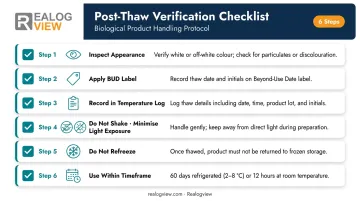
Post-Thaw Handling Checklist
Before use, verify:
- Inspect the product — it should appear white to off-white; translucent product-related particulates are acceptable. Discard if discolored or if non-product particulate matter is visible
- Apply a BUD label with the thaw date, time, and staff initials
- Record thaw time, quantity, and responsible staff member in the temperature log
- Do not shake; minimize room light exposure and avoid direct sunlight and UV light
- Do not refreeze
- Use within the applicable timeframe: 60 days refrigerated or 12 hours at room temperature
What to Do When a Temperature Excursion Occurs
A temperature excursion is any reading outside the range specified in the manufacturer's package insert. Not every excursion means the product is nonviable, but every excursion requires a formal assessment before any dose is administered or discarded.
Identifying an Excursion
Excursions are caught through:
- Alarm triggers on storage units or data loggers
- Out-of-range readings during data review
- Routine start-of-workday min/max checks
Continuous monitoring is the only reliable method. An excursion that occurs overnight and self-corrects before morning checks may never appear in a manual log. A continuous data logger will capture it — making devices like Realogview's TempTrail line essential for complete excursion documentation in vaccine storage environments.
Documenting and Reporting
Once an excursion is confirmed, documentation must happen right away — before any assessment or corrective action proceeds. Record at minimum:
- Date and time of discovery
- Minimum and maximum temperatures recorded
- Estimated duration of the excursion
- Affected inventory (lot numbers, quantities)
- Name of the staff member completing the report
- Corrective actions taken
- Final disposition
Reporting requirements: VFC providers must notify their state immunization program and follow its specific reporting procedure. For example, New York requires submission of a Temperature Excursion Report along with data logger files, with administration suspended pending disposition. Contact Moderna directly at 1-866-MODERNA (1-866-663-3762) or use the Temperature Excursion Tool available through Moderna's product resources site.
If vaccine has already been administered following an excursion, do not use the self-service tool — call Moderna directly.
Quarantine and Assessment
Immediately upon identifying an excursion:
- Label affected syringes "DO NOT USE — TEMPERATURE EXCURSION"
- Segregate into a separate container maintained at correct storage conditions
- Do not discard without formal assessment
- Submit the excursion details to Moderna's tool or support line — the tool requests the excursion direction, temperature range, and duration in hours and minutes
- Await disposition guidance before making any administration or discard decision
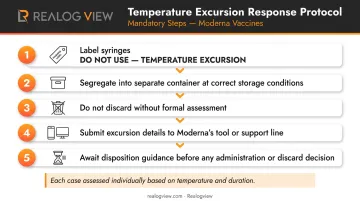
No public CDC, FDA, or Moderna source specifies a universal cumulative threshold at which Spikevax becomes automatically nonviable. Each case is assessed individually, based on the documented temperature and duration you submit to the manufacturer or immunization program.
Monitoring, Documentation, and Transport Requirements
CDC and VFC Monitoring Requirements
Ongoing temperature monitoring is a regulatory requirement for VFC providers and strongly recommended for all vaccine storage operations. Per the CDC Vaccine Storage and Handling Toolkit:
- Use a digital data logger (DDL) with a buffered probe, alarm capability, and programmable logging intervals of at least every 30 minutes
- Check and record minimum and maximum temperatures at the start of each workday
- Record date, time, staff name or initials, and any corrective actions
- Review downloaded data weekly
- Retain logs for a minimum of 3 years (longer if state law requires)
VFC providers face binding versions of these requirements — continuous DDL monitoring is mandatory for routine storage, transport, and off-site clinic settings.
The Role of Compliant Data Loggers
For vaccine storage documentation, FDA 21 CFR Part 11 defines what constitutes an audit-ready electronic record. Covered systems must maintain secure, accurate, time-stamped audit trails protected from unauthorized alteration. Realogview's TempTrail™ data loggers meet this standard across both frozen and refrigerated Spikevax storage conditions:
- TempTrail Glacial / Glacial Display: covers -85°C to +70°C with ±0.3°C accuracy, within Spikevax's frozen storage range; alarms are user-configurable to exact thresholds
- TempTrail Display: comes pre-configured with alarm thresholds at the 2°C to 8°C refrigerated storage limits
All TempTrail models automatically generate PDF and CSV reports upon USB connection, with no external software required. The PDF format provides a locked, non-editable compliance record ready for audits, excursion investigations, or health department reviews.
Transportation Guidelines
When transporting thawed Spikevax:
- Use insulated containers qualified to maintain 2°C to 8°C
- Maintain continuous DDL monitoring during transport
- Do not refreeze during or after transport
- Place syringes immediately into a qualified storage unit upon arrival at the destination
The current Spikevax prescribing information does not specify modal transport time limits (walking, vehicle, or air). Follow the 12-hour room-temperature ceiling and use containers validated for the 2°C to 8°C range. Realogview's TempTrail loggers carry DO-160G certification, which validates performance under the vibration, pressure, and temperature extremes of air and ground freight.
Frequently Asked Questions
Do mRNA vaccines require refrigeration?
Yes. mRNA vaccines like Spikevax require either frozen or refrigerated storage because the mRNA molecule is chemically unstable at ambient temperatures. Short-term room temperature exposure is permissible only within strict time limits — up to 12 hours at 8°C to 25°C for the current Spikevax prefilled syringe.
How long can Moderna be out of the refrigerator?
An unpunctured Spikevax syringe can remain at room temperature (up to 25°C/77°F) for a maximum of 12 hours. Always follow Moderna's current label guidance and minimize room-temperature exposure time wherever possible.
How long to thaw Spikevax at room temperature?
At 15°C to 25°C, a single syringe or carton of 2 thaws in approximately 40 minutes; a carton of 10 takes approximately 1 hour 20 minutes. Once thawed at room temperature, the 12-hour room temperature window applies.
Can the Moderna vaccine be refrozen after thawing?
No — refreezing is prohibited under any circumstances. Once thawed, Spikevax must be used within the applicable timeframe (up to 60 days refrigerated or 12 hours at room temperature) or discarded.
What temperature should a Moderna vaccine freezer be set to?
The current Spikevax prescribing information requires frozen storage at -50°C to -15°C (-58°F to 5°F). Freezer calibration is essential, especially when co-storing vaccines with different frozen storage requirements.
What happens if the Moderna vaccine is exposed to the wrong temperature?
Immediately label affected syringes "DO NOT USE — TEMPERATURE EXCURSION," segregate them under correct storage conditions, and document the event. Contact Moderna's Temperature Excursion Tool or call 1-866-MODERNA before deciding whether to administer or discard — never assess dose viability on your own based on temperature data alone.