Introduction
Airborne equipment operates in some of the most demanding environments imaginable. A cockpit display must function equally well in the scorching heat of a Phoenix tarmac and at sub-zero cruising altitude. A navigation unit has to survive vibration, lightning-induced transients, and humidity cycling that would destroy ordinary electronics within weeks.
Without a standardized testing framework, verifying that equipment can survive these conditions would be nearly impossible to do consistently across manufacturers and regulatory jurisdictions.
DO-160G was developed to solve that problem. Formally titled Environmental Conditions and Test Procedures for Airborne Equipment and published by RTCA, it defines the laboratory test conditions that airborne equipment must withstand before it earns a place in an aircraft. Both the FAA and EASA recognize it as an accepted means of demonstrating equipment airworthiness.
This guide covers everything you need to know: what DO-160G is, how its 23 test sections are structured, how the standard compares to MIL-STD-810 and related military standards, and what compliance documentation actually looks like in practice.
Key Takeaways
- DO-160G is RTCA's current environmental testing standard for airborne equipment, accepted by both the FAA and EASA
- The standard comprises 23 test sections covering climatic, mechanical, and electromagnetic environments
- Not every section applies to every device—test plans are tailored to the equipment's installation location and use
- DO-160G is an industry consensus standard, not a government regulation or government-issued certificate
- EUROCAE ED-14G is the technically equivalent European counterpart, giving DO-160G international recognition
What Is DO-160G? Definition, Purpose, and History
The Standard and Its Purpose
DO-160G, officially titled Environmental Conditions and Test Procedures for Airborne Equipment, is published by RTCA (the Radio Technical Commission for Aeronautics). Rather than a government regulation, it is an industry consensus standard that FAA, EASA, airlines, equipment manufacturers, and compliance laboratories have collectively adopted as the primary means of demonstrating equipment airworthiness.
DO-160G provides a controlled, laboratory-based method for confirming that airborne equipment performs reliably under the environmental conditions it will encounter during actual flight. Those conditions span dynamic, climatic, and electromagnetic environments across aircraft types ranging from rotary-wing helicopters to fixed-wing transports.
Version History
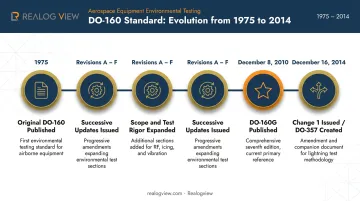
DO-160 has evolved considerably since its origins. Key milestones:
- 1975 — Original DO-160 published by RTCA
- Revisions A through F — Successive updates addressing evolving aircraft technology and test methods
- December 8, 2010 — DO-160G published, introducing updates to test conditions, power input requirements, and RF susceptibility procedures
- December 16, 2014 — Change 1 issued, moving user-guide material for Sections 9, 18, 20, 21, 22, and 26 into a separate guide document (DO-357)
Understanding where DO-160G sits within the broader standard helps clarify which revision applies to your equipment.
DO-160 vs. DO-160G
DO-160G is the most current revision of the overarching DO-160 standard, not a separate document. Earlier revisions (D, E, F) remain valid for previously certified equipment, but the FAA strongly encourages DO-160G for new articles per Advisory Circular AC 21-16G.
The European Counterpart
EUROCAE ED-14G, published May 2011, is the European equivalent of DO-160G. EASA AMC 20-158A recognizes ED-14G and DO-160G as technically equivalent for HIRF compliance purposes, giving the standard full recognition under both US and European certification frameworks.
| Standard | Body | Published | Scope |
|---|---|---|---|
| DO-160G | RTCA (US) | December 8, 2010 | FAA airworthiness compliance |
| ED-14G | EUROCAE (EU) | May 2011 | EASA airworthiness compliance |
The 23 DO-160G Test Sections: A Categorized Overview
DO-160G comprises 23 test sections (Sections 4 through 26), organized around three broad environmental domains. Not every section applies to every piece of equipment. Test engineers select applicable sections and categories based on the specific installation environment and intended use (a concept known as tailoring).
Climatic and Atmospheric Sections
| Section | Title |
|---|---|
| 4 | Temperature and Altitude |
| 5 | Temperature Variation |
| 6 | Humidity |
| 24 | Icing |
These sections address how equipment handles heat, cold, altitude pressure changes, moisture exposure, and ice accumulation—conditions that vary significantly depending on whether equipment is installed in a pressurized cabin, an unpressurized bay, or an external mount.
Mechanical and Physical Sections
| Section | Title |
|---|---|
| 7 | Operational Shocks and Crash Safety |
| 8 | Vibration |
| 9 | Explosion Proofness |
| 10 | Waterproofness |
| 11 | Fluids Susceptibility |
| 12 | Sand and Dust |
| 13 | Fungus Resistance |
| 14 | Salt Fog |
These sections cover the physical abuse equipment may endure during operation, maintenance, and ground exposure.
Electrical and Electromagnetic Sections
| Section | Title |
|---|---|
| 15 | Magnetic Effect |
| 16 | Power Input |
| 17 | Voltage Spike |
| 18 | Audio Frequency Conducted Susceptibility—Power Inputs |
| 19 | Induced Signal Susceptibility |
| 20 | Radio Frequency Susceptibility (Radiated and Conducted) |
| 21 | Emission of Radio Frequency Energy |
| 22 | Lightning Induced Transient Susceptibility |
| 23 | Lightning Direct Effects |
| 25 | Electrostatic Discharge |
| 26 | Fire, Flammability |
How Tailoring Works in Practice
The FAA instructs installers to compare the manufacturer's Environmental Qualification Form (EQF) against the specific installation requirements. The EQF identifies the DO-160 version, tests conducted, and category designations. A bare "DO-160G compliant" claim is insufficient; the applicable section and category string is the actionable qualification baseline.
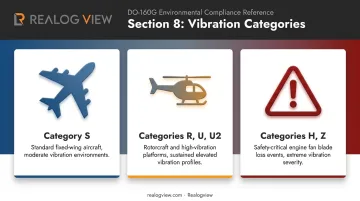
Vibration testing shows how much category selection matters in practice. The same physical device qualifies under different categories depending on where it's installed:
- Category S — standard fixed-wing aircraft
- Category R, U, or U2 — helicopters, which have higher sustained vibration profiles
- Category H or Z — safety-critical equipment requiring simulation of an engine fan blade loss event
Critical Environmental Test Sections Explained
Sections 4 and 5: Temperature, Altitude, and Temperature Variation
Section 4 tests performance across the full range of temperature and altitude conditions encountered in flight. The scope includes:
- Low-temperature extremes for cold-soak environments
- High-temperature extremes for equipment near heat sources
- Altitude-driven pressure effects including dielectric strength and cooling under low pressure
- Rapid decompression scenarios for pressurized-to-unpressurized transitions
Equipment installed in different aircraft zones faces dramatically different conditions. An avionics unit in a pressurized cabin and one mounted in an external pod operate in environments that Section 4 must address separately.
Section 5 tests whether equipment survives sudden, severe temperature swings—simulating rapid climbs into cold air or descents through warm, humid air. DO-160G added temperature-shock Categories S1 and S2, addressing rapid and sudden temperature changes for internally and externally mounted equipment.
Section 6: Humidity
Three categories address progressively harsh moisture environments:
- Category A — Standard humid environment for environmentally controlled compartments
- Category B — Severe humid environment for uncontrolled compartments
- Category C — External humidity environment for equipment exposed to outside air
Humidity testing evaluates corrosion risk, degradation of metals, conductors, and insulators, along with chemical changes in materials. Sensitive components typically require protective conformal coatings to pass the more demanding categories.
Sections 7 and 8: Shock and Vibration
Section 7 covers two distinct risks:
- Operational shocks — Equipment must keep functioning through forces from taxiing, landing, and sudden gusts
- Crash safety — Equipment must stay secured and non-hazardous during emergency landings, preventing hardware from becoming a projectile in a survivable crash
Section 8 addresses three vibration risk profiles:
- Category S — Fixed-wing aircraft in standard flight environments; equipment must maintain normal operation
- Categories R, U, U2 — Helicopter and high-exposure installations subject to prolonged, intense vibration
- Categories H, Z — Short-duration high-g events such as engine fan blade loss, where equipment failure poses a direct flight safety risk
DO-160G EMC and Electrical Testing: Sections 15–26
Why EMC Matters in Aircraft
Aircraft interiors concentrate dozens of electronic systems in close proximity—navigation, communications, flight management, cabin systems—all of which must coexist without interfering with each other. Sections 15 through 26 address this dense electromagnetic environment.
RF Susceptibility and Emissions
Section 20 addresses RF susceptibility (both radiated and conducted), determining whether equipment continues to operate correctly when exposed to RF energy from external sources—ground radar, other avionics, or high-power transmitters. Testing is often conducted in electromagnetic reverberation chambers, which replicate high-intensity radiated fields (HIRF) found near aircraft antennas.
Section 21 covers the reverse concern: emissions of RF energy from the equipment itself, ensuring the device doesn't become a source of interference for surrounding systems.
Lightning and Power Testing
Sections 22 and 23 address risks unique to aviation:
- Section 22 — Lightning-induced transient susceptibility through wiring and interconnects
- Section 23 — Lightning direct effects on the equipment itself
MIL-STD-810H contains no named lightning-effects test method, making Sections 22 and 23 a genuine differentiator for DO-160G in aviation applications.
The remaining electrical sections cover:
- Section 16 (Power Input) — AC/DC power variations applied at equipment terminals across operating conditions
- Section 17 (Voltage Spike) — Resistance to power lead transients
- Sections 18–19 — Audio frequency and induced signal susceptibility through interconnect wiring
- Section 25 (ESD) — Electrostatic discharge handling and operational resilience
- Section 26 (Fire, Flammability) — Verification that the assembly won't serve as an ignition source
Section 20's HIRF coverage warrants a specific note on compliance scope: EASA AMC 20-158A recognizes DO-160G Section 20 equipment testing as part of HIRF compliance, but equipment-level testing alone does not establish aircraft-level HIRF compliance. System-level and installation-level qualifications remain necessary.
DO-160G vs. MIL-STD-810, MIL-STD-461, and MIL-STD-704
These standards are complementary, not interchangeable. Each addresses a different domain of the qualification picture.
DO-160G vs. MIL-STD-810H
| Factor | DO-160G | MIL-STD-810H (Change 1) |
|---|---|---|
| Governing body | RTCA (industry consensus) | US Army Test and Evaluation Command |
| Primary scope | Airborne equipment, civil and commercial aviation | Military materiel across all operational environments |
| Overlapping methods | Temperature, humidity, vibration, shock, salt fog, sand and dust, fungus | Same, plus Rain, Immersion, Icing/Freezing Rain |
| DO-160G-only | Lightning Sections 22–23 (no MIL-STD-810H counterpart) | — |
| MIL-STD-810H-only | — | Solar Radiation 505.7, Acidic Atmosphere 518.2 |
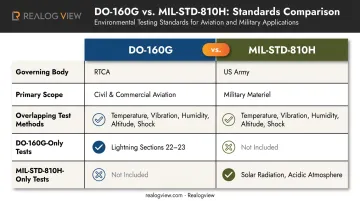
A frequently cited claim—that MIL-STD-810 lacks icing or waterproofness testing—is not accurate. MIL-STD-810H includes Rain (506.6), Immersion (512.6), and Icing/Freezing Rain (521.4). The subject matter overlaps; the test methods and tailoring approaches differ.
DO-160G vs. MIL-STD-461H
MIL-STD-461H (the current revision as of April 2026) is the DoD standard controlling EMI emissions and susceptibility for military equipment. DO-160G Sections 15–26 serve the equivalent function for civil aviation. Test engineers working on commercial programs typically reference DO-160G for EMI requirements because the standard is directly calibrated to the aircraft electrical environment. MIL-STD-461 primarily serves military procurement programs.
DO-160G vs. MIL-STD-704F
MIL-STD-704F (with Notice 4 validation dated June 2026) defines aircraft electric power characteristics at utilization-equipment terminals, covering:
MIL-STD-704F (with Notice 4 validation dated June 2026) defines aircraft electric power characteristics at utilization-equipment terminals, covering:
- Voltage limits and frequency behavior
- Transients, distortion, and DC ripple
DO-160G Section 16 addresses the same concerns for civil aviation by testing AC/DC power variations at equipment terminals. Programs with both civil and military requirements will reference both documents — they serve different qualification purposes and neither substitutes for the other.
DO-160G Compliance and Certification: What You Need to Know
How Compliance Is Achieved
Equipment manufacturers submit devices to accredited third-party test laboratories—or qualified in-house labs—that conduct the applicable DO-160G test sections. Labs document results in formal test reports and issue a declaration of compliance.
DO-160G compliance is not a government-issued certification. It is an industry-recognized demonstration of conformance. The FAA references DO-160G through Advisory Circular AC 21-16G as an acceptable means of showing equipment airworthiness, but the AC itself is not mandatory regulation. In practice, FAA, EASA, equipment suppliers, and airlines treat DO-160G as the required standard — so compliance is effectively non-negotiable for market acceptance.
Compliance Documentation
The manufacturer's Environmental Qualification Form (EQF) is the central compliance document. It identifies:
- The DO-160 revision tested against
- Which sections and categories were evaluated
- Equipment identification and test conditions
- Pass/fail results for each applicable test section
Installers should compare the EQF against their specific installation requirements — not simply accept a generic "DO-160G compliant" label. The section and category string is what matters.
DO-160G Certification Beyond Aviation
DO-160G certification carries weight beyond aviation — any hardware that must perform reliably under extreme temperature swings, humidity, shock, and vibration benefits from the same validation framework.
Realogview's TempTrail data loggers are a practical example. Most models in the TempTrail line carry DO-160G certification alongside FDA 21 CFR Part 11 compliance, including:
- TempTrail Classic and XL (single-use, high-capacity logging)
- TempTrail Display and Humidity & Display (with LCD, single/multi-use)
- TempTrail Glacial and Glacial with Display (cryo/ultra-low, down to -85°C)
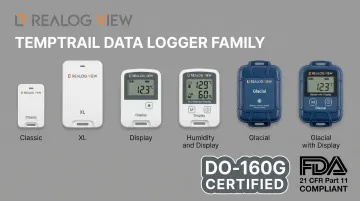
The combination addresses both physical durability and data integrity: DO-160G confirms the hardware won't fail under mechanical and environmental stress during transport, while FDA 21 CFR Part 11 ensures the electronic records the device generates are secure, traceable, and audit-ready.
For pharmaceutical cold chain and cryogenic storage applications—where a data logger must survive temperature cycling, vibration, and moisture exposure while producing legally defensible records—both certifications are directly relevant to what's at stake.
Frequently Asked Questions
What is the DO-160 standard?
DO-160 is the RTCA standard titled Environmental Conditions and Test Procedures for Airborne Equipment. It specifies the environmental conditions and test procedures airborne equipment must withstand. Both FAA and EASA adopt it as the primary means of demonstrating equipment airworthiness.
What is the difference between DO-160 and DO-160G?
DO-160G is the most current revision of DO-160, published December 8, 2010. It introduced updates to test conditions, power input testing, and RF susceptibility procedures compared to earlier revisions (D, E, F). The FAA recommends DO-160G for new articles per AC 21-16G.
What is the difference between MIL-STD-810 and DO-160?
MIL-STD-810 is a US DoD standard covering military operational environments broadly across all materiel types. DO-160 is specifically tailored to civil and commercial aviation equipment, with different tailoring approaches, governing bodies, and aviation-specific tests such as lightning direct effects.
What is DO-160 radiated susceptibility testing?
DO-160 Section 20 evaluates whether airborne equipment continues to operate correctly when exposed to high-intensity radiated RF fields from external sources such as radar or other avionics. Testing is typically conducted in an electromagnetic reverberation or shielded chamber.
Is DO-160G testing mandatory for airborne equipment?
DO-160G compliance is not legally mandated by regulation—AC 21-16G is nonmandatory guidance. However, FAA, EASA, equipment suppliers, and airlines reference it as the primary means of demonstrating equipment reliability and airworthiness, making it effectively required for market acceptance.
What industries beyond aviation use DO-160G certification?
DO-160G's environmental testing protocol—covering extreme temperatures, humidity, shock, vibration, and EMC—sets a recognized quality benchmark well beyond aviation. Pharmaceutical cold chain monitoring, cryogenic storage, and industrial manufacturing all reference it for equipment that must perform consistently under demanding conditions.