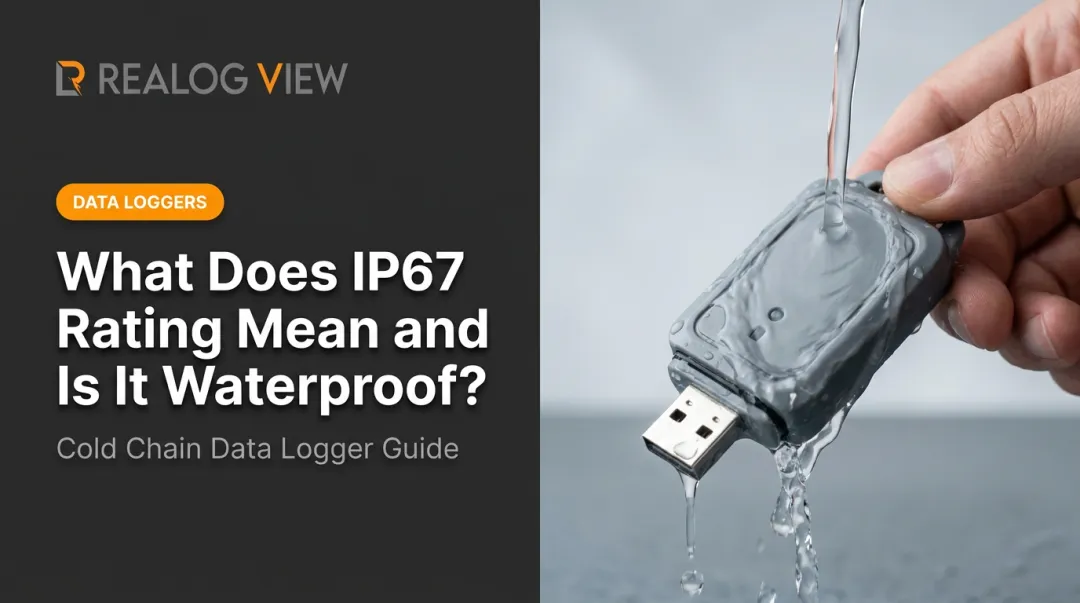
For pharmaceutical, cold chain, and food processing applications, choosing the wrong rating can mean equipment failure mid-cycle, a failed sanitation audit, or paying a cost premium for protection your application never needs. This guide breaks down exactly what separates IP67 from IP68, where each rating genuinely matters, and how to match the right specification to your operating environment.
Key Takeaways
- IP ratings are defined by IEC 60529; the first digit indicates dust protection, the second indicates water ingress resistance
- Both IP67 and IP68 are fully dust-tight — the difference is entirely about water immersion depth and duration
- IP67 covers immersion up to 1 meter for 30 minutes under standardized conditions
- IP68 allows deeper, longer submersion — but actual limits depend entirely on the manufacturer's declared specifications
- For washdown environments, cold storage, and pharmaceutical monitoring, IP67 is sufficient in most cases
- Always verify the manufacturer's declared depth and duration for any IP68 device — the label alone tells you nothing about actual limits
IP67 vs IP68: Quick Comparison
| Feature | IP67 | IP68 |
|---|---|---|
| Dust protection | Complete (dust-tight, no ingress) | Complete (dust-tight, no ingress) |
| Water immersion depth | Up to 1 meter | Beyond 1 meter (manufacturer-declared) |
| Immersion duration | 30 minutes | Manufacturer-declared (must exceed IP67) |
| Test conditions | Standardized by IEC 60529 Clause 14.2.7 | Agreed between manufacturer and user per Clause 14.2.8 |
| Test medium | Fresh water (static, non-pressurized) | Fresh water (static; depth/pressure per agreed conditions) |
| Typical applications | Washdowns, cold chain, pharma monitoring | Submersible pumps, marine sensors, autoclave environments |
| Comparability | Directly comparable between products | Varies — two IP68 devices may have very different real limits |
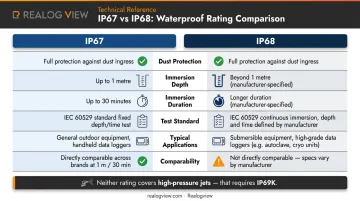
Two points the comparison table can't capture on its own:
- IP68 specifications vary widely by manufacturer. An Eaton/Tripp Lite industrial fiber coupler is rated at 1.5 meters for 30 minutes; a Siemens/AUMA industrial actuator is rated for 8 meters of water head for 96 hours. The label is the starting point, not the answer.
- Neither IP67 nor IP68 covers high-pressure water jets. That requires IP69K (or IEC's IPX9) — a completely separate test using hot water at 8–10 MPa. This distinction matters if your cleaning protocol involves pressure washers rather than immersion or spray rinsing.
What Is IP67?
The Standard Definition
Under IEC 60529 Edition 2.2, IP67 breaks into two digits:
- First digit (6): Complete dust-tight protection — no particles may enter the enclosure
- Second digit (7): Temporary immersion protection tested at up to 1 meter depth for 30 minutes in fresh water, under static (non-pressurized) conditions
The test is conducted in a tank, with the enclosure's lowest point submerged 1,000 mm below the water surface. For enclosures taller than 850 mm, the highest point must sit at least 150 mm below the surface.
Water and specimen temperatures must stay within 5°C of each other. Post-test inspection checks for any ingress that could interfere with operation.
What IP67 Does Not Cover
- High-pressure water jets or steam cleaning
- Salt water, corrosive chemicals, or disinfectant solutions
- Submersion beyond 1 meter or 30 minutes
- Pressure differentials from pumped water flow
The test uses clean, ambient-temperature fresh water — not the pressurized hot water from an industrial washdown gun, and not the disinfectant solutions used in pharmaceutical or food processing environments.
Why IP67 Works for Most Industrial Monitoring
Despite those exclusions, IP67 handles the most common exposure scenarios in regulated industries: routine sanitization sprays, condensation in cold storage, accidental spills, and brief immersion during handling. The fully dust-tight seal prevents particulate contamination in cleanrooms and processing environments, while the water resistance protects the device and its recorded data through cleaning cycles.
For Realogview's TempTrail range, the majority of models — including the TempTrail Glacial, TempTrail Display, TempTrail Humidity & Display, TempTrail Classic, and TempTrail XL — carry IP67 ratings. Their tamper-proof enclosures maintain data integrity through washdowns without requiring removal before cleaning, saving time during high-frequency sanitization cycles.
Where IP67 Fits in Industrial Workflows
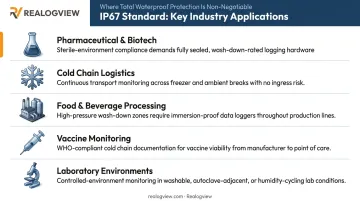
IP67 is the standard specification across these sectors:
- Pharmaceutical and biotech: Cleanroom disinfectant spraying, equipment sanitization between batches
- Cold chain logistics: Refrigerated transport, cold storage with condensation and moisture
- Food and beverage processing: Hygienic cleaning cycles, wet processing environments
- Vaccine monitoring: Storage and transport where moisture exposure is incidental, not deliberate
- Laboratory environments: High-humidity rooms, water bath proximity, routine cleaning
What Is IP68?
The Standard Definition and Why Variability Matters
IP68 shares the same first digit (6) — fully dust-tight, identical to IP67. The difference is the second digit (8), which covers continuous immersion beyond 1 meter. IEC 60529 Clause 14.2.8 sets no universal depth, duration, or pressure for IP68 testing. Conditions are agreed between manufacturer and user, or defined by a relevant product standard, and must only be more severe than IPX7.
This means two IP68 devices can have dramatically different real-world limits:
- An industrial fiber coupler rated at 1.5 meters for 30 minutes
- An industrial actuator rated for 8 meters of water head for 96 hours
Both legitimately carry IP68 — the label is the same, but the actual protection levels are not. When specifying IP68 equipment, always request the product data sheet and verify the declared depth and duration — the IP68 label alone is insufficient procurement evidence.
How IP68 Achieves Greater Water Resistance
Higher immersion performance typically requires more demanding sealing architecture — enhanced gasket geometry, higher-grade elastomer materials, and more rigorous pressure tolerance validation. IEC 60529 is performance-based and doesn't prescribe specific gasket materials, but engineering evidence shows that heat, compression set, chemical exposure, and temperature cycling can degrade elastomer seals over time.
IP68 devices typically carry higher manufacturing costs and may require more involved seal maintenance over their operational life.
What IP68 Does Not Cover
Like IP67, IP68 does not protect against:
- High-pressure water jets or steam sterilization pressure
- Corrosive chemicals or disinfectant solutions
- Seal degradation from repeated temperature cycling or chemical exposure
Realogview's TempTrail HiTemp is the only model in the TempTrail range with an IP68 rating, designed for autoclave validation and sterilization monitoring environments. Its sealed IP68 housing handles the wet, harsh conditions of these applications.
Buyers with autoclave sterilization workflows should contact Realogview directly to confirm whether the IP68 rating extends to pressurized steam conditions. IEC testing uses static fresh water, not pressurized steam — an important distinction for high-pressure sterilization processes.
Where IP68 Is Necessary
IP68 makes sense when genuine continuous submersion is part of the operating environment:
- Submersible pump and sensor systems
- Underwater marine and offshore monitoring equipment
- Scientific instruments deployed in floodplains or water bodies
- Autoclave validation devices in pharmaceutical sterilization
- Specialized industrial equipment requiring extended immersion
Which IP Rating Is Right for Your Application?
Decision Framework
Match the IP rating to actual operating conditions — not to a general sense that "higher is better." Run through these factors:
- Maximum expected water depth: Does it exceed 1 meter under any realistic scenario?
- Duration of exposure: Is it accidental and brief, or intentional and sustained?
- Presence of water pressure: Are pressure washers or high-velocity jets involved? (Neither rating covers this — IP69K does)
- Regulatory requirements: Does your compliance framework specify a minimum IP rating?
- Total cost of ownership: Does the higher sealing complexity of IP68 add maintenance obligations that outweigh the benefit?
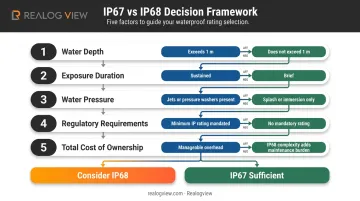
Situational Recommendations
Choose IP67 when:
- Water exposure comes from sanitization sprays, washdowns, condensation, or accidental spills
- Immersion depth won't exceed 1 meter and duration won't exceed 30 minutes
- Application is pharmaceutical monitoring, cold chain, food processing, or laboratory use
- You need cost-effective protection without unnecessary engineering overhead
Choose IP68 when:
- Intentional submersion beyond 1 meter is part of the operational design
- The device will experience extended or continuous water immersion
- The application involves sterilization environments requiring sustained water contact
The "Higher Is Better" Misconception
IP68 is not universally superior. For pharmaceutical cold chain, food processing, and laboratory monitoring applications — where the primary exposure is sanitization rather than submersion — IP67 delivers equivalent protection at lower cost. Specifying IP68 unnecessarily adds expense without operational benefit.
The more important questions are always: What conditions will this device actually face? and Does the manufacturer's declared specification cover those conditions?
IP Rating and Data Integrity in Regulated Environments
In regulated environments, IP rating is one layer of a broader compliance picture. For pharmaceutical and cold chain applications, physical sealing addresses environmental exposure — but data integrity requirements go further.
Realogview's TempTrail data loggers pair tamper-proof sealed enclosures with FDA 21 CFR Part 11 compliant recording architecture. The sealed design means internal components (sensor, memory, data storage) cannot be accessed or altered without visibly damaging the enclosure. The compliant recording layer ensures data is time-stamped, unalterable, and audit-ready.
These two layers address separate risks: the enclosure protects against environmental intrusion and physical tampering; the recording architecture protects against data manipulation. For pharmaceutical cold chain and laboratory monitoring, both matter — and neither substitutes for the other. Realogview's IP-rated TempTrail data loggers are built with both requirements as design criteria, not afterthoughts.
Conclusion
IP67 and IP68 aren't competing standards — they serve different levels of water exposure. For most industrial monitoring, pharmaceutical, and cold chain applications where washdown and sanitization are the primary concern, IP67 is the right specification. IP68 becomes necessary only when sustained submersion is part of the operating environment.
Match the rating to real conditions. For any IP68 device, verify the manufacturer-declared depth and duration, and confirm seal maintenance requirements. Ensure the rating aligns with operational demands and any applicable regulatory requirements — IP ratings address physical ingress, not regulatory compliance, and those are separate conversations.
For data loggers used in pharmaceutical, cold chain, or food safety environments, this distinction matters at spec time. A logger rated IP67 handles routine washdowns and condensation; one rated IP68, like Realogview's TempTrail HiTemp, is built for harsher submersion scenarios such as autoclave cycles. Choosing correctly the first time avoids requalification costs later.
Frequently Asked Questions
Which is better: IP67 or IP68?
Neither is universally better. IP68 offers greater water depth and duration protection, but IP67 is sufficient for the vast majority of industrial, pharmaceutical, and cold chain applications where water exposure is limited to washdowns and splashes. Choose based on your actual operating conditions, not the assumption that a higher number is always preferable.
Is IP68 enough for swimming?
For casual pool or surface swimming, IP68 is generally sufficient if the manufacturer's declared depth exceeds the expected immersion depth. For deeper diving or prolonged underwater activity, verify the specific depth and duration declaration on the product data sheet — the IP68 label alone doesn't tell you the actual limits.
Do IP ratings protect against high-pressure cleaning or steam?
No. Neither IP67 nor IP68 covers high-pressure water jets or steam exposure. Protection against pressurized cleaning requires IP69K (or IEC's IPX9), which tests enclosures against hot water jets at 8–10 MPa — a more demanding standard than immersion testing.
Can IP protection degrade over time?
Yes. Gaskets and seals deteriorate due to temperature cycling, chemical exposure, physical impact, and aging. IEC 60529 testing uses new specimens under controlled conditions, so type-test results don't guarantee continued performance. Periodic seal inspection and proper cleaning practices are essential for maintaining rated protection throughout the device's lifespan.
What does an IP67 or IP68 rating mean for data loggers used in cold chain monitoring?
An IP67 or IP68 rating means the logger is fully sealed against dust and can withstand washdown and sanitization procedures common in cold storage, refrigerated transport, and pharmaceutical environments. This protects both the device hardware and recorded temperature data from moisture ingress during cleaning cycles.
Does IP67 or IP68 meet pharmaceutical equipment standards?
IP67 and IP68 address physical ingress protection and are compatible with pharmaceutical washdown protocols. However, regulatory compliance — such as FDA 21 CFR Part 11 for electronic records — is a separate certification that must be verified independently based on your application and jurisdiction.