Introduction
A stability chamber power failure lasting 40 hours with no data logger in place. That's exactly what FDA inspectors found at Macsen Drugs in 2025 — and the consequences included investigation, recall consideration, and an inability to demonstrate product quality throughout labeled expiry periods. The stakes are that concrete.
Automated temperature monitoring has replaced manual logging as the expected standard in regulated medical environments. Not every system, however, delivers the measurement accuracy, regulatory certification, or physical durability that medical device applications require. A logger built for food logistics operates under entirely different specifications than one validated for cryogenic biologics storage or autoclave cycle monitoring.
This guide walks procurement and quality teams through six selection factors — regulatory certification, measurement accuracy, data integrity, hardware durability, operational simplicity, and total cost of ownership — so the system you choose fits both your compliance requirements and your operating environment.
Key Takeaways
- Tamper-evident audit trails are required for FDA 21 CFR Part 11 compliance — your monitoring system must produce them automatically
- Sensor accuracy of ±0.5°C or better is the benchmark for vaccine and biologic storage, per CDC and WHO guidance
- Temperature range requirements span from -85°C (ultra-low freezers, dry ice) to +140°C (autoclave validation)
- PDF/CSV reports generate automatically — no cloud access or connectivity required during transport
- Multi-use loggers lower lifecycle costs; single-use models simplify high-volume shipment workflows
What Is Automated Temperature Monitoring for Medical Devices?
Automated temperature monitoring is the continuous, self-operating capture and storage of temperature data in environments where medical products, components, or devices are manufactured, stored, transported, or tested. No manual recording required.
Three main system types exist:
- Wireless continuous monitoring platforms — cloud-connected, real-time alerts, suited for fixed regulated storage
- Standalone data loggers — self-contained, downloadable records, ideal for transport and remote applications
- Software-free PDF/CSV data loggers — fully autonomous reporting without external tools, cloud accounts, or IT infrastructure
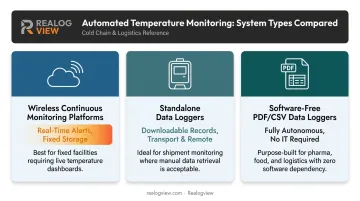
The right type depends on the application. A fixed pharmaceutical warehouse may benefit from real-time alerts. A dry ice shipment crossing three countries needs a standalone logger that works without any network connection at the destination.
Core System Components
Sensors and probes must deliver consistent, verifiable readings within the required accuracy tolerance. Integrated internal sensors eliminate probe-related failure points. In sealed or sterile environments, external probe cables create contamination risk and barrier penetration issues — making internal integration the practical choice.
Data logging and storage creates an unbroken chain of custody. The device records readings at configurable intervals, and tamper-evident storage with controlled access is required in regulated settings. Storage capacity matters for long deployments: loggers with 32,000 data points at 10-minute intervals can cover more than 220 days continuously.
Reporting output must produce inspection-ready records — PDF, CSV, or electronic audit trail — retrievable instantly during an audit without requiring specialized software or IT support.
Why Medical Device Applications Rely on Automated Monitoring
Core operational benefits:
- Eliminates human error from manual logging
- Ensures continuous records with no gaps during off-hours, weekends, or transit
- Enables rapid excursion response before product loss occurs
- Reduces staff time spent on documentation
The compliance case is just as concrete: automated, timestamped records with no edit capability deliver exactly the verifiable audit trail regulators expect. FDA's data integrity guidance defines compliant data as attributable, legible, contemporaneously recorded, original, and accurate — criteria that manual paper logs routinely fail under audit scrutiny.
What to Consider When Choosing Automated Temperature Monitoring
Medical device applications vary significantly. Cryogenic sample storage, vaccine cold chain transport, and autoclave cycle validation each impose different hardware, accuracy, and compliance requirements. A system that performs well in one context may be inadequate in another.
Regulatory Compliance and Certifications
Operating in a regulated medical environment means the monitoring system itself must meet applicable standards — not just claim general compliance.
FDA 21 CFR Part 11 is the foundational requirement for any facility subject to FDA oversight. The regulation governs electronic records and signatures, requiring:
- System validation for accuracy and reliable performance
- Time-stamped audit trails that cannot obscure prior entries
- Access restricted to authorized users
- Accurate and complete copies available throughout the retention period
Vendor labeling alone doesn't confirm Part 11 compliance. Request documentation and confirm which specific functions — data storage, report generation, access control, audit trail — are covered by the certification.
CE and RoHS certification matter for devices used in or exported to EU markets. CE confirms conformity with EU safety and electromagnetic directives; RoHS addresses restricted hazardous substances in electronic equipment. Neither establishes GxP suitability on its own, but both are part of the expected compliance documentation set.
When evaluating vendors, request formal certification documentation rather than relying on marketing language. Ask whether certification covers the full device or only a subset of its functions.
Measurement Accuracy and Temperature Range
Accuracy requirements vary by application:
| Application | Temperature Range | Accuracy Benchmark |
|---|---|---|
| Vaccine refrigerator storage | +2°C to +8°C | ±0.5°C or better |
| Vaccine freezer storage | -50°C to -15°C | ±0.5°C or better |
| Ultra-low freezer / dry ice transport | Down to -85°C | Application-specific |
| Autoclave / sterilization validation | Up to +140°C | Application-specific |
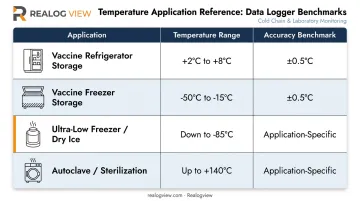
The CDC's 2025 VFC Program Operations Guide specifies continuous data logger monitoring with recommended ±0.5°C accuracy and logging intervals of at least every 30 minutes for vaccine refrigerators — a useful benchmark for any pharmaceutical cold chain application.
Calibration traceability to national standards (such as NIST) confirms that accuracy specifications are verifiable, not just stated. A documented, unbroken calibration chain is what makes metrological traceability meaningful — a vendor claiming "NIST-traceable" should be able to provide the calibration certificate, not just the label.
Realogview's TempTrail line exceeds the ±0.5°C benchmark across all models: most deliver ±0.2°C accuracy, while the ultra-low Glacial variants achieve ±0.3°C — both well within the thresholds required for vaccine and pharmaceutical storage monitoring.
Data Integrity and Reporting Capability
Accurate readings are necessary, but regulators also require verifiable, unalterable records. Key features to look for:
- Tamper-evident data storage that protects records from post-collection modification
- Configurable logging intervals to match application requirements
- Automatic report generation — where the device itself produces a formatted PDF upon USB connection, without relying on proprietary cloud platforms, subscriptions, or third-party software
That last point is a critical differentiator for transport applications. If the report generation depends on a cloud platform that becomes unavailable, a subscription that lapses, or a software version that breaks after an OS update, documentation gaps become a real compliance risk.
Realogview's TempTrail data loggers generate compliant PDF and CSV reports automatically upon USB connection to any Windows PC — no software installation, no internet access required. The only prerequisites are Windows 7 or higher and Adobe Reader 9.0 or higher, both standard on virtually any modern computer.
Hardware Durability and Environmental Ratings
Medical device environments are often harsh. Consider what the logger will actually encounter:
- IP67 — dust-tight and protected against temporary water immersion up to 1 meter for 30 minutes. Suitable for surface wipe-down cleaning, spray disinfection, and condensation exposure common in refrigerated transport.
- IP68 — dust-tight and protected against continuous submersion beyond 1 meter (depth and duration specified by manufacturer). Required for full immersion sanitization and autoclave environments.
- DO-160G — RTCA's environmental testing standard for airborne equipment, covering vibration, shock, temperature cycling, humidity, and other stressors. Meaningful assurance for air freight and transport applications where loggers experience rough handling.
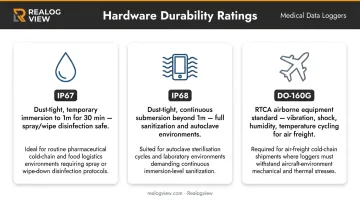
One practical distinction: IP ratings confirm ingress protection against water and dust. They don't establish pharmaceutical qualification or Part 11 compliance. A device needs both hardware durability ratings and regulatory compliance documentation — one doesn't substitute for the other.
For autoclave validation specifically, the logger must survive the sterilization cycle it is measuring. An IP68-rated device with an operating range extending to +140°C is a different product category than a standard cold chain logger — and the distinction matters during process validation.
Ease of Operation and Software Independence
Complex systems requiring dedicated software, IT configuration, or cloud subscriptions introduce operational risk. Staff turnover, software updates, and connectivity failures can all interrupt data collection or block access to records when they're needed most.
Look for systems that:
- Operate without external tools for data retrieval and report generation
- Allow user-configurable alarms, logging intervals, and measurement units on multi-use models
- Feature a large, clearly readable display for instant temperature and alarm visibility at receiving docks or transfer points
- Support field battery replacement without returning the device for service
The Realogview TempTrail Display and Glacial Display models include LCD screens showing real-time temperature and alarm status — a practical advantage when a cold chain handler needs to verify conditions during transfer without connecting to any device. Multi-use models support user-configurable logging intervals, alarm thresholds, and start delays.
Scalability and Total Cost of Ownership
Single-use disposable loggers have low upfront cost but accumulate significant ongoing expense in high-volume or repeat-use scenarios. Multi-use loggers with user-replaceable batteries offer lower lifecycle cost across continuous monitoring applications.
Total cost of ownership includes:
- Hardware purchase price
- Software or subscription fees (if any)
- Calibration costs and intervals
- Battery and replacement component costs
- Staff time for setup, retrieval, and report generation
A system with no software dependency and automatic reporting typically reduces hidden operational costs substantially. For operations running both shipment and fixed facility monitoring, a hybrid approach often makes sense. Single-use loggers (TempTrail Classic, XL) suit outbound shipments where device recovery is impractical; reusable models (Glacial, HiTemp, Display-M) work better for fixed environments where reconfigurability delivers long-term value.
How Realogview Can Help
Realogview (ColdTech Solutions LLC), headquartered in Fremont, CA, manufactures the TempTrail line of FDA 21 CFR Part 11 compliant data loggers built specifically for regulated medical device, pharmaceutical, and cold chain applications. Every model is engineered around three non-negotiable requirements: data integrity, durability under extreme conditions, and fully software-free operation.
Key differentiators across the TempTrail product line:
- FDA 21 CFR Part 11 compliant data storage, report generation, and data traceability across all models
- Automatic PDF and CSV report generation without external software, probes, or cloud dependency — plug into any Windows PC and reports generate instantly
- DO-160G certified across most models for proven durability under extreme environmental testing (vibration, shock, temperature cycling)
- IP67/IP68 sealed tamper-proof design compatible with sanitization, disinfection, and submersion protocols
- Wide temperature range from -85°C to +140°C across the product line — covering cryogenic storage (TempTrail Glacial), standard cold chain (-30°C to +70°C Display models), and autoclave validation (TempTrail HiTemp)
- Integrated internal sensors on most models, eliminating probe failure risk in sealed environments
- User-configurable alarms, logging intervals, and measurement units on all multi-use models
- User-replaceable ½ AA battery on Glacial and HiTemp models for uninterrupted field operation
- Single-use and multi-use options across the product line for cost-efficient deployment at any scale
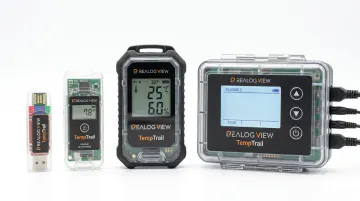
Whether the application is autoclave validation, vaccine transport, or cryogenic biologics monitoring, the TempTrail lineup handles each under one consistent data format and compliance standard. Contact Realogview at support@realogview.com for model-specific documentation or compliance materials.
Conclusion
The goal isn't finding the most technically advanced monitoring system available. It's finding one whose certifications, temperature range, reporting format, and hardware durability align precisely with the regulatory requirements and operational conditions of your specific application.
No single factor determines fit on its own. The six selection criteria in this guide — compliance certifications, accuracy and range, data integrity, hardware durability, operational simplicity, and total cost — must be evaluated together. A system that excels on five but fails on regulatory certification is not a viable option. That failure doesn't surface until an audit.
That same joint evaluation applies over time, not just at purchase. Requirements shift as organizations scale, add applications, or encounter updated regulatory guidance. The system covering your current workflow may not address a new autoclave validation requirement or an expanded biologics transport program two years from now. Review selected systems periodically against current compliance standards — treating them as a living compliance decision, not a one-time infrastructure purchase.
Frequently Asked Questions
What is automated temperature monitoring for medical devices?
It is the continuous, self-operating capture and storage of temperature data in environments where medical products or devices are stored, transported, manufactured, or tested. Sensors and data loggers record conditions without manual intervention and produce tamper-evident compliance records automatically, removing documentation gaps and the risk of manual recording errors.
What regulatory standard governs electronic temperature records in FDA-regulated environments?
FDA 21 CFR Part 11 sets requirements for electronic records and electronic signatures, requiring data to be attributable, accurate, contemporaneous, original, and legible. Temperature monitoring systems used in FDA-regulated facilities should be validated against this standard to ensure audit-readiness — not just labeled as compliant by the vendor.
What is the difference between a standalone data logger and a wireless continuous monitoring system?
Standalone data loggers record data internally and generate reports upon retrieval, making them better suited for transport and remote applications where connectivity isn't guaranteed. Wireless systems transmit data in real-time to a cloud platform for live alerts in fixed facilities. Either way, validation, access controls, and Part 11 record availability remain the operator's responsibility.
How do I verify that a temperature monitoring device is truly FDA 21 CFR Part 11 compliant?
Request the manufacturer's compliance documentation, validation reports, and any third-party audit records. Confirm that data storage, report generation, access control, and audit trail functions specifically meet Part 11 requirements — not just that the company claims general FDA compliance. Ask which device functions are covered and which are not.
What temperature range should a data logger cover for medical device applications?
Requirements vary by application: vaccine storage needs +2°C to +8°C; ultra-low freezers run at -80°C to -85°C; dry ice transport reaches approximately -78.5°C; and autoclave validation can require up to +140°C. A product line covering this full range reduces procurement complexity and keeps data formats consistent across applications.
How often should temperature monitoring equipment for medical devices be calibrated?
Calibration frequency depends on regulatory requirements, manufacturer guidance, and application criticality. The CDC recommends recalibration every 2 to 3 years for vaccine storage, though high-risk applications may require shorter intervals. All calibration records must be documented and retained as part of the compliance file.