SUDs are a cornerstone of modern infection control. A syringe used once, then discarded, protects the next patient. That same syringe reused — even if it looks clean — can transmit bloodborne pathogens, expose patients to chemical residues, and fail structurally mid-procedure.
This guide covers everything facility staff and compliance teams need to know: what SUDs are, how to handle and store them safely, what the regulations actually require, and which disposal rules apply.
Key Takeaways
- SUDs are designed for one use on one patient — reuse introduces cross-contamination, chemical exposure, and device failure risks
- Pre-use packaging inspection is mandatory — a compromised seal means discarded, not used
- FDA requires specific labeling and premarket compliance for any reprocessed SUD before it can be legally reused
- Storage conditions directly affect sterility; any temperature excursion must be documented and reviewed before use
- Disposal must follow OSHA and state regulations — sharps and biohazardous materials cannot go into general waste
What Are Single-Use Medical Devices and Why Proper Handling Matters
The Legal Definition
Understanding what qualifies as a single-use device starts with the legal definition. Under FD&C Act section 201(ll)(1), a single-use device is one "intended for one use, or on a single patient during a single procedure." That classification directly shapes procurement decisions, training requirements, inventory controls, and disposal protocols.
SUDs span all three FDA risk classes:
| Risk Class | Examples | Regulatory Requirement |
|---|---|---|
| Class I | Surgical gloves, gauze, tongue depressors | General Controls |
| Class II | Syringes, IV catheters, blood collection tubes | General Controls + Special Controls |
| Class III | Certain implantable and cardiac devices | Premarket Approval (PMA) |
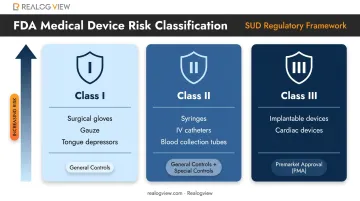
Risk class and single-use designation are separate attributes — a device being implanted does not automatically make it single-use. Verify the current FDA-hosted IFU before drawing conclusions.
Why Manufacturers Label Devices Single-Use
Manufacturers designate devices as single-use for concrete engineering reasons:
- The device material cannot survive sterilization intact
- Reprocessing validation was never conducted during product development
- The design makes thorough cleaning impossible (narrow lumens, textured surfaces, absorbent materials)
The CDC's guidance on single-use devices adds a practical rule: if a device has no reprocessing instructions, treat it as single-use regardless of other labeling. Items like certain burs, endodontic files, and broaches fall here — confirming that labeling gaps are not a gray area, but a directive to default to single use.
Best Practices for Safe Use of Single-Use Medical Devices
Safe SUD use spans the entire device lifecycle — from the moment a package arrives to the moment the used device enters a waste container. Each phase has its own failure points, and missing any one of them puts patients at risk.
Pre-Use Inspection and Packaging Verification
Before opening any SUD, inspect the outer packaging. Doing so prevents using a potentially contaminated device on a patient.
Check for:
- Intact seal — no tears, punctures, or open edges
- Dry packaging — moisture compromises sterile barriers
- Valid expiration date — sterility assurance and material integrity both degrade over time
- Sterility indicator — confirm it has responded correctly if present
A package that fails any of these checks means the device goes in the waste bin, not into the procedure. A device that looks physically intact inside a compromised package cannot be assumed sterile.
Correct Handling During Clinical Use
Once opened, the sterile field is broken — apply these handling rules without exception:
- Use the device immediately on the intended patient only
- Any contact with a non-sterile surface constitutes misuse
- Follow the manufacturer's Instructions for Use (IFU) exactly — anatomical site restrictions, technique requirements, and patient population limitations all exist for documented reasons
- Do not improvise use outside IFU parameters
PPE selection should match the procedure type and contact risk. Gloves are baseline. Eye protection and gowns apply where splashes may occur. Sharps handling requires additional puncture precaution — and immediate disposal into an appropriate sharps container, not placement on a tray for later.
Identifying the Single-Use Label
Staff need to recognize three forms of single-use designation:
- ISO symbol ISO 7000-1051 ("Do not re-use") — the official international symbol per ISO 15223-1:2021
- Explicit text — "Single use" or "Disposable" printed on the packaging
- Absence of reprocessing instructions — per CDC guidance, this alone is sufficient to treat a device as single-use
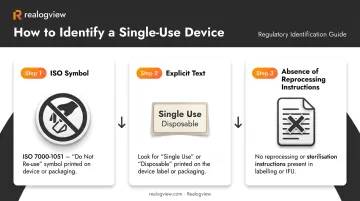
Training staff to recognize all three indicators, not just the explicit text, closes a common gap. Many reuse incidents occur not from deliberate decisions but from unfamiliarity with the symbol or an assumption that unlabeled devices are fair game.
Storage and Environmental Safety for Single-Use Medical Devices
Sterility failure doesn't always happen at the bedside. A SUD can reach the procedure room already compromised — because of how it was stored.
Heat, humidity, physical pressure, UV exposure, and condensation can all degrade packaging seals, weaken device materials, or enable microbial contamination inside sealed sterile packaging before the device is ever opened.
Acceptable Storage Conditions
- Clean, dry, temperature-controlled environments — away from direct sunlight, steam pipes, and sinks
- FIFO inventory rotation (first in, first out) prevents expiry without complex tracking systems
- Devices never stored on floors, near condensation-prone surfaces, or under heavy items that can crush flexible packaging
- Designated storage areas with controlled access
Storage requirements are label-specific. USP <659> defines controlled room temperature for pharmaceutical articles as 20–25°C, with permitted excursions to 15–30°C under defined conditions — but this is a pharmaceutical storage definition. Device storage follows each product's label and validated sterile-barrier conditions, not a single universal specification.
Continuous Environmental Monitoring for Temperature-Sensitive SUDs
For SUDs used in pharmaceutical administration, vaccine delivery, or biological procedures, storage condition verification is not optional. Spot checks twice per shift create blind spots — brief excursions that occur between checks go undetected.
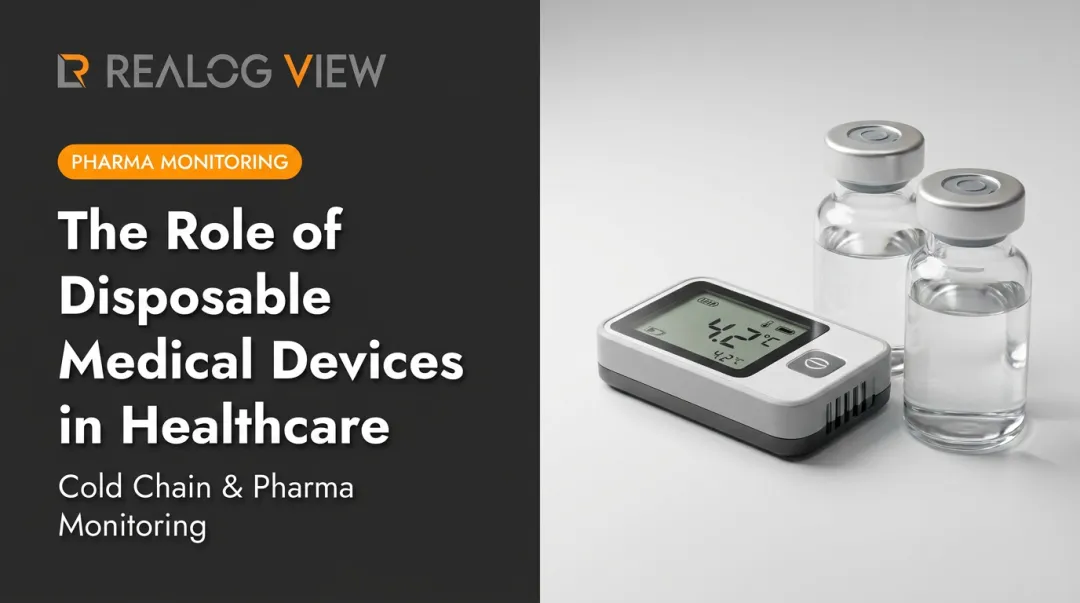
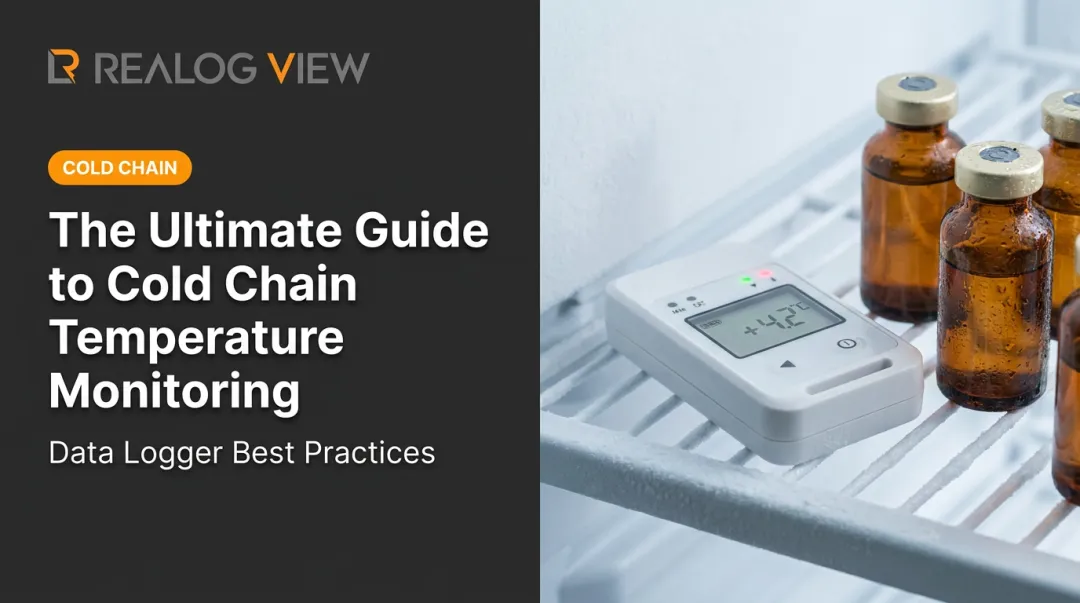
Continuous data loggers address this directly. At a 10-minute logging interval, a logger captures 144 data points per day, producing a time-stamped record dense enough to surface even short-duration excursions. Realogview's TempTrail™ Humidity & Display (Rh-M) monitors temperature (–30°C to +70°C) and relative humidity (0–100% RH) with ±0.2°C temperature accuracy and ±2% RH humidity accuracy, storing up to 32,000 combined data points in a tamper-proof, IP67-rated housing. USB connection triggers automatic **FDA 21 CFR Part 11 compliant PDF and CSV report** generation — no external software required.
Key capabilities relevant to SUD storage monitoring:
- Displays current temperature, humidity, and alarm status on a real-time LCD screen
- Triggers visible bell icon alerts when user-configured thresholds are breached
- Runs on a user-replaceable ½ AA battery with an 18-month shelf life
- Generates audit-ready PDF and CSV reports automatically on USB connection
Handling Temperature Excursion Events
A temperature excursion — even a brief one — requires a documented deviation review. The appropriate response is:
- Quarantine affected inventory immediately
- Contact the manufacturer for disposition guidance (typically a stability data review against the excursion duration and magnitude)
- Document the event with time-stamped logger data
- Determine whether the devices can be used or must be discarded based on manufacturer input
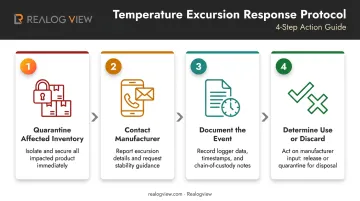
Using excursion-affected stock without manufacturer disposition voids the sterility guarantee — and creates an undocumented liability if an adverse event occurs downstream.
Regulatory Compliance, Labeling, and Disposal
FDA's Reprocessing Framework
Reusing a SUD is not automatically illegal — but the bar for doing it legally is high. Under the FD&C Act, any hospital or third party that reprocesses an SUD becomes a manufacturer subject to full FDA manufacturer controls:
- Applicable premarket review (510(k) for Class II, PMA for Class III)
- Cleaning, disinfection, sterilization, and functional performance validation
- Quality Management System Regulation (QMSR) compliance
- Medical device reporting and corrections/removals requirements
FD&C Act section 502(v) requires that any reprocessed SUD carry this exact statement: "Reprocessed device for single use. Reprocessed by [name of reprocessor]." Any reprocessed device missing this label is legally misbranded under federal law.
Unauthorized in-house reuse without FDA validation is a clear regulatory violation — facilities that attempt it take on full manufacturer liability without the required controls in place.
Disposal Categories and OSHA Requirements
Not all SUDs go into general waste. Segregation matters:
| Device Type | Disposal Method |
|---|---|
| Non-contaminated SUDs (intact packaging, unused) | General waste |
| Items saturated with blood or bodily fluids | Regulated medical waste - separate containers |
| Contaminated sharps (needles, scalpel blades) | Puncture-resistant, labeled sharps containers |
| Other OSHA-regulated medical waste | State and local regulated waste rules apply |
Under OSHA's Bloodborne Pathogens Standard (29 CFR 1910.1030), sharps containers must meet specific physical requirements. Each sharps container must be:
- Closable and puncture-resistant
- Leak-resistant on the sides and bottom
- Labeled or color-coded per OSHA standards
- Kept upright during use
- Replaced before reaching fill capacity
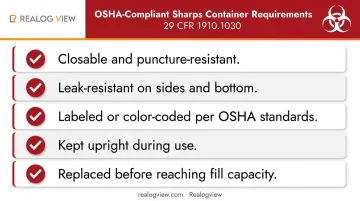
Medical waste is primarily regulated at the state level, so facilities must align OSHA categories with applicable state and local rules. Maintain written disposal policies, train all staff on waste segregation, and run periodic audits to stay inspection-ready.
Common Mistakes to Avoid with Single-Use Medical Devices
These five mistakes account for a disproportionate share of SUD-related patient safety incidents — and all of them are preventable.
Relying on visual inspection to confirm sterility. A device that looks clean isn't safe to reuse. Microorganisms, chemical residues, and structural micro-damage are invisible. In 2015, a Texas facility documented one HCV transmission and 392 patient notifications after reusing prefilled saline-flush syringes that appeared undamaged.
Misreading or overlooking single-use labeling. Staff unfamiliar with ISO 7000-1051 — or who assume unlabeled devices are reusable — create direct risk. Training should cover all three identification methods: the single-use symbol, explicit text labels, and the absence of reprocessing instructions.
Storing SUDs in uncontrolled environments. Steam pipes, UV-exposed window sills, and heavy items stacked on flexible packaging all compromise seal integrity before a device reaches a patient.
Treating expiration dates as conservative estimates. They aren't. SUD expiration dates account for both material degradation and sterility assurance level. An expired device voids manufacturer guarantees and creates direct liability exposure.
Skipping pre-use inspection under time pressure. In high-volume or emergency settings, bypassing seal and expiry checks is a documented behavioral risk. Brief reminders posted at packaging stations and routine audits close this gap without slowing workflow.
Frequently Asked Questions
What is the single-use medical device policy?
A single-use medical device policy requires facilities to use SUDs on one patient during one procedure, then dispose of them appropriately. It defines staff responsibilities for inspection, labeling recognition, and disposal, and prohibits unauthorized reuse per FDA guidance and OSHA standards.
What is the difference between single-use and single patient use?
"Single-use" means one use on one patient during one procedure, then disposal. "Single patient use" allows a device to be reused on the same patient across multiple sessions (for example, home-use respiratory equipment) but prohibits cross-patient use entirely.
What are examples of single-use medical devices?
Common examples across risk classes include syringes, needles, IV catheters, blood collection tubes, surgical gloves, gauze, oxygen masks, endoscopic biopsy forceps, and certain dental instruments such as prophylaxis angles and endodontic files.
What happens if a single-use medical device is reused?
Reuse risks include cross-contamination between patients — including bloodborne pathogen transmission — exposure to chemical decontamination residues, and device malfunction from material degradation. Unauthorized reuse also exposes the facility to regulatory penalties, misbranding violations, and legal liability.
How should single-use medical devices be stored?
SUDs should be stored in clean, dry, temperature-controlled areas away from sunlight and moisture, following FIFO inventory rotation. Temperature-sensitive devices require continuous environmental monitoring with documented deviation reviews for any excursion event to preserve sterility and device integrity until use.